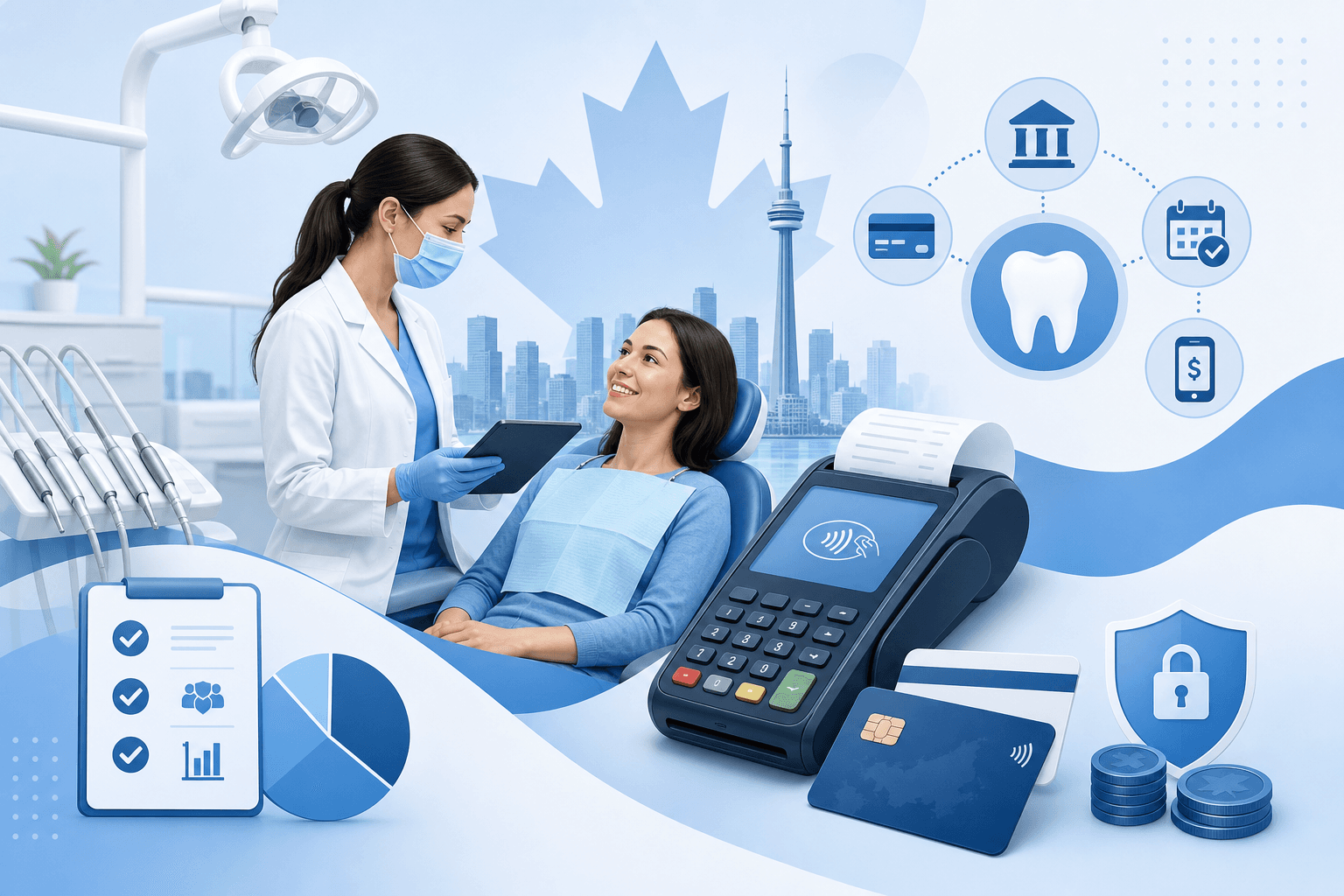
Why Dental Practices Need Smarter Payment Solutions
Running a dental office in Canada means juggling patient care, insurance claims, staffing, and a business that lives and dies by cash flow. Yet many practice owners still treat payment processing as an afterthought - sticking with whatever terminal came bundled with their business bank account years ago. That's a costly mistake.
Dental treatments often involve larger transaction amounts than a typical retail purchase, from routine cleanings to five-figure implant work. That means even small differences in processing rates or hidden fees can translate into thousands of dollars lost every year. On top of that, patients expect a modern, convenient checkout experience - tap-to-pay, online payment links, and financing options - not a clunky machine from 2012.
Finding the right dental office payment solutions in Canada isn't just about accepting Visa and Mastercard. It's about building a payment system that fits how dental practices actually operate: pre-authorizations for treatment plans, deposits for procedures, insurance coordination, and recurring payment plans for orthodontics. In this guide, we'll break down what Canadian dental practices should look for in a payment processor and how to avoid the pitfalls that cost clinics real money.
The Unique Payment Challenges Dental Offices Face
Dental practices aren't like a typical retail shop, and their payment needs reflect that.
Higher Average Transaction Values
A single crown, root canal, or cosmetic procedure can run into the thousands of dollars. Processors that charge a percentage-based rate (rather than transparent interchange-plus pricing) can quietly eat into your margins on these larger tickets. This is one of the biggest reasons dental offices should scrutinize their statements closely.
Treatment Plans and Payment Plans
Many patients pay for orthodontics or major restorative work in installments. Your payment system needs to support recurring billing or stored card-on-file options securely - without requiring your front desk staff to manually re-enter card details every month.
Insurance Coordination
Dental offices frequently collect a patient's portion at checkout while billing insurance separately. This requires flexible payment terminals that can process partial payments, refunds, and adjustments cleanly, with reporting that makes reconciliation easy for your bookkeeper or accountant.
Multiple Locations or Associates
Many Canadian dental groups operate multiple locations or have several associate dentists working under one practice. Centralized reporting across locations is essential for owners who want visibility into revenue without pulling data from five different terminals.
Key Features to Look for in a Payment Processor
When evaluating dental office payment solutions in Canada, look beyond the headline rate. Here's what actually matters:
- Transparent interchange-plus pricing - avoid flat-rate or tiered pricing that obscures your true cost per transaction.
- PCI compliance and strong security - patient payment data must be protected, especially with larger transaction amounts at stake.
- EMV chip, tap, and online payment support - patients expect contactless and tap-to-pay as standard.
- Recurring billing capability - essential for orthodontic plans and financing arrangements.
- Next-day or fast funding - cash flow matters, especially for practices covering payroll, lab fees, and equipment leases.
- Integration with practice management software - reducing double data entry between your scheduling/billing system and your terminal saves your front desk hours every week.
- Canadian-based support - you want a provider who understands Canadian regulations, GST/HST handling, and CAD settlement, not a call centre in another time zone.
If you're not sure how your current setup stacks up, use our savings calculator to see what you could be paying with a more transparent pricing structure.
Comparing Payment Processors for Dental Practices
Not all processors are created equal, and dental offices have specific needs that make some options better fits than others.
Bank-Bundled Processing
Many dentists default to whatever their business bank offers. Big banks like TD often bundle payment processing with business banking, but this convenience frequently comes with higher rates and less flexibility. See our TD comparison for a closer look at how bank-bundled processing stacks up against independent providers.
Flat-Rate Processors
Platforms like Stripe are popular with online businesses but aren't always ideal for in-person dental transactions where volume and ticket size are higher. Flat-rate pricing can actually cost more than interchange-plus once your average transaction climbs past a certain threshold. Check our Stripe comparison to understand the tradeoffs.
POS-Integrated Systems
Some dental offices benefit from a POS-style terminal that integrates with scheduling and billing software, similar to what's used in retail or hospitality. If you're considering a more robust terminal setup, our Clover comparison outlines features that can apply well to a dental front desk.
The bottom line: don't assume your current processor is the best - or even a reasonable - option. Compare processors side by side to see where you might be overpaying.
How Much Can Your Practice Actually Save?
Let's put this in real numbers. Say your practice processes $600,000 CAD per year in card payments - a realistic figure for a mid-sized clinic with two or three chairs. If you're on a tiered pricing plan averaging 2.9% versus a transparent interchange-plus plan averaging 1.8%, that's a difference of roughly $6,600 CAD per year. Over five years, that's over $33,000 - enough to cover a new sterilization system or a significant chunk of a new operatory build-out.
These numbers vary by practice, transaction mix, and card types your patients use, but the pattern holds true across the country: practices in Toronto, Vancouver, Calgary, Montreal, and Ottawa alike are frequently overpaying simply because they haven't reviewed their processing agreement in years.
The best way to know your actual number is to run your own statement through a proper comparison. Get a free quote and see exactly what a transparent pricing model would look like for your practice's real transaction volume.
Practical Steps to Improve Your Practice's Payment Setup
- Pull your last three months of processing statements. Look for your effective rate - total fees divided by total volume processed. If it's above 2%, you likely have room to improve.
- Ask about contract terms. Many providers lock practices into multi-year agreements with early termination fees. Understand what you're signing before committing.
- Evaluate your patient payment experience. Can patients tap their card or phone? Can they pay a deposit online before their appointment? Modern conveniences reduce no-shows and improve collections.
- Check your funding timeline. Some processors hold funds for 2-3 business days; others offer next-day deposit. For a practice managing lab fees and payroll, faster access to cash matters.
- Confirm PCI compliance and fraud protection. With larger transaction amounts typical in dental care, your practice is a more attractive target for fraud - make sure your provider offers robust protection.
- Talk to a specialist who understands healthcare billing. Generic merchant account reps may not understand the nuances of treatment plans, insurance coordination, or recurring billing that dental offices need.
If you'd like a second opinion on your current setup, contact our team - we work with healthcare practices across Canada every day and can usually spot savings opportunities within minutes of reviewing a statement.
Beyond Payments: A Full Healthcare Solution
Payment processing is just one piece of running an efficient dental practice. The best providers offer a broader suite of tools built specifically for healthcare and dental environments - from integrated terminals that sync with practice management software to reporting dashboards that make month-end reconciliation painless. Our healthcare solutions page covers the full range of tools available to Canadian medical and dental practices, including options tailored to multi-location groups and specialty clinics.
Whether you're a solo practitioner in a small town or part of a growing multi-location group in a major city, the right dental office payment solutions in Canada should reduce your admin burden, protect patient data, and put more money back into your practice rather than into processing fees.
Conclusion
Your dental practice works hard to deliver excellent patient care - your payment system should work just as hard for your bottom line. Between high transaction values, treatment plans, and insurance coordination, dental offices have payment needs that go well beyond a basic terminal. By choosing transparent pricing, modern payment technology, and a provider that understands healthcare billing, Canadian dental practices can save thousands of dollars annually while improving the patient experience at checkout.
Don't wait for your next statement to wonder if you're overpaying. Get a free quote today and find out exactly how much your practice could save with the right payment partner.