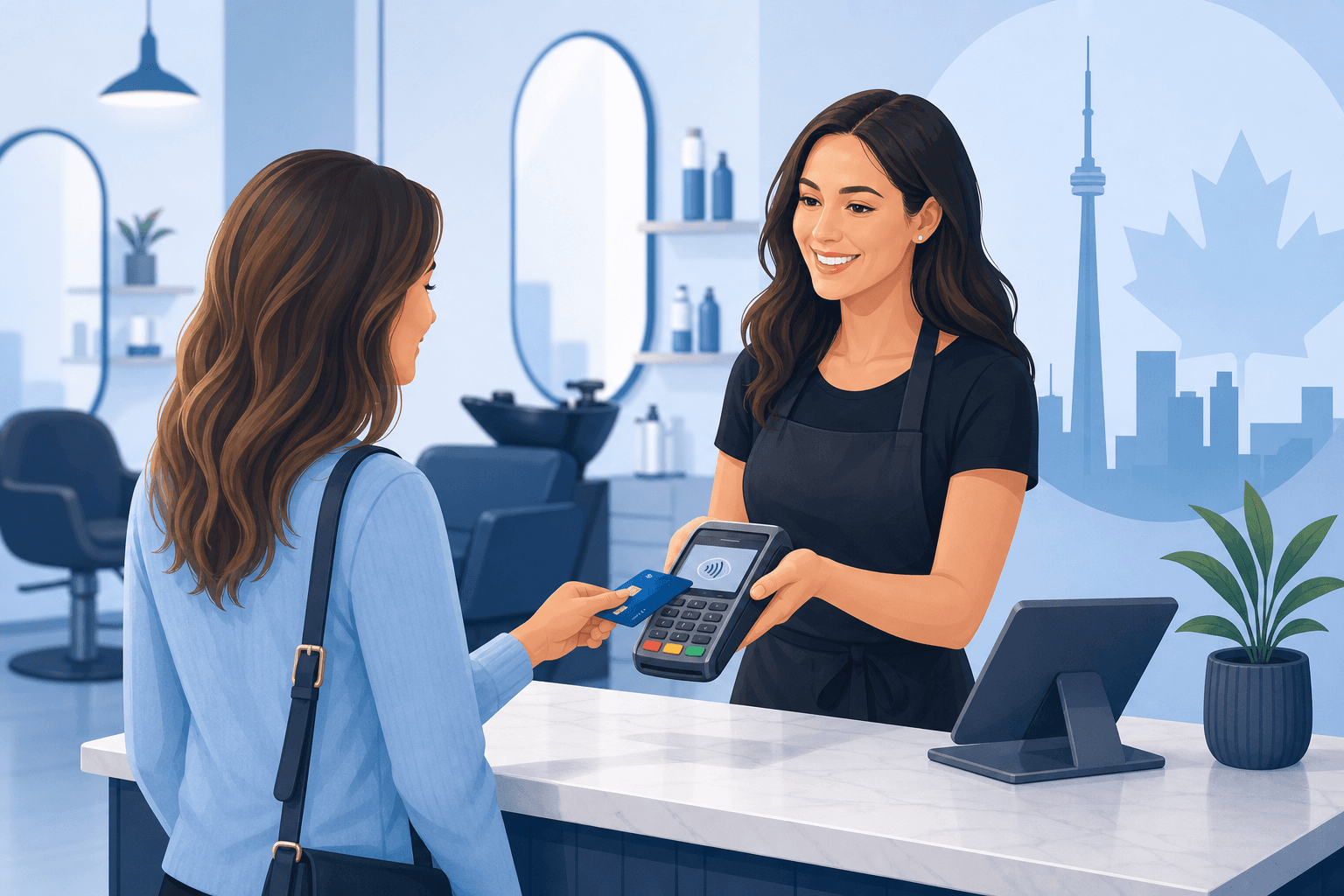
How to Accept Credit Cards at Your Salon in Canada
Walk into almost any Canadian salon today and you'll notice something: hardly anyone pays with cash anymore. From haircuts in Halifax to blowouts in Burnaby, clients expect to tap, swipe, or wave their phone at checkout. If your salon can't accept credit and debit cards smoothly, you're not just inconveniencing clients - you're actively losing bookings to the salon down the street that can.
The good news is that setting up credit card acceptance for a salon or spa in Canada has never been easier. But "easy" doesn't mean "cheap" or "risk-free" if you don't know what you're doing. Salons have unique needs - appointment-based billing, tipping, retail product sales, gift cards, and often a mix of in-chair and online payments - that make choosing the right processor more nuanced than it looks.
This guide walks you through exactly how to accept credit cards at your salon in Canada, what it costs, which equipment makes sense, and how to avoid the common pitfalls that eat into your profit margins.
Why Credit Card Acceptance Matters for Canadian Salons
Canada is one of the most cashless-friendly countries in the world, and the beauty industry reflects that trend strongly. Consider the realities of running a salon in 2024:
- Clients increasingly book and pay with contactless cards or mobile wallets like Apple Pay and Google Pay.
- Higher-ticket services (colour, extensions, spa packages) are rarely paid in cash.
- Tipping culture has shifted almost entirely to digital tip prompts on payment terminals.
- Retail add-ons (shampoo, styling products, skincare) need fast checkout to avoid bottlenecks at the front desk.
If you're still relying on an outdated terminal, a bank-bundled processor with high fees, or worse, no card acceptance at all, you're leaving money on the table - and possibly losing repeat clients who expect modern convenience.
Step 1: Understand Your Options for Accepting Cards
Before choosing a provider, it helps to understand the main ways Canadian salons accept credit cards:
Traditional Payment Processors
These are companies that give you a merchant account and terminal, letting you accept Visa, Mastercard, American Express, and Interac debit. Pricing structures vary significantly, so it's worth taking time to compare processors rather than accepting the first offer your bank presents.
Bank-Bundled Processing
Many salon owners start with whatever their business bank offers, such as a package from a major Canadian bank. This is convenient but often expensive over time. If you currently process through a big bank, it's worth reading our TD comparison to see how bundled banking rates stack up against dedicated processors.
Flat-Rate Processors
Providers like Stripe offer simple, flat percentage pricing that's popular for online bookings and e-commerce add-ons. It's straightforward, but salons with higher transaction volumes often pay more than necessary. Our Stripe comparison breaks down when flat-rate pricing makes sense and when it doesn't.
POS-Integrated Payment Systems
Modern salons benefit most from a point-of-sale (POS) system that combines appointment scheduling, retail inventory, and payment processing in one dashboard. Systems like Clover and Lightspeed are popular in the Canadian salon and spa space. See our Clover comparison and Lightspeed comparison to understand which fits your salon's size and workflow.
Step 2: Choose the Right Equipment for Your Salon
Salons have specific hardware needs that differ from, say, a restaurant or retail shop. Here's what to consider:
Countertop Terminals
Ideal for a single front-desk checkout station. Reliable, affordable, and simple to use for smaller salons with one or two chairs.
Mobile/Wireless Terminals
Perfect for larger salons or spas where stylists check clients out at the chair rather than making them walk to a front desk. Wireless terminals also work well for mobile estheticians or salons that offer at-home services.
Tablet-Based POS Systems
These combine booking software, client records, inventory, and payment in a single system. Many salon owners find this the most efficient option because it eliminates double data entry between a booking app and a separate card terminal.
Online Booking with Deposit Collection
If your salon takes online bookings, you'll want a processor that supports secure card-on-file payments for deposits and cancellation fees - a growing must-have to reduce no-shows.
Choosing the right combination of hardware and software depends on your salon's size, service menu, and how mobile your staff need to be. Our salon & spa solutions page outlines setups tailored specifically to beauty and wellness businesses.
Step 3: Understand Canadian Processing Fees and Regulations
Every salon owner asking how to accept credit cards in a Canadian salon needs to understand the fee structure, because this is where profit margins are won or lost.
Typical Fee Components
- Interchange fees: Set by Visa/Mastercard, typically 1.4%-2.5% depending on the card type.
- Processor markup: What your payment provider charges on top of interchange.
- Monthly/terminal fees: Rental or software fees for your equipment.
- PCI compliance fees: Required for data security standards - every business accepting cards in Canada must comply with PCI DSS.
Watch for These Common Pitfalls
- Long-term contracts with early termination penalties.
- Leased terminals that cost more over three years than buying equipment outright.
- Hidden batch or statement fees buried in monthly invoices.
- Non-transparent tiered pricing that lumps debit and premium rewards cards into high-cost tiers.
Because these fees compound over hundreds of transactions a month, even a 0.5% difference in rate can mean thousands of dollars a year for a busy salon. It's worth running the numbers with our savings calculator to see exactly how much you could save by switching providers.
Step 4: Factor in Tips, Gift Cards, and Retail Sales
Salons have payment needs that go beyond a simple swipe-and-done model.
Digital Tipping
Modern terminals allow clients to select a tip percentage or dollar amount right on the screen before signing. This has replaced cash tipping almost entirely and should be a non-negotiable feature in whatever system you choose.
Gift Cards
Gift cards are a major revenue driver for salons, especially around holidays and Mother's Day. Make sure your processor or POS supports easy gift card issuance and redemption tracking.
Retail Product Sales
If you sell shampoo, styling tools, or skincare products at the front desk, your POS needs solid inventory tracking alongside payment processing - not just a bare-bones card reader.
Multi-Location or Franchise Salons
If you operate multiple locations across Canada - say a location in Toronto and another in Calgary - you'll want a processor that can centralize reporting across locations while still complying with province-specific regulations and tax rates.
Step 5: Plan for Online and Mobile Payments
Many Canadian salons now take deposits or full payments online through booking platforms. If you're expanding into e-commerce (selling product lines online, for instance), you'll need a processor that supports secure online transactions in CAD. Our e-commerce solutions page can help you understand what's needed to safely process online payments alongside your in-salon terminal.
If your salon operates in Quebec, be aware of provincial nuances around bilingual receipts and Quebec-specific card networks - our Desjardins comparison is a useful read for Quebec-based salon owners weighing their options.
Step 6: Switching Providers Without Disrupting Your Business
If you're already accepting cards but suspect you're overpaying, switching processors is more straightforward than most salon owners assume. Here's a simple process:
- Audit your current statement - identify your effective rate (total fees ÷ total processed volume).
- Compare offers from a few providers, ideally ones who specialize in service-based businesses.
- Check contract terms for your current provider, including cancellation penalties.
- Request new equipment or software integration well ahead of your transition date to avoid downtime.
- Train your staff on the new terminal or POS before going live.
Most salons can switch processors within a week or two with minimal disruption, especially with support from a provider who handles setup and staff training for you. If you'd like a clear breakdown of your options, get a free quote to see what you could save compared to your current setup.
Location-Specific Considerations
Payment processing costs and options can vary slightly depending on where in Canada you operate:
- Salons in high-rent urban markets like Toronto or Vancouver often benefit most from bundled POS/payment systems to maximize efficiency during busy periods.
- Salons in Ottawa or Montreal should double check bilingual receipt requirements and provincial sales tax integration.
- Smaller-market salons in Alberta, including those served by our Calgary payment processing resources, often see strong savings by moving off big-bank bundled processing onto a dedicated provider.
Final Thoughts: Making the Right Choice for Your Salon
Learning how to accept credit cards at your salon in Canada isn't just about buying a terminal - it's about choosing a payment ecosystem that supports appointments, tipping, retail sales, and client convenience while keeping your fees as low as possible. The right setup pays for itself many times over through smoother checkouts, happier clients, and fewer hours spent reconciling payments at the end of the day.
Before you commit to any provider, take the time to compare your options, understand your true processing costs, and choose equipment that fits how your salon actually operates day to day.
Ready to see what a smarter payment setup could save your salon each month? Contact our team for a no-obligation consultation, or explore our dedicated salon & spa solutions to find the right fit for your business.