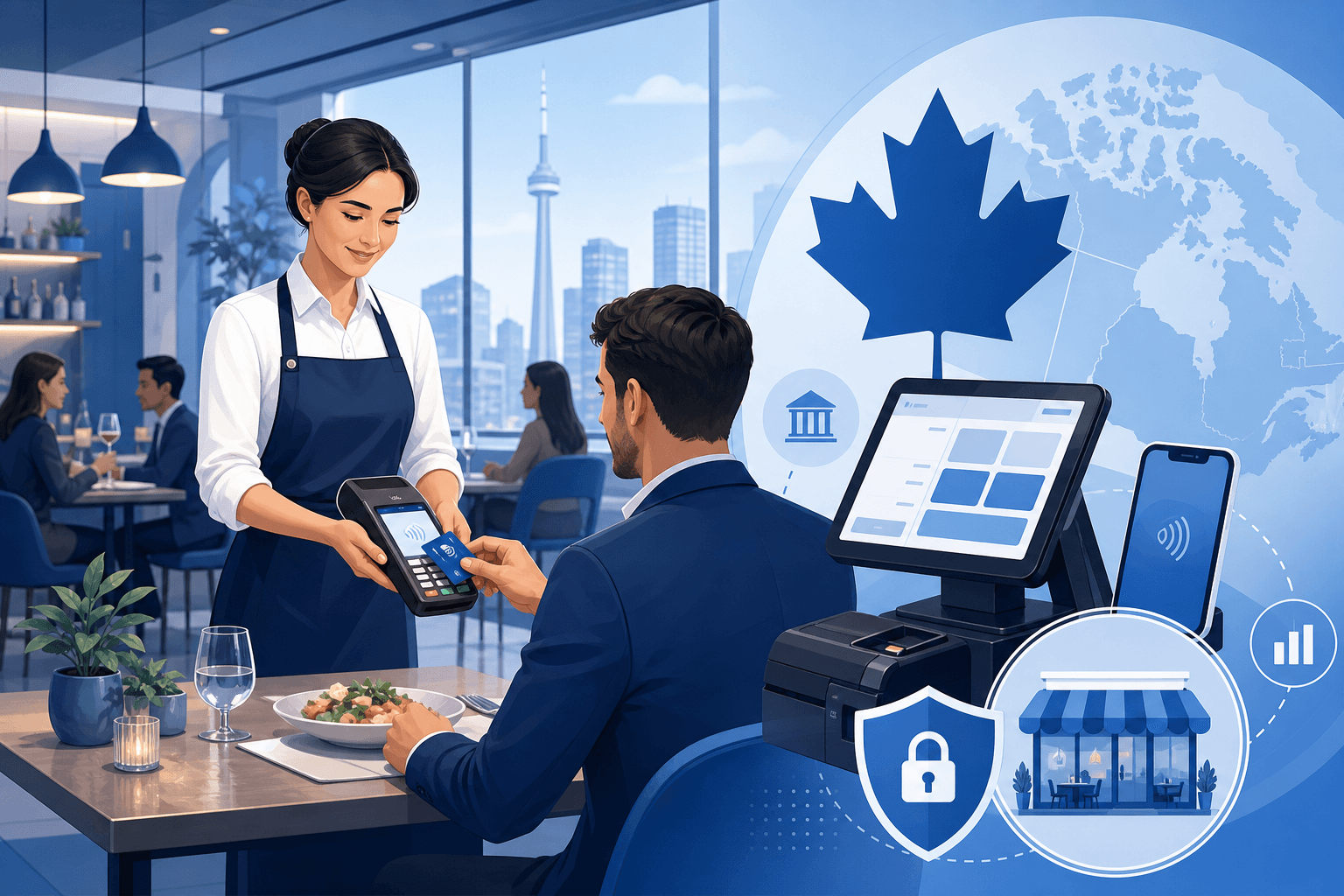
Why Payment Processing Matters More Than Ever for Canadian Restaurants
Running a restaurant in Canada today means razor-thin margins, rising food costs, and a customer base that overwhelmingly expects to pay by tap, card, or mobile wallet. Cash is becoming rare on the floor, which means your payment processor isn't just a back-office utility - it's directly tied to your bottom line. A poorly chosen processor can quietly eat away 2-4% of every sale, while a well-structured setup can save thousands of dollars a year and speed up service at the same time.
Many restaurant owners we talk to across Toronto, Vancouver, Calgary, Montreal, and smaller communities in between are still using legacy bank-bundled processing or outdated countertop terminals that weren't built for the pace of a busy dinner rush. They're paying for features they don't use and missing tools - like tableside payment, tip management, and split-bill functionality - that could genuinely improve both staff efficiency and customer experience.
This guide breaks down everything Canadian restaurant owners need to know about payment processing for restaurants Canada wide: how fees work, what to look for in a POS-integrated system, common mistakes, and how to know if you're overpaying.
How Restaurant Payment Processing Works in Canada
Every time a customer taps, inserts, or swipes their card, several parties take a cut before the money lands in your account:
- Interchange fees - set by Visa/Mastercard and paid to the customer's issuing bank
- Assessment fees - small fees paid to the card networks themselves
- Processor markup - the fee your payment processor charges on top
In Canada, interchange rates are generally lower than in the U.S., but they still vary significantly depending on the card type (premium rewards cards cost more to accept), whether the transaction is tapped, chip-inserted, or manually keyed, and whether you're taking Visa, Mastercard, Amex, or Interac debit.
Common Pricing Models
- Flat-rate pricing - One rate (e.g., 2.65%) regardless of card type. Simple but often more expensive for high-volume restaurants. This is how providers like Stripe typically price transactions - see our Stripe comparison for details.
- Interchange-plus pricing - You pay the true interchange cost plus a small, transparent processor markup. Usually the cheapest option for established restaurants.
- Bank-bundled processing - Offered by major banks, often folded into a business banking package. Convenient, but rarely competitive - check our TD comparison or Desjardins comparison if you're currently banking with either.
For most full-service and quick-service restaurants processing more than $15,000-$20,000 CAD a month, interchange-plus pricing offers the clearest path to savings.
What to Look for in a Restaurant Payment System
Payment processing for restaurants Canada businesses need isn't just about the rate - it's about how well the hardware and software fit your actual service model.
POS Integration
Your payment terminal should talk directly to your POS system so servers aren't manually re-entering totals. Look for:
- Tableside or handheld terminals for full-service dining
- Quick-tap kiosks or counter terminals for QSR and cafés
- Integrated tip prompts that meet CRA reporting requirements
- Split-bill and partial-payment support
Popular POS platforms in the Canadian restaurant space include Clover and Lightspeed. If you're evaluating hardware, our Clover comparison and Lightspeed comparison pages break down pricing, features, and which fits different restaurant sizes.
Speed and Reliability
A terminal that freezes during a Friday night rush costs you more than a slightly higher processing rate ever will. Look for processors with strong uptime guarantees, local Canadian support, and backup connectivity (Wi-Fi plus cellular failover) so a router outage doesn't halt service.
Reporting and Reconciliation
Your processor should give you clean, exportable reports that make end-of-day reconciliation and accounting simple - critical for multi-location restaurant groups and franchises tracking performance across sites.
Understanding the True Cost: Fees Restaurant Owners Often Miss
Beyond the headline rate, watch for:
- Monthly minimums - fees charged if you don't process enough volume
- PCI compliance fees - often padded well above the actual cost of compliance
- Batch/settlement fees - charged per day you close out transactions
- Early termination fees - can trap you in a contract for years
- Equipment lease fees - leasing a terminal for 48-60 months can cost far more than buying outright
Many restaurant owners don't realize how much they're paying until they add it all up. If it's been more than a year since you've reviewed your statement, it's worth using our savings calculator to see what interchange-plus pricing could save you monthly. It only takes a few minutes and requires nothing more than a recent statement.
Choosing the Right Processor for Your Restaurant Type
Full-Service Restaurants
Full-service dining needs tableside payment for faster table turns and better tip capture. Look for processors that integrate tip adjustment directly into the terminal workflow, and consider whether your system supports pre-authorization for bar tabs.
Quick-Service and Cafés
Speed is everything. Tap-to-pay and mobile wallet acceptance (Apple Pay, Google Pay) reduce line times significantly. Contactless limits in Canada are high enough now that most transactions clear instantly without a PIN.
Food Trucks and Pop-Ups
Mobile connectivity matters most here. Cellular-enabled terminals or smartphone-based readers let you process payments anywhere, without relying on venue Wi-Fi.
Multi-Location Groups and Franchises
Centralized reporting across locations, consistent processor pricing, and dedicated account support become essential once you're managing more than one location. Enterprise-level processing, similar to what's offered through Chase comparison, may be worth exploring for larger restaurant groups, though many Canadian multi-location operators find better flexibility with a dedicated Canadian processor.
No matter your format, it helps to start with a side-by-side look - compare processors to see how rates, contracts, and hardware options differ before committing.
Regional Considerations Across Canada
Payment processing needs can vary slightly depending on where you operate:
- Restaurants in Toronto and the GTA face high transaction volumes and tight margins amid rising commercial rent - see our Toronto payment processing resources for local insight.
- Vancouver restaurants often deal with a high mix of tourist traffic and international cards; check our Vancouver payment processing page for details relevant to BC operators.
- Calgary and Alberta restaurants frequently see seasonal swings tied to tourism and energy-sector spending - our Calgary payment processing guide covers what to expect.
- Montreal and Quebec restaurants have unique bilingual receipt and reporting requirements, plus a strong presence of Desjardins in the local market - our Montreal payment processing and Desjardins comparison pages are worth reviewing.
- Ottawa restaurants serving a mix of government, tourism, and local repeat customers should check our Ottawa payment processing page for region-specific tips.
Regardless of province, all Canadian restaurants need to be mindful of PCI-DSS compliance, proper tip reporting to the CRA, and GST/HST handling on processed transactions.
Common Mistakes Restaurant Owners Make
- Signing multi-year contracts without reading the fine print - Early termination fees can lock you into a bad deal for years.
- Leasing equipment instead of buying - Leases often cost 3-5x the equipment's actual value over the contract term.
- Ignoring monthly statements - Junk fees creep in over time; review your statement quarterly at minimum.
- Choosing a processor based on rate alone - Reliability, support, and POS integration matter just as much as the percentage you're quoted.
- Not negotiating - Processing rates are often negotiable, especially once you can show consistent monthly volume.
How to Switch Processors Without Disrupting Service
Switching your payment processor can feel risky when you're mid-service every night, but a well-managed transition is usually seamless:
- Review your current statement and identify your effective rate
- Get a transparent quote from a new provider with interchange-plus pricing
- Confirm POS compatibility before signing anything
- Schedule installation and staff training during a slow period (e.g., a Monday or Tuesday)
- Run both systems in parallel for a short window if possible
If you're ready to see what a modern, transparent processing setup could look like for your restaurant, get a free quote and we'll walk you through exactly what you'd pay based on your actual transaction mix.
Final Thoughts
Payment processing for restaurants Canada wide has evolved well beyond simple card swipes - it's now a core part of how efficiently you run service, how accurately you report tips and taxes, and how much of every sale you actually keep. Whether you're running a single café or a multi-location franchise, taking the time to understand your fee structure and choosing the right POS-integrated processor pays off quickly.
Our restaurant solutions are built specifically for Canadian food service businesses, from single-location cafés to multi-site franchise groups. If you're not sure where to start, contact our team for a no-pressure review of your current setup - we'll show you exactly where you might be overpaying and what a better deal looks like.