Introduction
If you run a business in Canada and accept credit or debit cards, chances are you've heard the word "tokenization" thrown around by your payment processor or POS provider. But what does it actually mean, and why should a busy shop owner in Toronto or a clinic administrator in Calgary care about it?
Here's the short version: tokenization is one of the most important - and most underappreciated - technologies protecting your business and your customers from fraud. Every time a customer taps their card, your systems handle sensitive financial data. If that data is ever exposed in a breach, the consequences can be devastating: regulatory fines, lawsuits, damaged reputation, and lost customer trust. Tokenization dramatically reduces that risk by making sensitive card data useless to criminals even if they manage to steal it.
In this guide, we'll explain exactly what is tokenization and how it protects Canadian businesses, how it differs from encryption, why it matters for PCI compliance, and practical steps you can take to make sure your business is using this technology effectively.
What Is Tokenization, Exactly?
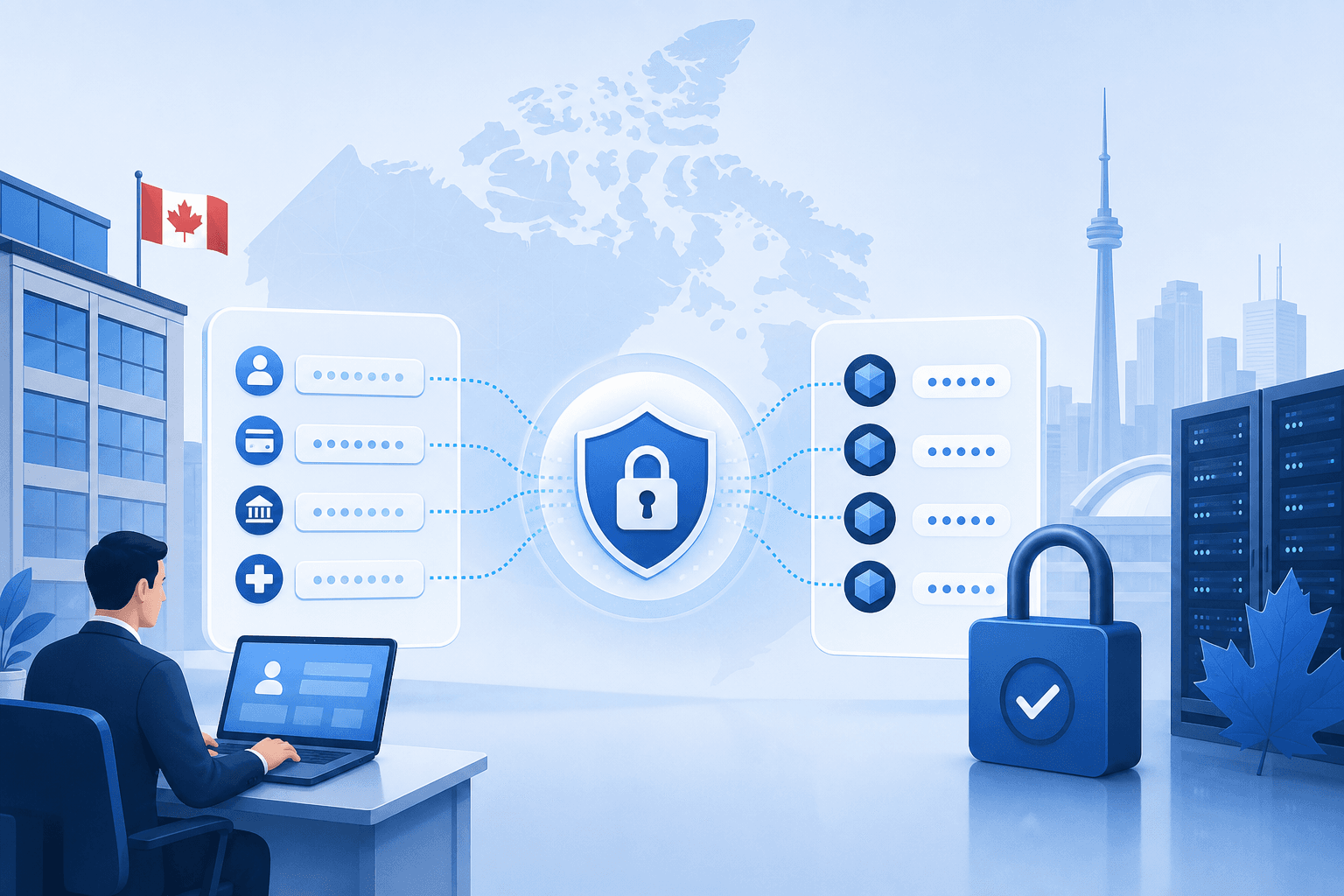
Tokenization is the process of replacing sensitive payment data - like a 16-digit credit card number - with a randomly generated string of characters called a "token." This token has no exploitable value on its own. It can't be reverse-engineered to reveal the original card number, and it's only meaningful within the specific system that generated it.
Here's a simple example:
- A customer pays with a card ending in 4242.
- Your payment processor converts that card number into a token, something like
tok_9f8x7a2b1c. - Your business stores and uses this token for refunds, recurring billing, or record-keeping - never the actual card number.
- If your systems were ever breached, hackers would only find meaningless tokens, not usable card data.
This is fundamentally different from simply "hiding" data. The original card number is stored securely in a highly protected vault (usually managed by your payment processor or a PCI-compliant third party), completely separate from your business's own systems.
Tokenization vs. Encryption
People often confuse tokenization with encryption, but they work differently:
- Encryption scrambles data using a mathematical algorithm and a key. With the right key, encrypted data can be decrypted back into its original form.
- Tokenization replaces data entirely with a substitute value that has no mathematical relationship to the original. There's no "key" that can convert a token back into a card number - only the secure vault holds that mapping.
Many modern payment systems actually use both: encryption to protect data in transit, and tokenization to protect data at rest and during storage or reuse.
Why Tokenization Matters for Canadian Businesses
Canadian small and medium-sized businesses are increasingly attractive targets for cybercriminals, partly because many SMBs assume they're "too small to be hacked." Unfortunately, that's not true - smaller businesses often have weaker security infrastructure, making them easier targets.
Reducing the Impact of Data Breaches
If your business stores actual card numbers on your servers or POS system and experiences a breach, you could be looking at:
- Costly forensic investigations
- Mandatory breach notifications under Canadian privacy law (PIPEDA)
- Fines and penalties from card networks
- Reputational damage that drives customers to competitors
With tokenization, even if a hacker breaches your network, they gain access only to meaningless tokens. There's no usable card data to steal, dramatically limiting your liability and the potential fallout.
Simplifying PCI DSS Compliance
Every Canadian business that accepts card payments is required to comply with the Payment Card Industry Data Security Standard (PCI DSS). Businesses that store raw card data face a much heavier compliance burden - more security controls, more audits, more paperwork.
Tokenization reduces your PCI DSS scope significantly. Since your systems never actually hold real card numbers, you have less sensitive data to protect, fewer systems that need to be audited, and a simpler path to maintaining compliance year after year.
Supporting Recurring Billing and Customer Convenience
Tokenization isn't just about security - it also enables convenient features Canadian customers expect, such as:
- Saved cards for one-click checkout on e-commerce sites
- Recurring subscription billing for gyms, salons, or membership-based businesses
- Faster in-store checkout for returning customers
Because the token - not the actual card number - is stored and reused, businesses can offer these conveniences without taking on the risk of storing real card data themselves.
How Tokenization Works in Real Canadian Business Scenarios
Retail and Point-of-Sale
When a customer taps or inserts their card at your terminal, tokenization happens almost instantly. The card data is tokenized before it ever touches your point-of-sale software, protecting your retail business from the reputational and financial risk of a breach. If you're evaluating new POS hardware, our Clover comparison and Lightspeed comparison breakdowns explain how different systems handle tokenization and security. You can also explore our Retail solutions for tokenization-ready setups.
E-commerce
Online businesses are especially vulnerable to data breaches since card data is entered directly by customers over the internet. Tokenization allows Canadian online retailers to securely store customer payment methods for repeat purchases without ever touching raw card numbers on their own servers. Check out our E-commerce solutions to see how tokenized checkout can reduce fraud and cart abandonment simultaneously.
Restaurants and Hospitality
Restaurants and hotels frequently deal with pre-authorizations, tips added after the fact, and stored cards for loyalty programs. Tokenization allows these transactions to happen securely without repeatedly exposing card data. Our Restaurant solutions and Hospitality solutions pages outline how tokenized payment systems fit into fast-paced service environments.
Healthcare, Salons, and Recurring Payments
Clinics, spas, and salons often store client payment information for recurring appointments or subscription packages. Tokenization means this can be done safely and in compliance with Canadian privacy expectations. Learn more on our Healthcare solutions and Salon & spa solutions pages.
Tokenization and Canadian Regulatory Considerations
Canada doesn't have a single dedicated "tokenization law," but tokenization directly supports compliance with several important frameworks:
- PIPEDA (Personal Information Protection and Electronic Documents Act): Requires businesses to protect customer personal and financial information. Tokenization minimizes the personal data your business actually holds.
- Provincial privacy laws in Quebec, British Columbia, and Alberta impose additional obligations, especially for businesses handling sensitive financial data. Quebec's Law 25, for instance, has strict breach notification requirements - another reason Quebec businesses benefit from tokenized systems. If you're in Quebec, our Desjardins comparison and Montreal payment processing resources are worth a look.
- PCI DSS, while not government legislation, is contractually required by Visa, Mastercard, and other card networks operating in Canada.
Businesses in major Canadian markets - including Toronto payment processing, Vancouver payment processing, Calgary payment processing, and Ottawa payment processing - should confirm with their processor that tokenization is built into every transaction, not offered as an optional add-on.
How to Make Sure Your Business Is Using Tokenization Properly
You don't need to be a security expert to take advantage of tokenization - but you do need to ask the right questions when choosing a payment processor or POS provider.
- Ask directly if tokenization is included. Not all processors handle this the same way, and some legacy systems still store raw card data.
- Confirm where token vaults are hosted. Reputable processors use PCI-compliant, secure vaults - ideally with data residency options relevant to Canadian businesses.
- Review your PCI DSS compliance level with your provider annually to ensure tokenization is reducing your scope as expected.
- Avoid manually keying and storing card numbers in spreadsheets, email, or non-tokenized systems - this is one of the most common (and dangerous) shortcuts small businesses take.
- Compare providers carefully. Pricing structures and security features vary widely between companies like Stripe, TD, and Chase Paymentech. Our Compare processors page - including our Stripe comparison, TD comparison, and Chase comparison - can help you evaluate which provider offers the strongest security combined with fair Canadian pricing.
If you're unsure whether your current setup uses proper tokenization, it's worth a quick conversation. Contact our team and we'll walk through your current processing setup at no cost.
The Cost-Security Balance
Some business owners worry that stronger security features come with a higher price tag. In reality, tokenization is now a standard feature across most modern, reputable processors - it shouldn't cost you extra, and it often reduces costs indirectly by lowering your PCI compliance fees and breach-related risk exposure.
If you're currently paying high processing fees and aren't confident your provider offers proper tokenization, it may be time for a change. Use our savings calculator to see how much you could save by switching to a more secure, cost-effective processor, or get a free quote to compare your current rates against a modern, tokenized payment solution built for Canadian businesses.
Final Thoughts
Understanding what is tokenization and how it protects Canadian businesses isn't just a technical exercise - it's a critical part of protecting your revenue, your customers, and your reputation. As fraud tactics grow more sophisticated and Canadian privacy regulations continue to tighten, businesses that rely on outdated, non-tokenized systems are taking on unnecessary risk.
The good news is that modern payment processing makes tokenization accessible and affordable for businesses of every size - from a single-location salon to a multi-province construction company. Whether you're in retail, hospitality, healthcare, or e-commerce, upgrading to a tokenized, secure payment system is one of the smartest moves you can make this year.
Ready to see how secure, modern payment processing can work for your business? Get a free quote today, or contact our team to discuss the right solution for your industry.