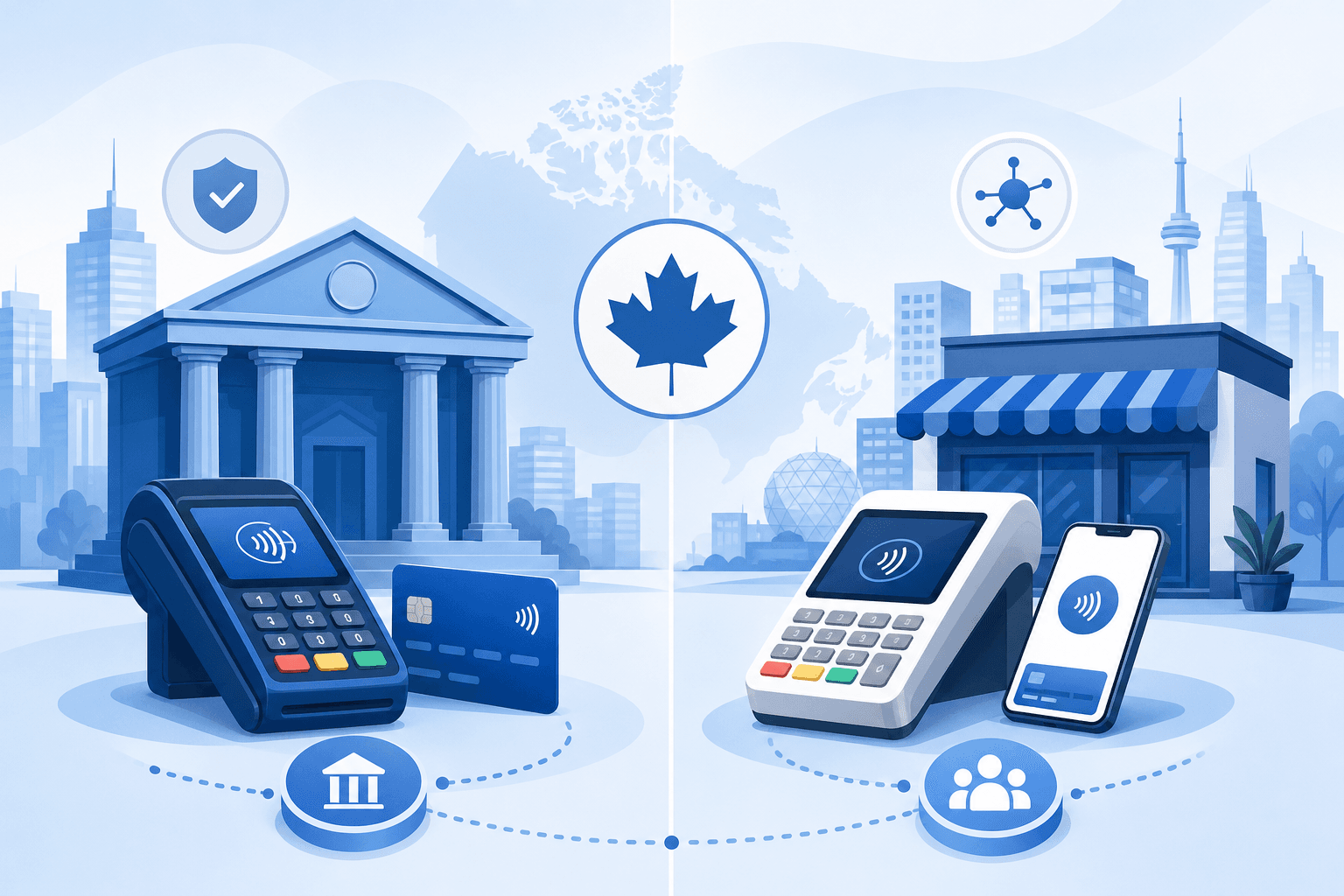
If you've started researching how to accept credit and debit cards in Canada, you've probably noticed that your options generally fall into two camps: the big banks (think RBC, TD, Scotiabank, BMO, and Desjardins) and independent payment processors that operate outside the traditional banking structure. Both can get a transaction from your customer's card to your bank account, but how they price, support, and structure their services can look very different.
For Canadian small and medium business owners, this decision affects more than just your monthly statement. It can influence how quickly you get your money, how much flexibility you have to switch providers, and how easy it is to get a real person on the phone when something goes wrong. In this guide, we'll break down bank-owned vs independent payment processors in Canada so you can make a confident, informed choice for your business.
Whether you run a restaurant in Toronto, a retail shop in Vancouver, or an e-commerce store shipping across the country, understanding these differences is the first step toward processing payments in a way that actually works for you, not just for the provider.
What Is a Bank-Owned Payment Processor?
Bank-owned payment processors are merchant services divisions operated directly by Canada's major financial institutions. When you open a business bank account, it's common for the bank to offer to "bundle" your payment processing alongside it. This can feel convenient since everything is under one roof.
How Bank-Owned Processing Typically Works
With bank-owned processing, your merchant account, business banking, and sometimes even your point-of-sale hardware are tied to the same institution. This can simplify some administrative tasks, but it can also mean less flexibility if your business needs change. Pricing structures, contract terms, and fees vary by bank and by merchant, so it's important to check any bank's current published pricing and terms directly before signing up, rather than assuming all banks offer the same deal.
If you currently process with a major bank, you may want to see how that compares. Our TD comparison page and Desjardins comparison page walk through what bank-bundled processing tends to look like for Canadian businesses, particularly those in Quebec where Desjardins has a strong presence.
What Is an Independent Payment Processor?
Independent payment processors are companies that specialize solely in payment processing. They aren't tied to a specific bank, which means they can often work with the bank account you already have while offering more flexibility in pricing, contract structure, and the type of support you receive.
Why Businesses Consider Independent Processors
Many Canadian business owners move toward independent processors because they're looking for:
- Transparent pricing that clearly separates the actual cost of processing from the provider's markup
- Flexibility to switch providers or adjust services as the business grows
- Dedicated merchant support from a team whose core business is payments, not banking in general
- Faster, more personalized service when questions or issues come up
At PaymentsPlus, for example, we use interchange-plus pricing, which means the card network cost and our markup are shown separately on every statement. That transparency is something that's harder to find in many bundled bank packages, where fees can be blended together and harder to break down.
Key Differences: Bank-Owned vs Independent Payment Processors in Canada
When you line them up side by side, the differences between bank-owned vs independent payment processors in Canada tend to show up in a few consistent areas.
Pricing Structure
Bank-owned processors often use tiered or flat-rate pricing models that bundle multiple fee types together. This can make it harder to see exactly what you're paying for card network costs versus the provider's margin. Independent processors like PaymentsPlus commonly use interchange-plus pricing, where the card network cost plus our markup are shown separately on every statement, making it easier to understand exactly what you're being charged and why.
If you're not sure what you're currently paying, it's worth a closer look. You can get a free quote built from your business's own processing statement, which shows the dollar difference compared to your current setup.
Contract Terms and Flexibility
Historically, bank merchant agreements have sometimes come with longer-term contracts or early termination fees, though this varies by institution and you should always check the specific terms offered to you. Independent processors increasingly compete by offering more flexible terms. PaymentsPlus, for instance, has no long-term contracts and no cancellation fees, so your business isn't locked into a relationship that no longer fits.
Funding Speed
How quickly you receive your money matters for cash flow, especially for seasonal businesses or those with tight margins. Funding timelines vary by processor, and it's worth asking any provider directly what their standard is. At PaymentsPlus, next-day funding is the standard, with same-day funding available for qualified merchants.
Customer Support
With a large bank, your merchant services inquiry may be routed through a general banking call center, which can mean longer wait times or less specialized knowledge of payment processing specifically. Independent processors that focus solely on payments can sometimes offer more direct, specialized support. PaymentsPlus responds within 24 hours, and because payments are our only focus, our team is well-versed in the day-to-day realities of merchant processing.
Hardware and POS Options
Bank-owned processors sometimes require you to use their proprietary terminals or POS systems, which can limit your choices if you want to switch software down the road. Independent processors often provide more flexibility here. PaymentsPlus offers hardware placement options for qualified merchants, and we can also help connect your payment processing to the POS or e-commerce platform you already use or want to adopt. If you're comparing POS systems directly, our Clover comparison and Lightspeed comparison pages are a good place to start.
Which Should You Choose? Questions to Ask Yourself
There's no single right answer for every business. The right choice depends on your priorities, your industry, and how your business operates day to day. Here are some questions to work through:
- How important is pricing transparency to you? If you want to see exactly what you're paying in card network costs versus provider markup, interchange-plus pricing from an independent processor may be a better fit.
- Do you value flexibility over bundling? If having your payments tied to the same institution as your business bank account is convenient for you, a bank-owned option might simplify your life. If you'd rather keep those services separate and flexible, an independent processor may suit you better.
- How fast do you need access to your funds? Cash flow needs vary by business type. Restaurants and retailers with daily transaction volume may prioritize faster funding timelines more than a business with less frequent sales.
- What kind of support do you expect? Consider whether you want a dedicated payments team or are comfortable navigating a larger institution's general customer service structure.
- Do you plan to grow or change platforms? If you expect to add an online store, switch POS systems, or expand to new locations, flexibility in your processing contract can save headaches later.
To help sort through the differences systematically, you can compare processors directly, or use our savings calculator to estimate how your current costs stack up against alternative pricing models.
Industry Considerations in Canada
Different types of Canadian businesses tend to have different priorities when it comes to choosing between bank-owned and independent processors.
- Restaurants and hospitality businesses often need fast funding and reliable hardware at the counter or tableside. See our restaurant solutions and hospitality solutions pages for more detail.
- Retail shops frequently want POS flexibility and clear reporting. Our retail solutions page covers common considerations.
- E-commerce businesses need processing that integrates cleanly with their online platform. Our e-commerce solutions page and our integration service, where we set up your merchant account and connect it to platforms like Shopify, WooCommerce, or Odoo, can help here. If you're specifically running Odoo, take a look at our Odoo Clover integration page.
- Healthcare practices, salons and spas, construction businesses, automotive shops, and nonprofits all have their own processing patterns and seasonal cash flow considerations. Visit our healthcare solutions, salon & spa solutions, construction solutions, automotive solutions, or nonprofit solutions pages for more tailored information.
Regardless of industry, Canadian businesses should also keep PCI compliance in mind. This is a security standard required for any business handling card data, and it's something that should be included as part of your processing service rather than a separate cost you have to manage on your own. PaymentsPlus includes PCI compliance as part of our service.
Regional Considerations Across Canada
Payment processing needs can also vary slightly depending on where your business operates. If you're located in a major Canadian city, it can help to understand local market context:
- Businesses in the GTA can check out our Toronto payment processing page.
- Businesses in British Columbia may find our Vancouver payment processing page useful.
- Alberta businesses can review our Calgary payment processing page.
- Quebec merchants, particularly those more familiar with Desjardins, can see our Montreal payment processing page and Desjardins comparison.
- Businesses in the capital region can visit our Ottawa payment processing page.
Making the Switch
If you've decided an independent processor is worth exploring, switching from a bank-owned provider doesn't have to be disruptive. A good starting point is a statement review: send in your current processing statement and get a free quote that shows the dollar difference in plain terms, rather than vague promises of savings. From there, if you decide to move forward, the process typically includes setting up your new merchant account, confirming your hardware or integration needs, and testing everything before you fully rely on it for live transactions.
Conclusion
Choosing between bank-owned vs independent payment processors in Canada ultimately comes down to what matters most for your business: bundled convenience or pricing transparency, bank-standard support or specialized payments expertise, proprietary hardware or more flexible options. Many Canadian business owners find that independent processors offer a level of clarity and flexibility that's hard to get from a bundled bank package, particularly when it comes to understanding exactly what they're paying for.
If you're ready to see where your business stands, get a free quote built from your own processing statement, or contact our team to talk through your specific setup. There's no pressure and no obligation, just a clearer picture of your options.