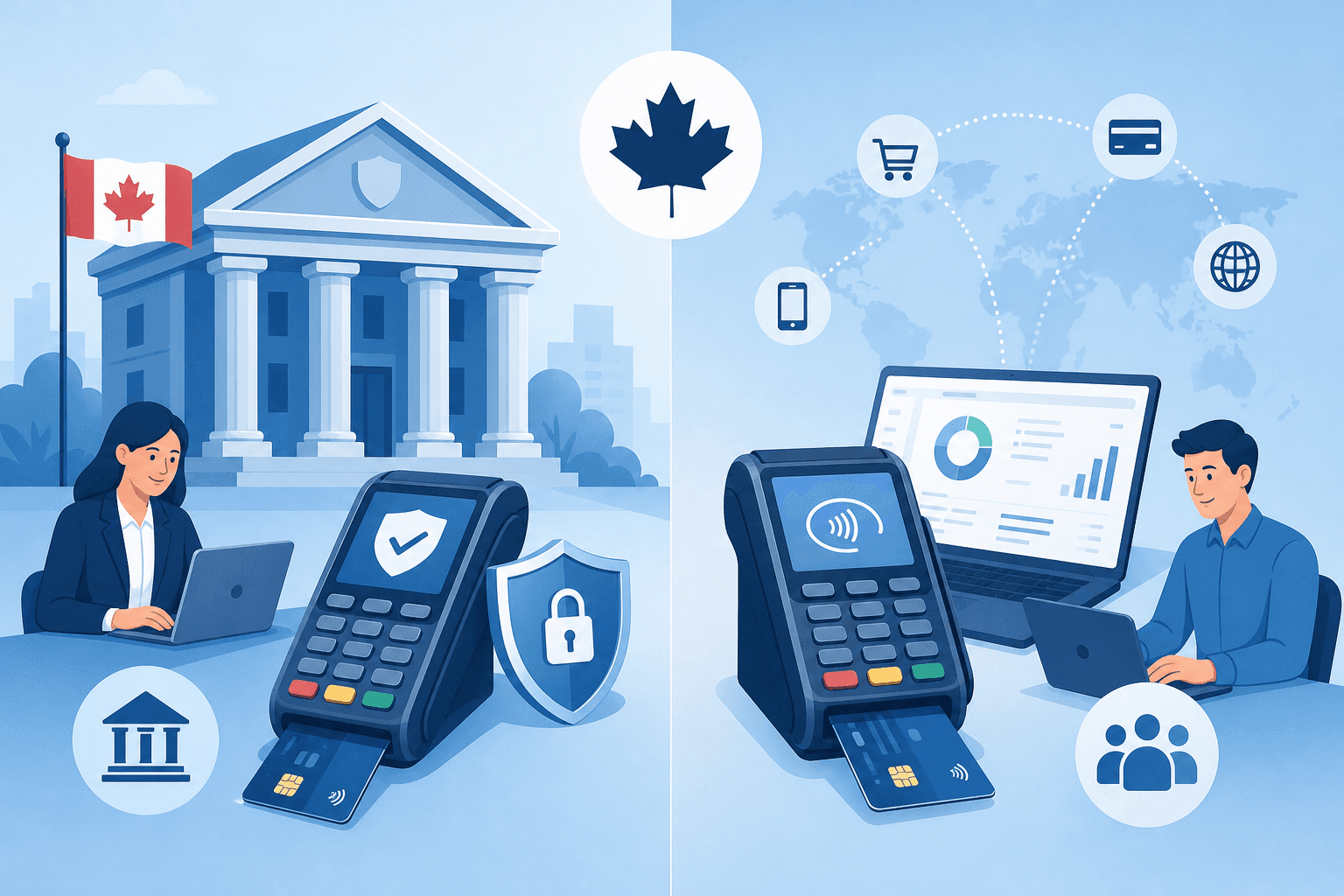
If you've ever tried to compare payment processing options in Canada, you know the landscape can feel overwhelming. Should you stick with the "safe" choice of your business bank for merchant services, or branch out to a third-party processor promising lower rates and modern technology? It's one of the most common questions we hear from small and medium business owners across Toronto, Vancouver, Calgary, Montreal, and beyond.
The decision matters more than most entrepreneurs realize. Payment processing fees can quietly eat into your margins year after year, and the wrong provider can leave you stuck with clunky technology, poor customer support, or hidden charges buried in the fine print. On the other hand, the right choice can save you thousands of dollars annually while giving your customers a smoother checkout experience.
In this guide, we'll break down the real differences in the Canadian Bank Merchant Services vs Third-Party Processors debate, so you can make an informed decision based on your business size, industry, and growth plans - not just brand recognition.
Understanding the Basics: What Each Option Offers
Canadian Bank Merchant Services
When you open a business account with one of Canada's major banks - RBC, TD, Scotiabank, BMO, CIBC, or Desjardins - they typically offer bundled merchant services as part of your banking relationship. This means your deposits, loans, and payment processing all live under one roof.
Banks market this as convenience: one statement, one relationship manager, one phone number to call. For some business owners, especially those who value simplicity and already have strong banking relationships, this bundled approach feels like the natural choice. If you're curious how a specific bank stacks up, check out our detailed TD comparison or Desjardins comparison, especially relevant for Quebec-based businesses.
Third-Party Processors
Third-party processors - companies that specialize exclusively in payment processing - operate independently from traditional banks. These include dedicated merchant service providers (like PaymentsPlus), as well as tech-forward platforms like Stripe, Square, and Clover.
Because payment processing is their entire business, third-party processors tend to invest heavily in technology, customer support, and competitive pricing structures. They often provide more flexibility in hardware, software integrations, and contract terms compared to banks. Want to see how the big names stack up? Our Stripe comparison and Clover comparison pages dig into the details.
Comparing Costs: Where the Real Differences Show Up
Cost is usually the first thing business owners want to compare, and it's where Canadian Bank Merchant Services vs Third-Party Processors differences become most apparent.
Bank Pricing Structures
Banks often use tiered pricing models that bundle different card types (Visa, Mastercard, Amex, debit) into broad categories. While this can look simple on paper, it frequently means you're overpaying for lower-cost transactions to subsidize higher-cost ones. Banks may also:
- Require longer-term contracts with early termination fees
- Charge monthly minimums regardless of processing volume
- Offer limited transparency into true interchange costs
- Provide less room for rate negotiation once you're locked in
Third-Party Pricing Structures
Independent processors often offer interchange-plus pricing, which separates the actual card network cost (interchange) from the processor's markup. This transparency allows you to see exactly what you're paying and why. Many third-party providers also offer:
- Month-to-month agreements with no long-term lock-in
- Volume-based discounts as your business grows
- Clear breakdowns of fees in CAD with no surprise charges
- More competitive rates for businesses processing higher volumes
If you're not sure how much you could save by switching, use our savings calculator to see a side-by-side estimate based on your actual processing volume.
Technology and Integration Capabilities
Bank-Provided Equipment and Software
Traditional banks typically offer standard terminal options with limited customization. Integration with modern point-of-sale (POS) systems, e-commerce platforms, or accounting software can be clunky or require third-party workarounds. If your business relies on specialized software - like inventory management for retail or appointment booking for salons - bank-provided systems may not integrate smoothly.
Third-Party Technology Advantages
This is where independent processors tend to shine. Most third-party providers offer:
- Modern POS systems like Clover or Lightspeed with intuitive interfaces
- Seamless e-commerce integrations for online stores
- API access for custom development
- Compatibility with accounting and ERP systems
For businesses using enterprise resource planning software, integrations like our Odoo Clover integration allow you to connect your payment processing directly with your business management tools, eliminating manual data entry and reducing errors. If you're comparing POS platforms directly, our Lightspeed comparison is a great resource.
Industry-Specific Considerations
Not every business has the same payment processing needs, and this is another area where Canadian Bank Merchant Services vs Third-Party Processors comparisons get interesting.
Restaurants and Hospitality
Restaurants need fast, reliable processing with tableside payment options and tip adjustment features. Banks often lack specialized hospitality tools, while third-party providers offer purpose-built solutions. Check out our restaurant solutions and hospitality solutions for industry-specific recommendations.
Retail and E-commerce
Retailers need inventory syncing and omnichannel capabilities, while online businesses require secure, fast checkout experiences. Our retail solutions and e-commerce solutions pages outline the tools best suited for these needs.
Healthcare, Salons, and Professional Services
Appointment-based businesses benefit from processors that integrate booking and payment. Explore our healthcare solutions and salon & spa solutions for tailored options.
Construction and Automotive
Mobile and field-based businesses need portable payment solutions. Our construction solutions and automotive solutions pages cover processors built for on-the-go transactions.
Nonprofits
Charities need low-cost processing to maximize donations. Our nonprofit solutions page explains how specialized pricing can help organizations keep more funds going toward their mission.
Customer Support and Contract Flexibility
The Bank Experience
Banks offer the comfort of established reputations, but merchant services support is often outsourced or siloed from your regular banking contact. Business owners frequently report long wait times and limited specialized knowledge when payment issues arise outside regular banking hours.
The Third-Party Experience
Dedicated processors typically offer specialized support teams who understand payment processing inside and out. Many Canadian third-party providers offer extended support hours, dedicated account managers, and faster issue resolution - critical when a payment outage could mean lost sales.
Contract flexibility is equally important. Banks often require multi-year commitments, while many third-party processors offer month-to-month terms, giving you the freedom to switch if your needs change.
Regional Considerations Across Canada
Payment processing needs can vary depending on where your business operates. Businesses in major hubs like Toronto payment processing, Vancouver payment processing, Calgary payment processing, Montreal payment processing, and Ottawa payment processing each face unique market conditions, from bilingual requirements in Quebec to higher transaction volumes in dense urban retail corridors.
Local providers who understand Canadian regulations, PCI compliance requirements, and regional banking nuances can offer more tailored support than a one-size-fits-all national bank program.
Making the Right Choice for Your Business
So, which is better - Canadian bank merchant services or third-party processors? The honest answer depends on your priorities:
Choose bank merchant services if:
- You strongly prefer having everything under one financial institution
- Your transaction volume is very low and simplicity outweighs cost savings
- You don't need specialized POS or e-commerce integrations
Choose a third-party processor if:
- You want transparent, competitive pricing
- You need modern technology and integrations
- You value flexible contract terms
- You're processing a significant volume and want to maximize savings
For most growing Canadian businesses, the flexibility, transparency, and technology advantages offered by third-party processors make them the stronger long-term choice. To see exactly how different providers stack up for your specific business, compare processors side by side.
Conclusion: Take Control of Your Payment Processing Costs
The Canadian Bank Merchant Services vs Third-Party Processors decision isn't just about saving a few dollars per transaction - it's about choosing a payment partner that supports your business's growth, technology needs, and customer experience goals. While banks offer familiarity, third-party processors increasingly deliver better pricing transparency, more modern tools, and dedicated support tailored to Canadian businesses.
Before renewing your current contract or signing up with your bank, take the time to compare your options. Explore our services to see how PaymentsPlus supports businesses across Canada, or get a free quote to see how much you could be saving. If you have questions specific to your industry or location, contact our team - we're happy to help you find the right fit.