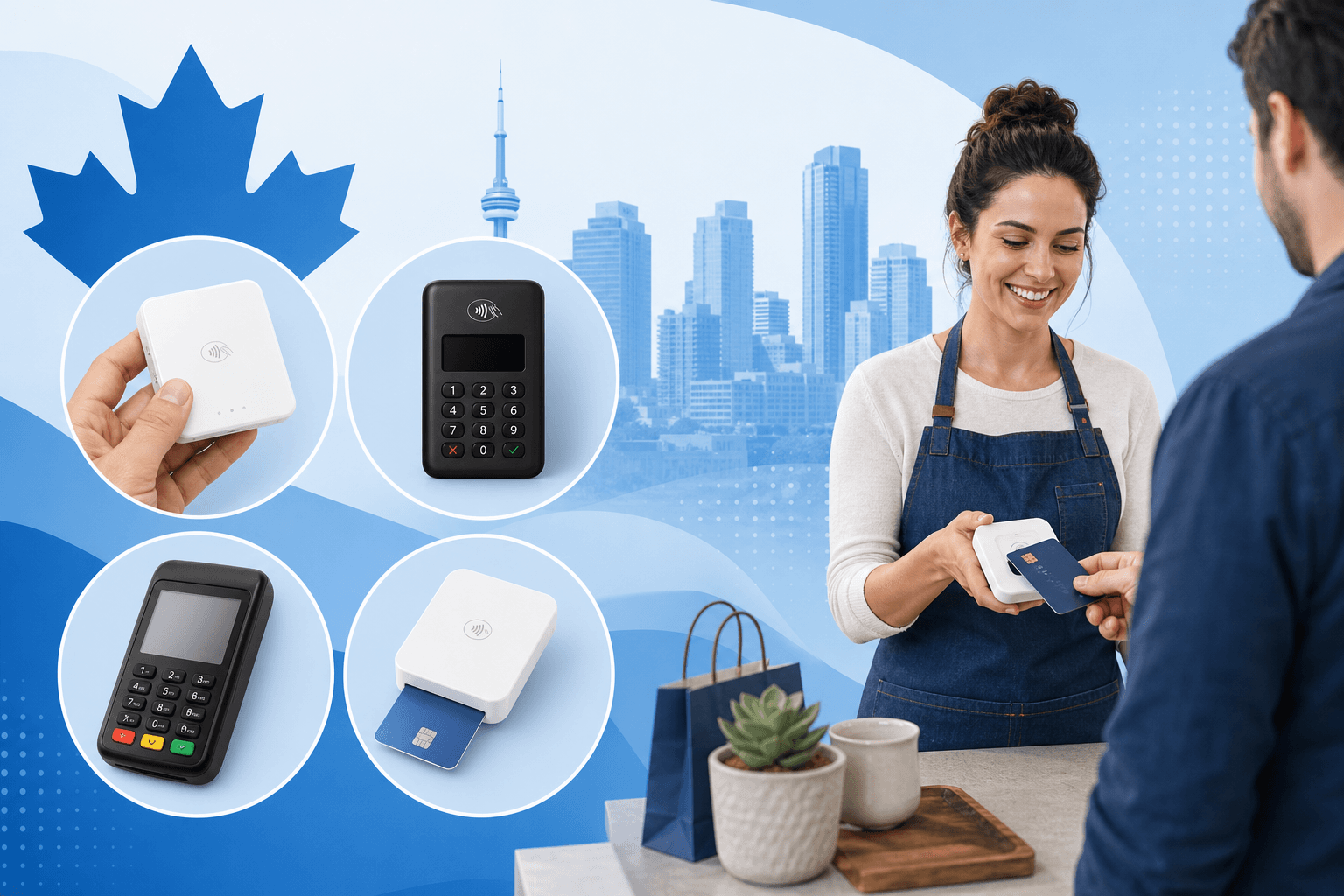
If you run a small business in Canada that needs to accept payments on the go - whether you're a food truck operator in Calgary, a contractor in Ottawa, or a market vendor in Montreal - a reliable mobile card reader isn't optional anymore. Canadians overwhelmingly prefer tapping their card or phone over handling cash, and businesses that can't accept contactless payments risk losing sales on the spot.
The challenge is that the mobile card reader market in Canada has grown crowded, with options ranging from simple plug-in dongles to full-featured smart terminals that double as mini POS systems. Pricing structures vary wildly too, with some providers charging flat percentages per transaction and others bundling in monthly fees, hardware costs, and interchange-plus pricing that can be confusing to compare.
This guide breaks down the top mobile card readers available to Canadian small businesses in 2024, comparing fees, features, and ease of use so you can make an informed decision. We'll also cover what to actually look for beyond the marketing claims, since the "best" option really depends on your business type, transaction volume, and how often you're processing payments away from a fixed location.
Why Mobile Card Readers Matter for Canadian Small Businesses
Mobile card readers have become essential infrastructure rather than a nice-to-have add-on. Consider the scenarios where a traditional countertop terminal simply doesn't work:
- A landscaping or construction crew invoicing clients on-site
- A hair stylist or esthetician doing house calls
- A food truck or farmers market vendor with no fixed checkout counter
- A plumber or electrician collecting payment after a service call
- Pop-up retail shops and craft fair vendors
In all these cases, being able to accept debit and credit cards (plus Apple Pay and Google Pay) directly from a smartphone or tablet means faster payment collection, fewer unpaid invoices, and a better customer experience. For service-based businesses like those in our construction solutions or salon & spa solutions categories, mobile readers are often the single most impactful payments upgrade they can make.
There's also a compliance angle. Canadian businesses need to ensure their payment hardware is PCI-compliant and properly supports EMV chip and interac debit standards. Not every reader marketed to Canadian businesses actually supports Interac debit, which is a critical feature given how many Canadian customers default to debit over credit.
What to Look for in a Mobile Card Reader
Before comparing specific products, it helps to know which features actually matter for your business.
Transaction Fees and Pricing Structure
This is usually the biggest differentiator. Mobile card readers in Canada typically use one of three pricing models:
- Flat-rate pricing - a fixed percentage per transaction (often 2.65%-2.9% + a per-transaction fee), regardless of card type
- Interchange-plus pricing - you pay the actual interchange rate set by Visa/Mastercard plus a small processor markup, which is usually cheaper for higher-volume businesses
- Tiered pricing - rates vary based on card type, which can be unpredictable and harder to budget around
Flat-rate providers like Stripe and Square are popular for their simplicity, but businesses processing more than roughly $10,000/month often save meaningfully by switching to interchange-plus pricing. If you're unsure which model makes sense, use our savings calculator to see the real dollar difference based on your actual transaction volume.
Interac Debit Support
Make sure any reader you choose fully supports Interac debit, not just Visa Debit or Mastercard Debit. Full Interac support typically means lower fees on debit transactions compared to running everything as credit.
Hardware Cost and Connectivity
Mobile readers range from free (with ongoing fee commitments) to $200-$400 for a standalone smart terminal. Consider:
- Bluetooth readers that pair with your existing phone or tablet
- Standalone smart terminals with built-in SIM/Wi-Fi (useful where phone service is unreliable)
- Battery life if you're processing payments for a full workday without charging access
Deposit Speed
Some providers deposit funds next business day, while others take 2-3 business days. If cash flow is tight, this matters more than it might seem.
Comparing the Top Mobile Card Readers in Canada
Square Reader
Square remains one of the most recognizable names in mobile payments, and for good reason - it's simple to set up, has no monthly fees for the basic plan, and the app includes built-in invoicing and basic inventory tools. Square charges a flat rate per tap, chip, or swipe transaction, which makes it predictable but potentially more expensive for higher-volume merchants. It's a solid choice for very small or seasonal businesses that prioritize simplicity over the lowest possible rate.
Stripe Terminal
Stripe's mobile terminal options are popular among businesses that already use Stripe for online payments, since it allows a unified dashboard for in-person and e-commerce transactions. This makes it a natural fit for hybrid businesses - think a retail shop with an online store, which might also want our e-commerce solutions. Stripe's pricing is also flat-rate, and like Square, it can become costly at higher volumes. See our full Stripe comparison for a detailed fee breakdown.
Clover Go
Clover Go is a compact mobile reader built by the company behind Clover's popular POS systems. It integrates tightly with the broader Clover ecosystem, which is valuable if you're already using Clover hardware at a fixed location and want a seamless mobile extension of the same system. Businesses running Clover alongside platforms like Odoo for inventory and accounting may also want to look at Odoo Clover integration options. For a broader look at how Clover stacks up, check our dedicated Clover comparison.
Moneris Go
As one of Canada's longest-standing processors, Moneris offers a mobile reader with strong Interac debit support and solid reliability - an important factor for Canadian merchants who want to ensure full compliance with domestic debit network standards. Moneris tends to work well for businesses that want a Canadian-rooted provider with established customer support infrastructure.
Bank-Bundled Options (TD, Desjardins)
Many Canadian banks offer mobile readers bundled with business banking packages. TD's mobile payment solutions, for example, can be convenient if you already bank with TD, though bundled processing rates aren't always the most competitive compared to independent processors - see our TD comparison for specifics. Similarly, Quebec-based businesses banking with Desjardins should review our Desjardins comparison before committing, since Desjardins has unique positioning for Quebec merchants with French-language support and provincial considerations.
Lightspeed Mobile
For retail and restaurant businesses that need mobile payments tightly integrated with inventory and table management, Lightspeed's mobile POS tools are worth a look. It's a heavier solution than a simple card reader, but for businesses already using or considering Lightspeed as a full POS system, the mobile payment integration can eliminate double-entry and reconciliation headaches. Our Lightspeed comparison covers how it stacks up against other POS-integrated payment options.
Industry-Specific Considerations
Different business types should weigh these options differently.
Restaurants and food trucks benefit most from readers that support tipping prompts, split payments, and quick order entry - worth exploring through our restaurant solutions page.
Retail pop-ups and market vendors usually prioritize low upfront hardware costs and simple flat-rate pricing, making Square or Stripe reasonable starting points, though our retail solutions page covers more permanent setups too.
Healthcare and wellness providers doing mobile or home-visit billing need to be especially mindful of PCI compliance and secure transaction handling - see our healthcare solutions for tailored guidance.
Nonprofits collecting donations at events often need simple, low-fee mobile readers with minimal setup, something our nonprofit solutions page addresses directly.
Hotels, inns, and hospitality businesses handling mobile check-in payments or poolside service should look at hospitality solutions for integrated options beyond a basic reader.
Regional Considerations Across Canada
Where your business operates can influence which provider makes the most sense, largely due to regional banking relationships and support availability. Businesses in Toronto and the GTA have access to the widest range of processor sales offices and support. Vancouver businesses often deal with higher transaction volumes tied to tourism, which affects which pricing model saves the most money. Calgary merchants in trades and energy services frequently need rugged mobile hardware suited to outdoor conditions. Montreal businesses should factor in bilingual support and Quebec-specific regulations, while Ottawa businesses - including many government contractors - often need processors comfortable with invoicing and B2B payment flows.
Making the Right Choice for Your Business
There's no single "best" mobile card reader in Canada - the right choice depends on your transaction volume, industry, and whether you need standalone functionality or POS integration. As a general rule:
- Low-volume or seasonal businesses: Square or Stripe for simplicity
- Established businesses already using Clover or Lightspeed POS: stick with their mobile extensions
- High-volume businesses: negotiate interchange-plus pricing instead of accepting flat rates
- Bank customers wanting bundled convenience: TD or Desjardins, with eyes open on rate competitiveness
Before signing any contract, always ask for a full breakdown of transaction fees, monthly costs, and contract length. Many processors advertise low headline rates but add monthly minimums, PCI compliance fees, or early termination penalties that aren't obvious upfront. Our team can walk you through actual numbers side-by-side - compare processors directly to see how your options stack up.
Conclusion
Choosing among mobile card readers in Canada for small business ultimately comes down to matching the hardware and pricing model to how your business actually operates. A flat-rate reader from Square or Stripe might be perfect for a seasonal vendor, while a growing retail or restaurant operation processing tens of thousands of dollars monthly will likely save more with interchange-plus pricing through a dedicated processor.
The best next step is getting real numbers rather than relying on advertised rates. Get a free quote tailored to your transaction volume and industry, or contact our team to talk through which mobile card reader setup makes the most financial sense for your Canadian small business.