Introduction
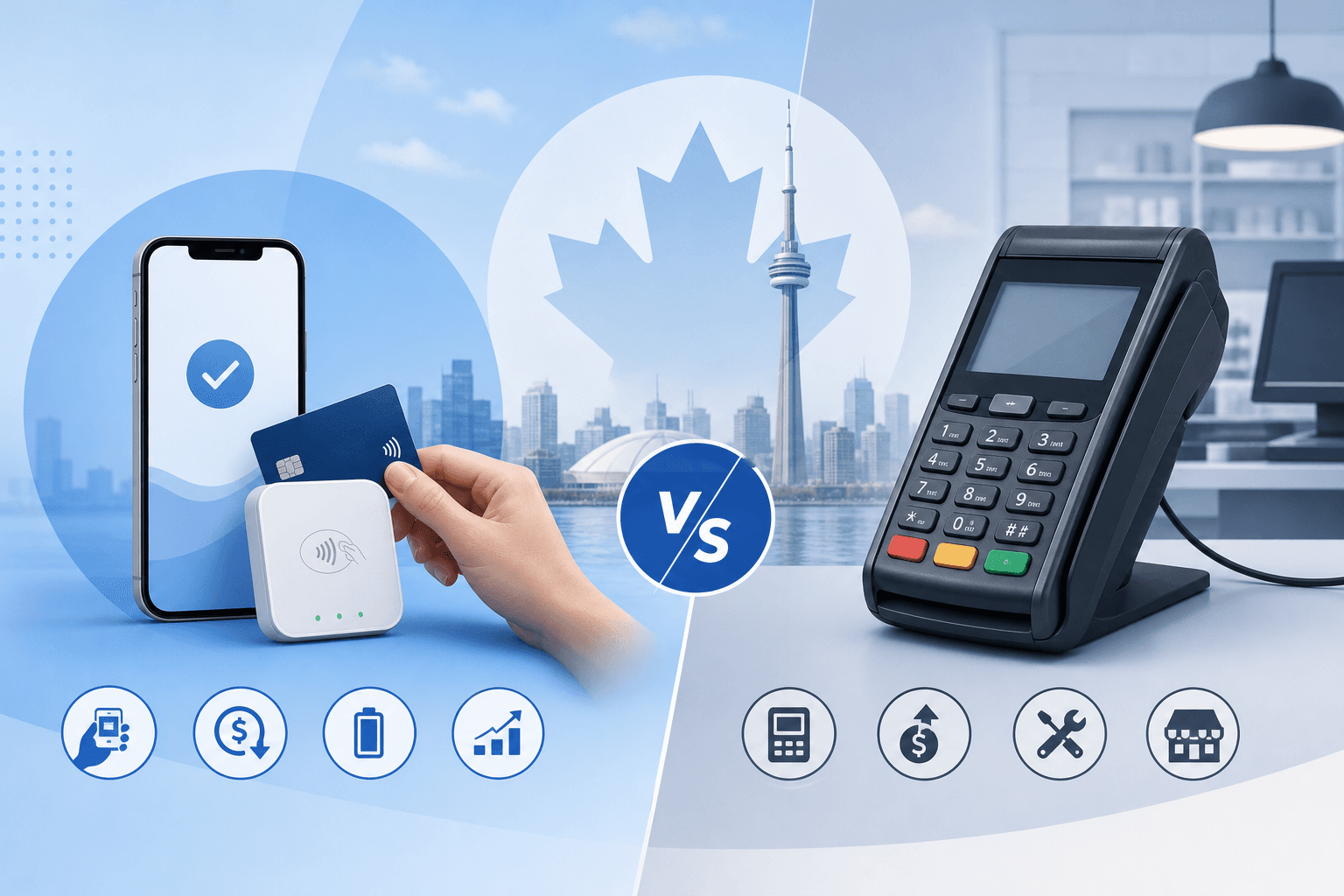
Choosing how you accept payments is one of the most practical decisions a Canadian business owner will make. Walk into any market, craft fair, or busy retail shop today and you will see two very different approaches: a sleek mobile card reader paired with a smartphone, or a countertop terminal plugged into a dedicated phone line or internet connection. Both get the job done, but they are built for different ways of doing business.
The debate over mobile card readers vs traditional terminals: best option for Canadian businesses isn't about which technology is "better" in some absolute sense. It's about matching the hardware to how you actually operate, whether that's a fixed storefront in Toronto, a mobile dog grooming service in Calgary, or a food truck that moves around Montreal all summer. Get the match wrong and you could be paying for mobility you don't need, or missing mobility you do.
This guide breaks down the real differences between mobile card readers and traditional terminals, covering cost, reliability, use cases, and what Canadian business owners should ask before committing to either option.
What Are Mobile Card Readers and Traditional Terminals?
Mobile Card Readers
Mobile card readers are small, often pocket-sized devices that connect to a smartphone or tablet via Bluetooth or a headphone jack, or that function as standalone handheld units with built-in screens and SIM cards. They're designed for businesses that need to take payments anywhere: on a sales floor, at a client's home, at a market booth, or on a delivery route.
Traditional Terminals
Traditional terminals are the countertop or wired devices most people associate with retail checkout. They typically connect via Ethernet, a phone line, or Wi-Fi, and they stay in one fixed location behind the counter. Many modern versions also support tap, chip, and contactless payments, and some integrate directly with a point-of-sale (POS) system for inventory and sales tracking.
Both categories have evolved significantly, and the line between them has blurred. Many "traditional" terminals now offer Wi-Fi flexibility, while some mobile readers are robust enough to serve as a primary checkout device for a small shop.
Key Differences That Matter for Canadian Businesses
Mobility and Flexibility
The most obvious difference is movement. Mobile card readers go wherever your business goes, which matters for:
- Contractors and tradespeople invoicing on-site
- Mobile pet groomers, personal trainers, or home service providers
- Pop-up shops, markets, and seasonal vendors
- Delivery-based businesses
Traditional terminals are built to stay put, which suits businesses with a fixed checkout point, like a retail counter or restaurant till.
Upfront and Ongoing Costs
Mobile readers are often lower-cost to start with, since many run on a phone or tablet you already own. Traditional terminals can involve more setup, especially if a dedicated phone line or wired internet connection is needed, though Wi-Fi models have reduced that gap.
Beyond the hardware itself, what matters more for your bottom line is the pricing structure behind the transactions. Interchange-plus pricing, where you pay the card network cost plus a clear markup shown separately on your statement, applies regardless of which hardware you choose. The hardware is just the entry point. The real cost difference over a year comes from your processing rates, which is why a free quote built from your actual processing statement tells you more than comparing device prices alone.
Reliability and Connectivity
This is where Canadian geography comes into play. Mobile readers depend on cellular signal or a paired smartphone's data connection, which can be unreliable in rural areas, basements, or buildings with poor reception. Traditional terminals with a wired internet or phone line connection tend to offer more consistent uptime in a fixed location, which matters for high-volume businesses like restaurants where a failed transaction at a busy dinner rush is costly in time and frustration.
If your business operates in both a fixed location and on the road, such as a retail shop that also does craft fairs, many Canadian business owners choose to run both: a terminal for the counter and a mobile reader for everything else.
Funding and Cash Flow
Regardless of the hardware you choose, your processor's funding schedule affects your cash flow. Next-day funding is the standard to expect, with same-day funding available for qualified merchants who need faster access to their money. Ask any processor you're evaluating what their standard funding timeline actually is, since this affects your day-to-day cash flow more than the device sitting on your counter.
Which Option Fits Your Type of Business?
Retail Stores
A fixed retail location generally benefits from a traditional terminal at the register, possibly paired with a mobile reader for busy periods or in-aisle checkout. See our retail solutions for setups designed around in-store volume.
Restaurants and Hospitality
Restaurants often need both: a terminal at the host stand or bar, and mobile readers for tableside payment, which also improves the customer experience by keeping cards in the guest's sight. Explore our restaurant solutions and hospitality solutions for guidance specific to food service and lodging.
Home and Mobile Services
Contractors, landscapers, and other mobile service providers typically do better with a mobile reader that can travel to the job site. The same applies to construction businesses invoicing clients at various sites. Check out our construction solutions for field-friendly payment setups.
Salons, Spas, and Personal Services
Many salon and spa businesses use a countertop terminal at the front desk but add a mobile reader for stylists or estheticians who take payment directly at the chair or table. Our salon & spa solutions page covers this in more detail.
Healthcare and Professional Offices
Clinics and healthcare offices often prefer the consistency of a fixed terminal tied to patient billing systems, though mobile readers can help with home visits or mobile health services. See our healthcare solutions for compliant setup options.
Automotive Services
Repair shops and mobile mechanics frequently split the difference, using a terminal in the shop and a mobile reader for roadside or at-home service calls. Our automotive solutions page outlines common configurations.
Nonprofits
Nonprofits collecting donations at events, galas, or door-to-door campaigns often rely heavily on mobile readers for their flexibility, while maintaining a terminal or online option for the office. Visit our nonprofit solutions page for more.
E-commerce Businesses
If your business sells primarily online, neither mobile readers nor traditional terminals may be your main concern, instead you need a dependable integration between your online store and your merchant account. Our e-commerce solutions page explains how we handle integration for online sellers, including connecting a merchant account to platforms like Shopify, WooCommerce, or Odoo.
Making the Decision: Questions to Ask Before You Choose
Before settling on hardware, Canadian business owners should ask:
- Where do most of my transactions happen? In one fixed location, multiple locations, or on the move?
- What's my internet and cellular reliability like? Rural or basement locations may favor wired terminals.
- Do I need POS integration? Inventory tracking, staff management, and reporting needs may point toward a terminal connected to a full POS system.
- What does my current processing actually cost? Use our savings calculator to see how your current rates compare, or request a statement review to see the dollar difference in plain terms.
- Am I locked into a contract? Look for providers with no long-term contracts and no cancellation fees, so you can adjust your hardware setup as your business changes without financial penalty.
- Is PCI compliance included? Protecting customer card data should be built into whatever solution you choose, not an added cost or afterthought.
It's also worth comparing how different providers approach hardware and pricing. If you're currently with a bank-bundled processor or an all-in-one platform, it can help to see how the numbers stack up. Our Clover comparison, Stripe comparison, TD comparison, Desjardins comparison, Lightspeed comparison, and Chase comparison pages break down how different processors structure their pricing and hardware. You can also compare processors side by side to get a fuller picture.
Regional Considerations Across Canada
Payment habits and infrastructure can vary across the country. Businesses in dense urban centers like Toronto and Vancouver generally have strong, consistent connectivity, making mobile readers a practical option even for primary checkout. In contrast, businesses in more rural parts of Alberta or Quebec, outside hubs like Calgary and Montreal, may want to lean on wired terminals for dependability, supplementing with mobile readers only when needed. Ottawa businesses serving both government offices and retail foot traffic often find a hybrid setup works best.
Wherever you operate, Canadian businesses should also confirm that any processor they work with supports CAD settlement and understands Canadian interchange categories, since these differ from US-based pricing structures.
Conclusion
There's no single answer to mobile card readers vs traditional terminals: best option for Canadian businesses, because the right choice depends on how and where you sell. Fixed retail and restaurant counters generally benefit from the reliability of a traditional terminal, while mobile services, markets, and field-based businesses do better with the flexibility of a mobile reader. Many businesses land somewhere in between, using both depending on the situation.
What matters most, regardless of hardware, is the pricing and service behind it: interchange-plus pricing with costs shown separately on your statement, dependable funding, included PCI compliance, and no long-term contract locking you into a setup that no longer fits. With hardware placement options available for qualified merchants, you can build a setup around your business rather than the other way around.
If you're ready to see how your current processing costs compare, get a free quote built from your own statement, or contact our team to talk through which hardware setup makes sense for your business. We respond within 24 hours.