Why Mobile Payments Matter More Than Ever for Canadian Businesses
Canadian consumers have shifted decisively toward tap-to-pay, mobile wallets, and on-the-go checkout experiences. Whether you run a food truck in Calgary, a mobile salon service in Toronto, or a contracting business that invoices clients on-site in Ottawa, the ability to accept a payment anywhere, anytime, is no longer a nice-to-have. It's table stakes.
But not all mobile payment processors are built the same way, and the differences show up in your monthly statement, your cash flow, and how quickly you can get help when something goes wrong. As you evaluate the best mobile payment processors for Canadian small businesses in 2026, the fine print matters just as much as the marketing. Pricing models, contract terms, funding speed, and hardware flexibility can vary widely between providers, even when their sales pitches sound nearly identical.
This guide breaks down what Canadian business owners should actually look for in a mobile payment processor, the questions to ask before signing anything, and how to compare your options with confidence. We'll also walk through how PaymentsPlus approaches mobile payments for small businesses across Canada.
What "Mobile Payment Processing" Really Means in 2026
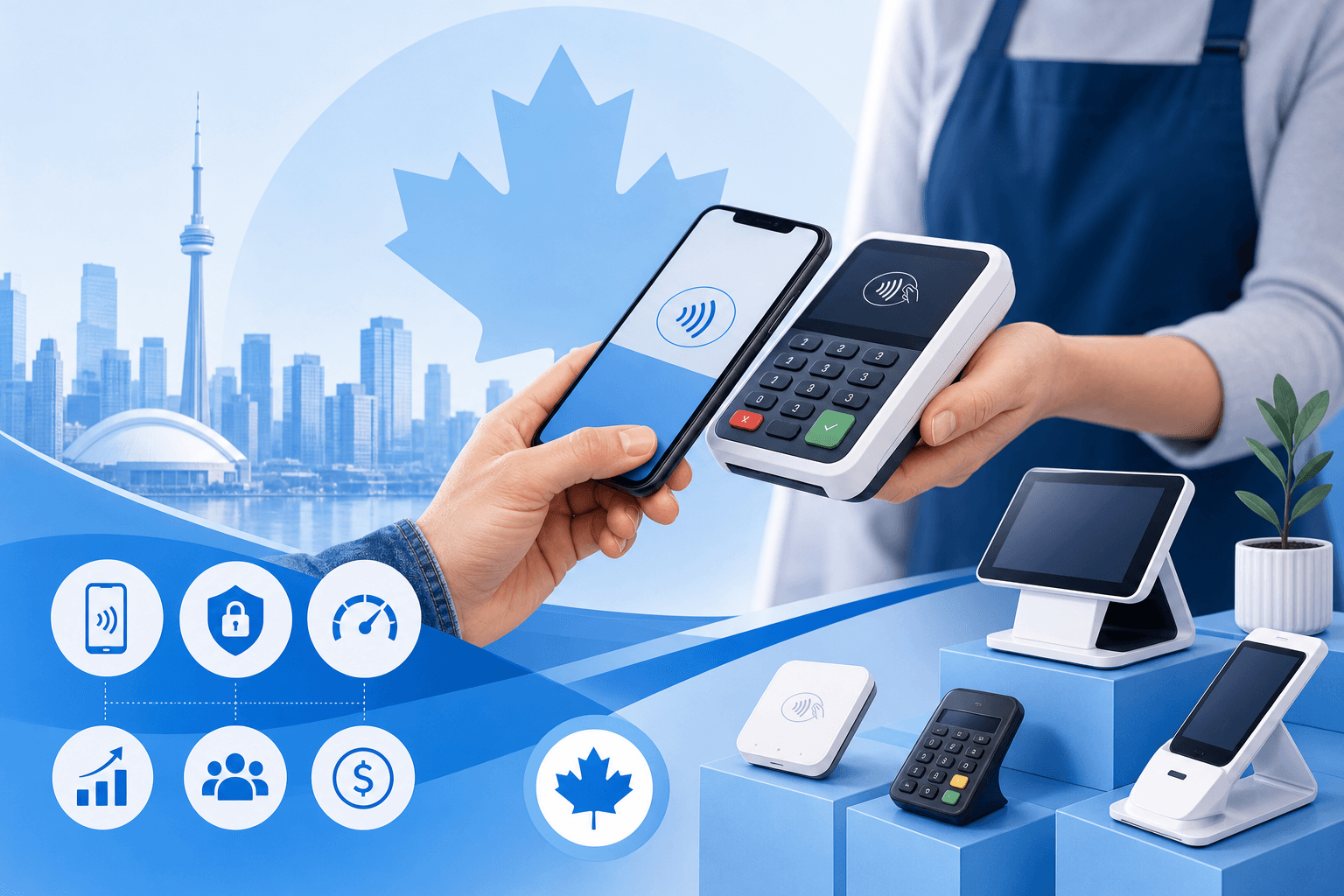
Mobile payment processing covers a broad range of tools, and it helps to know what you're actually shopping for:
- Mobile card readers that connect to a smartphone or tablet via Bluetooth or a plug-in connector, letting you accept chip, tap, and swipe payments anywhere you have a signal.
- Standalone mobile POS terminals that combine a card reader, receipt printing, and inventory or invoicing features into one handheld device.
- In-app or tap-to-pay on phone solutions, where a compatible smartphone itself becomes the terminal.
- Mobile wallets like Apple Pay and Google Pay, which customers use to tap their phone at your terminal instead of a physical card.
For Canadian small businesses, the right mix depends on how and where you take payments. A retail shop with a fixed counter has different needs than a landscaping company billing clients in the driveway. When you compare processors, make sure you're comparing like-for-like categories rather than assuming all "mobile payment" solutions are interchangeable.
Key Factors to Compare When Choosing a Processor
Pricing Structure
This is where most Canadian merchants lose money without realizing it. Many processors advertise a flat rate that sounds simple, but bundles the card network's actual cost with their markup, making it difficult to see what you're really paying for each transaction type. An interchange-plus pricing model, by contrast, separates the card network cost from the processor's markup so you can see both lines on your statement.
PaymentsPlus uses interchange-plus pricing on every account, with the markup shown separately from the network cost on every statement. If you want to see the real difference this makes for your business, you can get a free quote built directly from your current processing statement, showing the dollar difference rather than a generic estimate.
Funding Speed
Cash flow is often the deciding factor for small businesses, especially seasonal operations like landscaping, patios, or holiday retail pop-ups. Ask any processor you're considering:
- How soon after a transaction does the money actually land in your bank account?
- Is faster funding available, and if so, does it require qualification?
- Are there extra fees tied to faster payout options?
PaymentsPlus offers next-day funding as the standard, with same-day funding available for qualified merchants. That distinction matters: same-day funding isn't guaranteed to every business, so ask any provider you're evaluating exactly how their standard funding timeline works and what qualification looks like.
Contract Terms and Cancellation Fees
Long-term contracts and early termination fees are among the most common complaints Canadian merchants have about payment processors. Before signing anything, ask:
- Is there a minimum contract length?
- What happens if you switch providers or close your business?
- Are there fees for cancelling early?
PaymentsPlus doesn't use long-term contracts and doesn't charge cancellation fees. That gives you the flexibility to reassess your setup as your business grows, without being locked into a multi-year agreement signed back when your needs looked different.
Hardware Flexibility
Mobile businesses need hardware that matches how they actually work, not a one-size-fits-all terminal. Ask whether a provider offers hardware placement options for qualified merchants, and whether that hardware is suited to your specific setup, such as a compact reader for a farmers market booth versus a full mobile POS for a food truck with a menu and tip prompts.
PCI Compliance and Security
Any processor you work with should include PCI compliance as part of your account, not as an upsell. PaymentsPlus includes PCI compliance for every merchant account, which helps protect both your business and your customers' payment data without adding a separate line item to manage.
Support When You Need It
Mobile businesses don't operate strictly nine-to-five, and neither do payment problems. A terminal that stops connecting during a Saturday farmers market or a declined transaction at a busy lunch rush needs a fast answer, not a ticket queue. PaymentsPlus responds within 24 hours, so you're not left guessing when an issue comes up.
Comparing Popular Options in the Canadian Market
When researching the best mobile payment processors for Canadian small businesses in 2026, you'll likely come across a handful of recurring names. Here's how to think about each category, though you should always check a provider's current published pricing and terms directly before deciding.
Bank-Bundled Processing
Many Canadian small businesses start with whatever processor their bank offers alongside their business account. This can be convenient for consolidating statements, but bundled offerings aren't always the most competitive on rate structure or contract flexibility. If you currently process through a bank like TD, it's worth reviewing how that setup stacks up. See our TD comparison for a closer look, and do the same if you're with Desjardins, particularly for Quebec-based businesses navigating bilingual receipts and provincial requirements.
Flat-Rate Tech Platforms
Providers like Stripe are popular with e-commerce and app-based businesses because of their developer-friendly tools. For brick-and-mortar or mobile card-present transactions, though, flat-rate pricing can work differently than it does for online checkout. Check our Stripe comparison if that's part of your current stack.
POS-Centric Providers
Companies like Clover and Lightspeed bundle point-of-sale software with payment processing, which can be a good fit for businesses that want inventory management and reporting built into the same system. If you're currently using or considering one of these, review our Clover comparison or Lightspeed comparison to understand how the processing side of those platforms works alongside the software.
Enterprise-Grade Processors
Larger or high-volume operations sometimes look at providers like Chase Paymentech, built for scale rather than small business simplicity. Our Chase comparison breaks down when that kind of setup makes sense versus when it's overbuilt for a small or growing operation.
Whatever you're using today, a side-by-side look often reveals gaps you didn't know existed. Use our savings calculator to get a quick sense of how your current rates compare before committing to a change.
Matching Mobile Payments to Your Industry
Mobile payment needs look different depending on what kind of business you run:
- Restaurants and food trucks need fast, reliable tableside or window-side payment with tip prompts built in. See our restaurant solutions for setups designed around service speed.
- Retail pop-ups and markets need lightweight, portable readers that still support tap, chip, and contactless. Our retail solutions page covers options built for in-store and on-the-go selling.
- Healthcare and wellness providers taking payments at mobile clinics or home visits need secure, compliant processing. Check our healthcare solutions for details.
- Construction and trades businesses often invoice on-site after a job is complete. Our construction solutions page addresses mobile invoicing in the field.
- Automotive service businesses, including mobile detailing and roadside repair, need processing that works outside a traditional shop. See our automotive solutions.
- Hotels and hospitality operators often need both front-desk and mobile processing for events or room service. Our hospitality solutions outlines that mix.
- Salons and spas offering mobile or in-home appointments benefit from compact readers paired with booking systems. Visit salon & spa solutions for more.
- Nonprofits collecting donations at mobile fundraising events have their own considerations too. Our nonprofit solutions page covers that use case.
Don't Forget Your Online Presence
Even mobile-first businesses increasingly need an online payment option, whether that's a simple product page, an online booking deposit, or a full e-commerce storefront. PaymentsPlus offers an integration service where we set up your merchant account for online payments and connect it to platforms like Shopify, WooCommerce, or Odoo, working directly with you or your developer using the payment options your platform supports, and testing everything together before go-live. If you're running an Odoo-based operation, see our Odoo Clover integration page for how that connection works. For broader online selling needs, our e-commerce solutions page is a good starting point.
Regional Considerations Across Canada
Payment processing isn't entirely uniform across the country. Provincial sales tax rules, bilingual receipt requirements in Quebec, and regional business mixes all shape what "best" looks like depending on where you operate. If you're based in a major Canadian market, these resources dig into local considerations:
- Toronto payment processing
- Vancouver payment processing
- Calgary payment processing
- Montreal payment processing
- Ottawa payment processing
How to Actually Make the Switch
If you've decided your current mobile payment setup isn't serving your business well, the switching process doesn't need to be complicated:
- Pull your last one to three months of processing statements.
- Request a review that shows your actual dollar difference rather than a generic percentage estimate.
- Ask about contract terms, cancellation fees, and funding timelines in writing.
- Confirm hardware compatibility with how your business actually operates day to day.
- Set a go-live plan with testing before you rely on the new setup for real transactions.
PaymentsPlus builds free quotes directly from your existing statement, so you can see the dollar difference before making any decision. Our services page outlines what's included across mobile, in-store, and online processing.
Final Thoughts
Finding the best mobile payment processors for Canadian small businesses in 2026 comes down to looking past the sales pitch and into the details that affect your business every single day: how pricing is structured, how fast funds actually reach your account, whether you're locked into a long contract, and how quickly someone answers when you need help. Canadian business owners have more mobile payment options than ever, which makes doing the comparison work upfront worth the effort.
If you're ready to see where you stand, get a free quote built from your own statement, or contact our team to talk through what mobile setup makes the most sense for how your business operates.