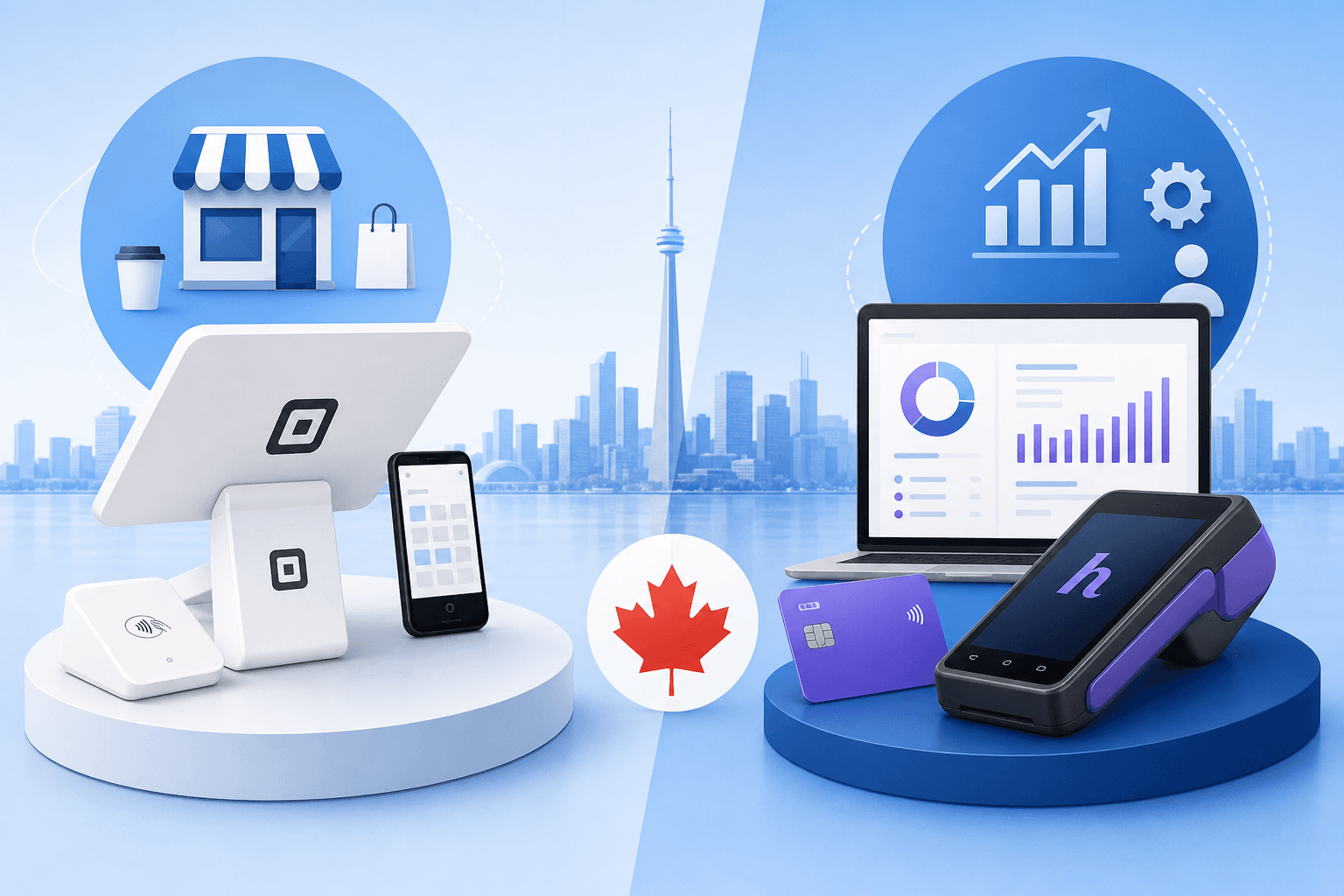
Square vs Helcim: Which Payment Processor Is Better for Canadian Small Business?
If you've spent any time researching payment processors for your Canadian business, you've likely come across Square and Helcim. Both are popular with small and medium-sized businesses, both offer online and in-person payment tools, and both market themselves as simple alternatives to traditional bank processing. But "popular" doesn't always mean "right for your business," especially when it comes to how much you pay to accept a debit or credit card.
Choosing a payment processor isn't just about picking a recognizable name. It's about understanding how pricing works, what happens when your sales volume grows, and whether the contract terms and support fit the way you actually run your business. For Canadian business owners, there's an added layer: CAD processing, Canadian interchange rates, and how each provider handles cross-border card transactions.
In this guide, we'll break down how Square and Helcim generally approach pricing and features, what Canadian business owners should ask before signing up with either, and how an interchange-plus pricing model compares to the alternatives. Our goal isn't to tell you Square or Helcim is universally "bad," it's to help you ask the right questions and understand what a statement review can reveal about your actual costs.
How Square and Helcim Approach Pricing
Pricing structure is the single biggest factor that determines what you'll actually pay to process payments, and it's also the area where providers differ most.
Square's Pricing Model
Square is widely known for flat-rate pricing: a fixed percentage per transaction, regardless of the card type or how it was processed. This is appealing because it's simple to understand, but flat-rate pricing means every transaction is priced the same whether it's a low-cost debit card or a premium rewards credit card with higher interchange costs. For the exact rates Square currently charges Canadian merchants, check their published pricing directly, as rates and structures can change.
Helcim's Pricing Model
Helcim has positioned itself as a more transparent alternative to flat-rate processors, often using interchange-based pricing with volume discounts. This is a step in a more transparent direction compared to flat-rate models. As with Square, you'll want to check Helcim's current published pricing and terms directly rather than relying on older reviews or comparison articles, since providers update their fee schedules over time.
Why Pricing Structure Matters More Than the Headline Rate
Here's what often gets lost in a Square vs Helcim comparison: the advertised rate isn't the whole story. What matters is:
- Whether the rate changes based on card type (debit vs credit, rewards vs standard)
- Whether there are monthly fees, PCI compliance fees, or batch fees
- How refunds and chargebacks are handled financially
- Whether online and in-person transactions are priced differently
This is exactly why interchange-plus pricing has become the standard recommendation for businesses that process a meaningful volume of card payments. With interchange-plus, you pay the actual interchange cost set by the card networks, plus a clearly disclosed markup, shown separately on every statement. There's no blending of rates and no guessing about what you're actually being charged for a given transaction. At PaymentsPlus, every statement is built this way, so the card network cost and our markup are visible as two separate line items.
If you want to see how your current provider's pricing compares, use our savings calculator or request a free quote built directly from your existing processing statement. It shows the dollar difference in plain numbers, not percentages or estimates.
Hardware and Point-of-Sale Options
Both Square and Helcim offer their own branded hardware and point-of-sale software, which is part of their appeal for businesses that want an all-in-one setup out of the box.
- Square offers a range of terminals and POS hardware designed to work specifically within its ecosystem.
- Helcim also provides terminal options and its own card reader and POS software.
Before committing to either, check each provider's current published hardware pricing and terms, since equipment costs, leasing terms, and compatibility can change and vary by business type.
If you're comparing processors more broadly, including how hardware is provided and priced, it's worth looking at hardware placement options for qualified merchants, which is how PaymentsPlus approaches equipment, as an alternative to being locked into proprietary hardware ecosystems. For businesses running full POS systems, you may also want to see our Clover comparison or Lightspeed comparison if you're weighing POS platforms alongside the processor itself.
Contract Terms, Fees, and Flexibility
One of the most overlooked parts of choosing a processor is what happens if you want to leave. Some providers lock merchants into long-term agreements with early termination fees, while others operate on a more flexible, month-to-month basis.
Before signing with Square, Helcim, or any processor, ask directly:
- Is there a long-term contract, and if so, how long?
- Is there a cancellation or early termination fee?
- Are there monthly minimums or inactivity fees?
- Is PCI compliance included, or billed separately?
- How is funding timed, and is there a cost for faster funding?
For comparison, PaymentsPlus operates with no long-term contracts and no cancellation fees, and PCI compliance is included rather than billed as an add-on. Funding is next-day as the standard, with same-day funding available for qualified merchants. These are the kinds of terms every Canadian business owner should be confirming in writing before moving forward with any provider, not just assuming based on marketing pages.
What Canadian Businesses Should Watch For
Currency and Cross-Border Processing
If you sell to customers outside Canada, or if your business has any US-dollar transactions, ask how each provider handles currency conversion and whether there are additional fees for processing in a currency other than CAD. This is especially relevant for e-commerce businesses selling across the border.
Support When Something Goes Wrong
Payment processing issues, whether it's a declined batch, a funding delay, or a question about a chargeback, tend to happen at inconvenient times. Ask each provider what their support hours look like and how quickly you can expect a response. At PaymentsPlus, our team responds within 24 hours, and we're a Canadian company working directly with Canadian merchants on Canadian processing questions.
Integration With Your Existing Platform
If you're running an online store or using a platform like Shopify, WooCommerce, or Odoo, how the payment processor connects to that platform matters as much as the processing rate itself. A mismatch here can cause checkout friction or reporting headaches down the road.
PaymentsPlus offers an integration service where our team sets up the merchant account for online payments and connects it to your platform, whether that's Shopify, WooCommerce, Odoo, or another supported system, working directly with you or your developer using the payment options your platform supports. We test the setup with you before go-live so there are no surprises when you start processing live transactions. If you're running Odoo specifically, see our Odoo Clover integration page for more detail.
Square vs Helcim: Which Fits Your Business Type?
There's no single answer to Square vs Helcim that applies to every Canadian business, because the right processor depends heavily on your business model, average transaction size, and sales channels.
- Retail businesses with high transaction volume often benefit most from interchange-plus pricing, since flat-rate models can cost more as volume grows. See our retail solutions page for more on what retailers should prioritize in a processor.
- Restaurants and hospitality businesses need to weigh tip handling, split payments, and integration with POS systems. Check our restaurant solutions and hospitality solutions pages for industry-specific considerations.
- E-commerce businesses should pay close attention to online transaction rates and how each provider handles recurring billing or subscriptions. Our e-commerce solutions page covers what online sellers should ask.
- Healthcare, salon and spa, and other appointment-based businesses often process a high volume of smaller transactions, where even small percentage differences add up. Visit healthcare solutions or salon & spa solutions for more.
- Construction and automotive businesses often deal with larger average ticket sizes, which changes the math on flat-rate vs interchange-plus pricing. Our construction solutions and automotive solutions pages go into more detail.
- Nonprofits have their own considerations around donation processing and fee transparency. See nonprofit solutions for specifics.
Rather than guessing which pricing model wins for your business, the most reliable approach is to compare processors side by side using your actual transaction data, not published averages that may not reflect your business.
Beyond Square and Helcim: What to Compare Next
Square and Helcim aren't the only options Canadian businesses weigh. Depending on how you currently process payments, you might also be comparing:
- A Stripe comparison if you're focused on online and developer-friendly payment flows
- A TD comparison if your bank has bundled processing into your business banking package
- A Desjardins comparison if you're a Quebec-based business
- A Chase comparison if you're evaluating enterprise-level processing
And if you're based in a specific city, local considerations like provincial sales tax handling and regional support can matter too. Businesses in Toronto, Vancouver, Calgary, Montreal, and Ottawa each have local processing resources worth reviewing.
Making the Right Choice for Your Business
The Square vs Helcim decision ultimately comes down to your transaction volume, average sale size, and how much you value pricing transparency versus simplicity. Flat-rate pricing is easy to understand but can cost more as your business scales. Interchange-based pricing requires a bit more attention but often reflects your true costs more accurately, especially when it's shown as interchange-plus with the markup disclosed separately.
Rather than guessing which model saves you more, the most reliable way to know is to look at your own numbers. A statement review doesn't rely on industry averages or marketing claims, it shows the actual dollar difference based on your real processing history.
If you're ready to see where your business stands, get a free quote built from your own statement, or contact our team if you have questions about switching, integrations, or how interchange-plus pricing would apply to your specific business.