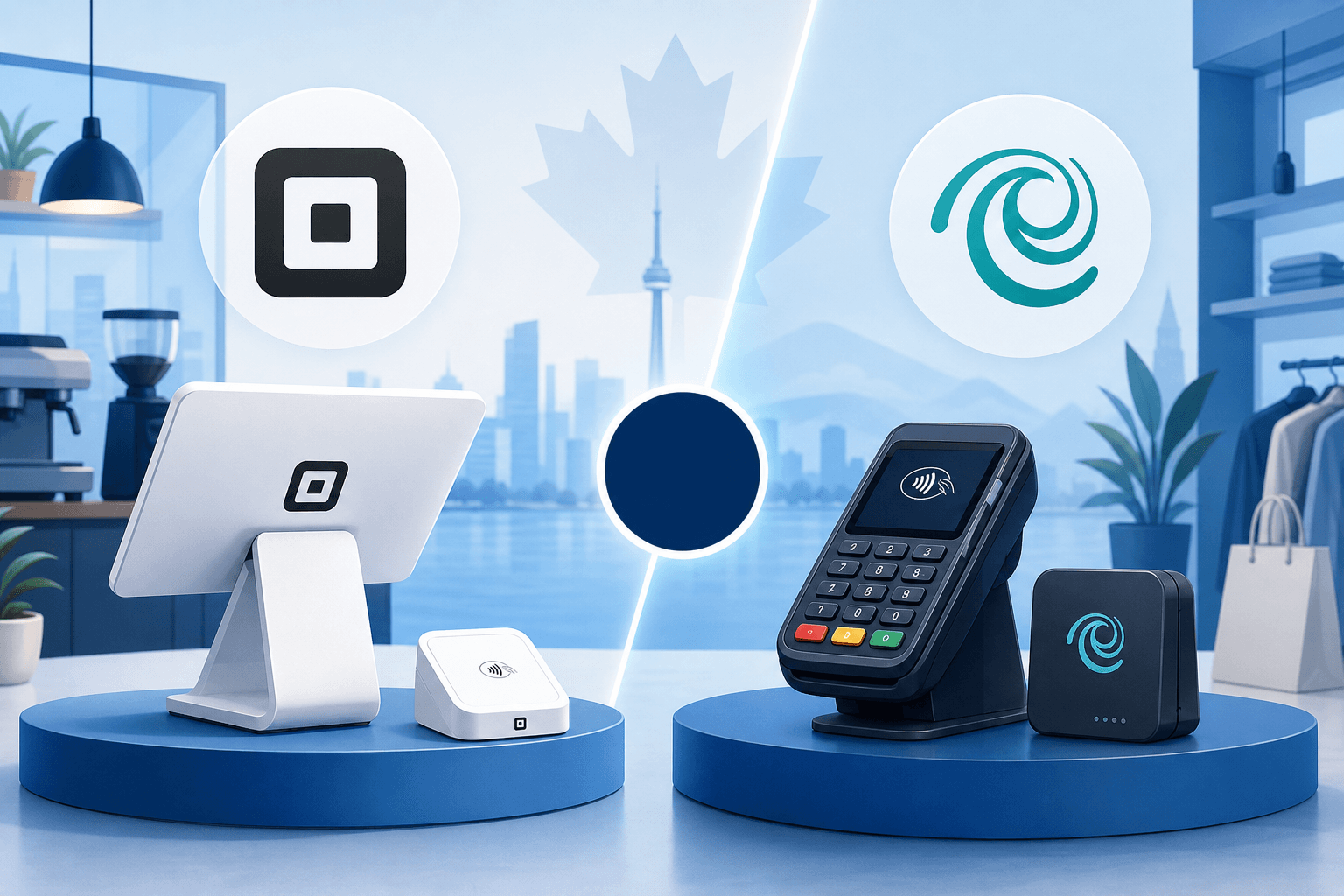
Square vs Moneris: Which Payment Processor Wins for Canadian Small Business
If you're running a small or medium-sized business in Canada, you've probably had the "which payment processor should I use" conversation more than once. Two names almost always come up: Square and Moneris. Square built its reputation on simple, flat-rate pricing and sleek hardware that any business owner can set up themselves. Moneris, backed by two of Canada's biggest banks, has long been the default choice for merchants who want a processor with deep Canadian roots.
But "which one is more popular" and "which one is right for your business" are two very different questions. The right answer depends on your transaction volume, your industry, how you take payments, and how much you value flexibility versus simplicity. In this guide, we'll break down Square vs Moneris across the factors that actually affect your bottom line, so you can make a decision based on your numbers, not just brand recognition.
We'll also show you where a third option, interchange-plus pricing through a provider like PaymentsPlus, might outperform both when it comes to transparency and long-term cost control.
Square vs Moneris: The Basics
Square
Square is known for its all-in-one approach. It combines point-of-sale software, hardware, and payment processing into a single package that's easy to set up without a dedicated IT team or merchant services rep. Square typically uses flat-rate pricing, meaning you pay the same percentage on every transaction regardless of card type. For current rates, contract terms, and funding timelines, check Square's published pricing directly on their website, since providers update these terms from time to time.
Moneris
Moneris is a Canadian-based processor jointly owned by RBC and BMO, and it's one of the most established names in the country. It offers a wide range of hardware and software options for retail, restaurant, and e-commerce businesses, along with integrations for many Canadian POS systems. As with Square, you'll want to confirm Moneris's current rates, contract terms, and funding timelines on their official site, as pricing structures and terms can change.
Where PaymentsPlus Fits In
Both Square and Moneris can be solid choices depending on your business, but neither is necessarily the most cost-transparent option available. That's where Compare processors like PaymentsPlus can help you see the fuller picture, particularly around how pricing is structured and what you're actually paying for.
Pricing Structure: Flat-Rate vs Interchange-Plus
This is where the real differences between processors tend to show up on your monthly statement.
Flat-Rate Pricing
Square's flat-rate model charges one percentage per transaction no matter what type of card is used. This is appealing because it's predictable and easy to explain to a new employee ringing through sales. The tradeoff is that flat rates are generally built to cover the processor's costs across all card types, including premium rewards cards that carry higher interchange costs. If your customers frequently pay with premium or corporate cards, you may be paying more than necessary under a flat-rate model.
Interchange-Plus Pricing
Moneris offers various pricing structures depending on the merchant agreement, so it's worth asking specifically what you'll be charged. PaymentsPlus, by contrast, uses interchange-plus pricing as standard: you pay the card network's interchange cost plus our markup, and both are shown separately on every statement. This structure tends to benefit businesses that want to see exactly what they're paying for, rather than a single blended rate that obscures the breakdown.
If you want to see the real dollar difference between what you're currently paying and what an interchange-plus structure would look like, you can Get a free quote built directly from your own processing statement. It shows the dollar difference, not a theoretical estimate.
Hardware and Point-of-Sale Options
Square's Hardware Approach
Square is well known for its simple, self-service hardware: small card readers and tablet-based POS terminals that business owners can order online and set up themselves. This appeals to very small businesses, mobile vendors, and pop-up shops that want something running quickly without an installation appointment.
Moneris Hardware
Moneris offers a broader lineup of countertop and wireless terminals designed for established retail and restaurant environments, often bundled with their processing agreements. Businesses already using a Moneris terminal through their bank relationship may find the integration familiar, but it's worth comparing hardware costs and lease terms carefully, as terminal leasing can add up over a long contract.
The PaymentsPlus Alternative
PaymentsPlus offers hardware placement options for qualified merchants, so businesses can get equipment suited to their setup, whether that's a countertop terminal for a retail counter or a mobile option for a food truck, without being locked into rigid long-term terms. This matters more than it might seem: a terminal that doesn't fit your workflow (for example, a stationary terminal for a business that needs to take payments tableside) can slow down service and frustrate staff.
If you're running a restaurant or cafe, it's worth looking at Restaurant solutions built around how your floor actually operates. Retailers comparing countertop versus mobile setups may find it useful to review Retail solutions as well.
Funding Speed and Cash Flow
For small businesses, how quickly funds land in your account can matter as much as the rate you're paying. Slow funding ties up cash you need for payroll, inventory, or rent.
Square and Moneris each have their own funding schedules and you should check their current published terms, since funding speed can vary by account type and business history. PaymentsPlus structures next-day funding as the standard for merchants, with same-day funding available for qualified merchants who need faster access to cash flow. If your business operates on tight margins or seasonal swings, such as a retail shop ahead of the holidays or a landscaping company in peak season, that funding cadence can make a real difference in how comfortably you manage short-term cash needs.
Contracts, Fees, and Flexibility
One of the most overlooked parts of choosing a payment processor is what happens if you want to leave.
- Contract length: Some processors require multi-year agreements, which can lock you into pricing or hardware that no longer fits your business. Always ask directly about contract terms before signing with Square, Moneris, or any other provider.
- Cancellation fees: Early termination fees can be a significant cost if your business needs change or you find a better rate elsewhere. PaymentsPlus does not charge cancellation fees and does not require long-term contracts, which gives merchants room to switch if their needs change.
- PCI compliance: Every processor needs to address PCI compliance, but how it's billed varies. PaymentsPlus includes PCI compliance as part of its service rather than treating it as a separate line-item surprise.
Before signing anything, ask your current or prospective processor for their contract length, cancellation policy, and PCI compliance fee structure in writing. If you're unsure how your existing agreement stacks up, Use our savings calculator to get a clearer sense of where you stand.
Industry Fit: Which Processor Works Best for Your Business Type
Not every processor is built the same way for every type of business. Here's how the fit tends to break down:
E-commerce and Online Sales
If you're selling online through Shopify, WooCommerce, or a custom storefront, your payment processor needs to connect cleanly to your platform. PaymentsPlus offers an integration service where our team sets up the merchant account and connects it to your platform, using the payment options that platform supports, and tests everything with you or your developer before go-live. This is particularly useful for businesses expanding into E-commerce solutions who don't want to manage the technical setup alone.
Healthcare, Salons, and Service Businesses
Appointment-based businesses like clinics and salons often need recurring billing or card-on-file capabilities. Review Healthcare solutions and Salon & spa solutions to see what setup fits your booking flow.
Construction and Automotive
Mobile trades and service businesses that invoice on the go need hardware that travels well and funding that keeps pace with job costs. Construction solutions and Automotive solutions are worth a look if your team is processing payments at job sites rather than a fixed counter.
Hospitality and Nonprofits
Hotels and hospitality operators juggling deposits, no-shows, and group bookings have different needs than a nonprofit processing one-time and recurring donations. See Hospitality solutions and Nonprofit solutions for processing considerations specific to those sectors.
Regional Considerations for Canadian Businesses
Payment processing isn't one-size-fits-all across Canada. Local market conditions, typical transaction sizes, and even customer card preferences can vary by region. Businesses in major hubs like Toronto, Vancouver, Calgary, Montreal, and Ottawa often deal with different volume patterns and competitive pressures than rural or small-town merchants.
If you're based in a major city, it's worth reviewing region-specific guidance:
- Toronto payment processing
- Vancouver payment processing
- Calgary payment processing
- Montreal payment processing
- Ottawa payment processing
Quebec businesses in particular should also check out our Desjardins comparison, since Desjardins has a strong regional presence that Square and Moneris compete with directly in that market.
Other Processors Worth Comparing
Square and Moneris aren't the only two options on the table. Depending on your setup, it's worth also comparing:
- Stripe comparison if you're leaning toward flat-rate, developer-friendly online processing
- Clover comparison if you want a POS-first hardware ecosystem
- Lightspeed comparison for retail and restaurant-specific POS needs
- TD comparison if your bank is already bundling processing with your business account
- Chase comparison if you're scaling toward enterprise-level volume
So, Which One Wins?
There's no universal answer to Square vs Moneris that applies to every Canadian small business. Square tends to suit businesses that want fast, self-service setup and predictable flat-rate pricing for lower transaction volumes. Moneris tends to suit businesses that want a Canadian bank-backed name with a wide range of hardware options. But both come with pricing models and contract terms worth scrutinizing closely, especially as your transaction volume grows.
Before you commit to either one, or before renewing with whatever processor you currently use, it's worth seeing the actual numbers side by side. A statement review doesn't cost you anything to find out, and it shows exactly where your money is going today.
Ready to See the Real Difference?
Choosing between Square, Moneris, or any other processor shouldn't be a guessing game. Get a free quote built from your own processing statement and see the dollar difference for your business, or Contact our team to talk through your specific setup. We respond within 24 hours, and there's no long-term contract or cancellation fee standing in the way if PaymentsPlus turns out to be the right fit.