Introduction
If you're running a business in Canada today, deciding how to accept payments is no longer as simple as picking whatever terminal your bank hands you. Between pop-up shops, food trucks, home service calls, and brick-and-mortar counters, Canadian business owners now have real options, and the choice between mobile card readers and traditional terminals can meaningfully affect how smoothly your business runs day to day.
This decision isn't just about hardware. It touches your cash flow, your customer experience, and even how much you pay in processing fees over time. A coffee shop in Toronto with a fixed counter has very different needs than a landscaping company in Calgary billing customers on-site, or a market vendor in Montreal who needs to accept Interac and credit cards wherever the day takes them.
In this guide, we'll break down the real differences between mobile card readers vs traditional terminals for Canadian businesses, so you can make a decision based on how you actually operate, not just on what's trendy or what a sales rep pushes on you.
What's the Real Difference?
Before comparing pros and cons, it helps to be clear on what each option actually is.
Mobile Card Readers
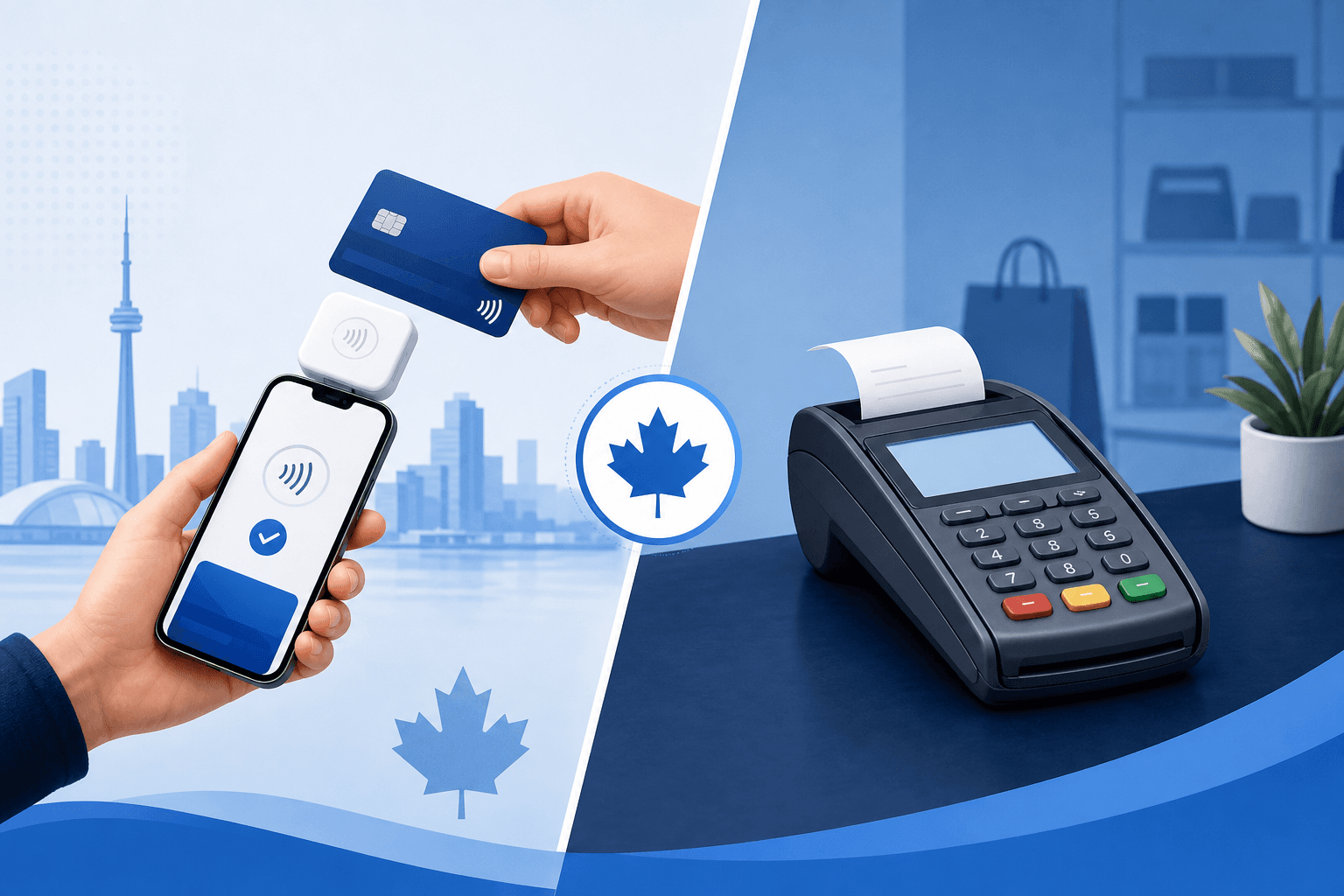
Mobile card readers are compact devices, often connecting via Bluetooth to a smartphone or tablet, that let you accept tap, chip, and sometimes swipe payments from virtually anywhere. They're popular with:
- Food trucks and market vendors
- Home service providers (plumbers, electricians, contractors)
- Salons and spas offering mobile appointments
- Pop-up retail and trade show vendors
- Delivery and field service businesses
Traditional Terminals
Traditional terminals are the countertop or wireless devices most Canadians are used to seeing at retail checkouts and restaurant tables. They typically offer:
- A dedicated, purpose-built device not reliant on a personal phone
- Wired or standalone wireless connections
- Receipt printing built in
- A stable setup for fixed locations with consistent transaction volume
Both options can support Interac debit, which remains essential for Canadian consumers, along with major credit cards.
Mobile Card Readers vs Traditional Terminals: Key Comparison Points
When Canadian business owners ask about mobile card readers vs traditional terminals, the decision usually comes down to five factors: mobility, cost, reliability, customer experience, and scalability.
Mobility and Flexibility
This is the most obvious difference. Mobile readers go wherever you go, which matters if your business involves:
- Multiple job sites
- Seasonal or outdoor events
- Deliveries or house calls
- Markets, festivals, or pop-ups
Traditional terminals, by contrast, are built for a fixed point of sale. If your business operates from one location with a consistent checkout flow, like a retail store or a clinic, a traditional terminal is usually the more practical and durable choice.
Cost Considerations
Both mobile readers and traditional terminals come with hardware and processing costs, but the fee structure behind the scenes often matters more than the device itself. Many processors advertise low-cost or "free" hardware while building in higher processing markups that cost businesses more over time.
This is where it pays to look closely at your statement rather than just the sticker price of the device. With interchange-plus pricing, you see the card network cost plus the markup separately on every statement, which makes it much easier to compare mobile and terminal setups on a level playing field. If you're unsure what you're currently paying, you can use our savings calculator to see how your current setup compares, or request a free quote built directly from your existing processing statement showing the dollar difference.
Reliability and Connectivity
Traditional terminals, especially wired ones, tend to offer more consistent uptime since they aren't dependent on a paired smartphone or a personal data plan. Mobile readers rely on Bluetooth connections and cellular or Wi-Fi data, which can be a drawback in areas with spotty coverage, such as rural parts of Canada or large outdoor venues.
That said, mobile readers have improved significantly and are generally reliable for businesses that don't process extremely high transaction volumes in one sitting.
Customer Experience
Canadian consumers are accustomed to fast, contactless payments. Both mobile readers and modern terminals support tap-to-pay, but traditional terminals at a fixed checkout can sometimes feel faster for high-volume environments like restaurants or busy retail counters, since staff aren't juggling a phone and a card reader simultaneously.
For service-based businesses, though, a mobile reader often improves the customer experience because it lets staff complete the transaction right at the customer's doorstep, table, or job site instead of asking them to come inside or wait.
Scalability
If you expect to grow, think about how each option scales:
- Mobile readers scale well for businesses adding more staff or locations gradually, such as a mobile pet grooming service adding a second van.
- Traditional terminals scale well for businesses opening additional fixed locations, like a second retail storefront or restaurant.
Which Option Fits Your Industry?
Different industries naturally lean toward one option or a hybrid of both.
Restaurants and hospitality: Pay-at-table mobile readers are increasingly popular for full-service dining, while counter-service terminals remain standard for quick-service spots. See our restaurant solutions for more on this.
Retail: Fixed terminals usually make sense for checkout counters, though mobile readers are useful for line-busting during busy periods or seasonal pop-ups. Check out our retail solutions page for details.
Healthcare and clinics: Reception-based traditional terminals are common, though mobile options help with in-home care or mobile health services. Learn more via our healthcare solutions.
Construction and field services: Mobile readers are often the better fit since work happens on job sites rather than at a fixed counter. Visit our construction solutions page.
Automotive services: Many shops use a mix, a terminal at the front desk and a mobile reader for mobile mechanics or valet services. See our automotive solutions.
Salons and spas: Mobile readers support mobile stylists and traveling estheticians, while terminals remain practical for in-studio checkout. Explore our salon & spa solutions.
Hotels and hospitality groups: Front-desk terminals paired with mobile readers for room service or events can cover both ends. Our hospitality solutions page has more detail.
Nonprofits: Mobile readers are especially useful for fundraising events and donation drives held outside a fixed office. See our nonprofit solutions page.
If your business also sells online, keep in mind that neither mobile readers nor traditional terminals address e-commerce on their own. For that, you'll want a proper online payment setup. Our e-commerce solutions page covers what to consider, and our integration service can set up your merchant account and connect it to platforms like Shopify, WooCommerce, or Odoo, testing everything with you before go-live.
Costs Beyond the Hardware: What Canadian Businesses Should Watch For
Regardless of which hardware you choose, there are a few things every Canadian business owner should check carefully before signing with a processor:
- Contract length: Look for providers offering no long-term contracts, so you're not locked in if your needs change.
- Cancellation fees: Confirm there are no cancellation fees buried in the fine print.
- Funding speed: Ask how quickly funds land in your account. Next-day funding is the standard to expect, with same-day funding available for qualified merchants.
- PCI compliance: Make sure PCI compliance is included rather than billed as a confusing add-on.
- Support responsiveness: If something goes wrong with your terminal or reader, you want a provider that responds quickly. We aim to respond within 24 hours.
If you're currently with a bank-bundled processor or a flat-rate provider, it's worth doing a side-by-side look. Our compare processors page, along with specific breakdowns like our Stripe comparison, TD comparison, Clover comparison, Lightspeed comparison, Desjardins comparison, and Chase comparison, can help you understand how different providers structure their pricing and contracts. For any of these, check that provider's current published pricing directly, since rates and terms change.
Making the Decision: A Practical Framework
To decide between mobile card readers vs traditional terminals, walk through these questions:
- Where do most of your transactions happen? One fixed location favors a terminal; multiple or changing locations favor a mobile reader.
- How many transactions do you process per hour at peak times? High-volume, fast-paced checkout environments often run more smoothly with a dedicated terminal.
- Do you need receipt printing on-site? Traditional terminals often include this built in, while mobile setups may rely on digital receipts.
- What does your current statement actually show you're paying? This matters more than which device looks newer. A clear breakdown helps you compare true costs.
- Could you benefit from both? Many Canadian businesses, especially those with a storefront and a delivery or event component, use a hybrid approach.
Hardware placement options for qualified merchants can help you test what works best without overcommitting to a single setup right away.
Conclusion
There's no single right answer when it comes to mobile card readers vs traditional terminals for Canadian businesses. The best choice depends on where and how you serve customers, how many transactions you process, and what your current processing statement is actually costing you. A food truck owner in Vancouver and a retail shop owner in Ottawa are going to reach very different conclusions, and that's expected.
What matters most is working with a provider that's transparent about pricing, flexible about hardware, and responsive when you need support. If you're ready to see where you stand, get a free quote built from your own processing statement, or contact our team to talk through which setup, mobile, traditional, or a hybrid of both, makes the most sense for your business.