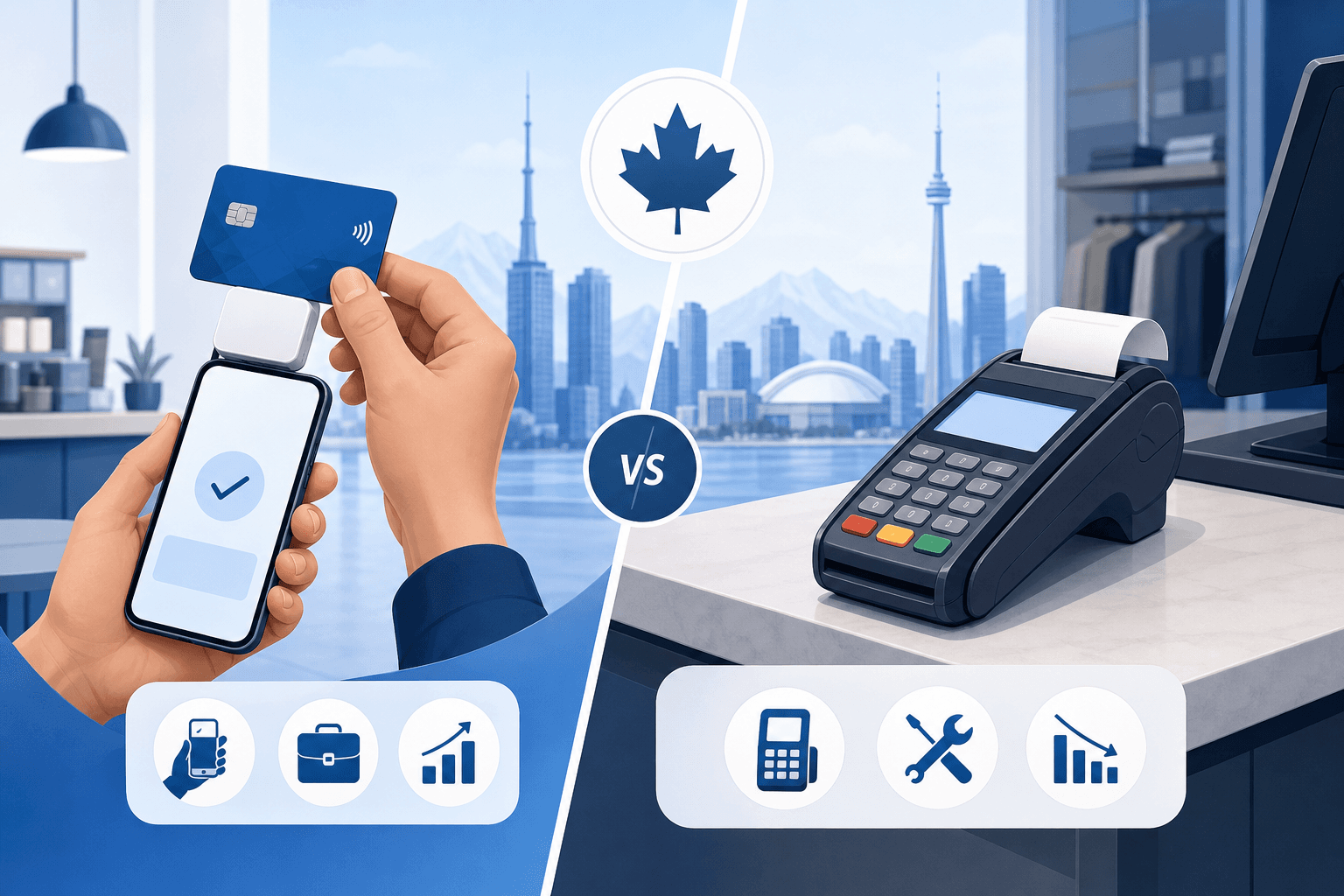
If you're running a small business in Canada, choosing how you accept card payments is one of those decisions that seems simple until you actually sit down to do it. Walk into any electronics store or search online and you'll find dozens of options, from pocket-sized mobile card readers that plug into your phone to sturdy countertop terminals that have been the backbone of retail for decades. Both get the job done, but they serve different kinds of businesses in very different ways.
This comparison of mobile card readers vs traditional terminals is meant to help Canadian small business owners cut through the noise. Whether you're a food truck operator in Calgary, a boutique owner in Toronto, or a contractor who needs to invoice clients on-site in Ottawa, the right hardware choice can affect everything from your monthly costs to how quickly customers move through checkout.
We'll break down how each option works, what they cost, and which scenarios favor one over the other. By the end, you should have a clear sense of which direction makes sense for your business, and how to get a straightforward answer on pricing before you commit to anything.
What Are Mobile Card Readers?
Mobile card readers are small, often Bluetooth-connected devices that pair with a smartphone or tablet to process payments. Some are the size of a deck of cards, others clip directly onto a phone case. They're popular with businesses that move around or need to keep overhead low.
Where Mobile Readers Shine
- Businesses on the move: food trucks, market vendors, mobile pet groomers, and tradespeople who invoice on-site
- Seasonal or pop-up operations: craft fairs, holiday markets, farmers markets across Canada
- Low transaction volume businesses: side hustles or businesses just getting started that don't want to commit to a full POS system
- Service providers: contractors and landscapers who want to accept payment the moment a job is finished
The appeal is obvious: low upfront cost, no need for a dedicated power source or internet line, and the flexibility to take payments anywhere your phone gets signal or Wi-Fi.
Where Mobile Readers Fall Short
Mobile readers aren't without tradeoffs. They typically rely on your phone's battery and data connection, which can be a problem in areas with spotty cell coverage, think rural Alberta or cottage country in Ontario. They also tend to be slower for high-volume checkout lines, and some models have more limited reporting or inventory features compared to full POS setups.
What Are Traditional Terminals?
Traditional terminals are the countertop or wireless units most Canadians are used to seeing at checkout: the kind with a screen, a card slot, tap functionality, and sometimes a receipt printer built in. They're typically connected to a dedicated internet or phone line, or operate on a secure wireless network provided by your processor.
Where Traditional Terminals Shine
- Storefronts with consistent foot traffic: retail shops, salons, restaurants
- Businesses needing reliable uptime: a dropped Wi-Fi signal shouldn't mean you can't take payment
- Higher transaction volumes: terminals are generally built for speed and durability over thousands of taps per month
- Integration with a full POS system: inventory tracking, employee management, and sales reporting in one place
For many retail solutions and restaurant solutions, a traditional terminal or integrated POS setup is still the more practical backbone of day-to-day operations, especially when paired with a system that can handle tipping, order modifiers, or multi-location reporting.
Where Traditional Terminals Fall Short
The obvious tradeoff is flexibility. Terminals are generally built to stay put, and while wireless models exist, they're not designed for businesses that need to move location to location throughout the day. They can also come with a higher upfront hardware cost, and depending on your processor, might be tied to longer contract terms.
Mobile Card Readers vs Traditional Terminals: Cost Considerations
When comparing mobile card readers vs traditional terminals for Canadian small businesses, cost is usually the first question owners ask, and it's more nuanced than just the price tag on the device.
With either option, you'll want to understand how your processor actually charges for transactions. Many providers use flat-rate or tiered pricing that bundles the card network's cost with their own fee, making it hard to see what you're really paying. PaymentsPlus uses interchange-plus pricing instead, meaning the card network cost and our markup are shown separately on every statement. That transparency matters whether you're running a $40 mobile reader or a $600 countertop terminal, because the hardware is only part of the picture. The ongoing processing fees are usually the bigger cost over time.
Other cost factors to weigh:
- Upfront hardware cost: mobile readers are generally cheaper to acquire than full terminal setups
- Monthly fees: some providers charge monthly terminal rental or software fees on top of processing
- Funding speed: how quickly money from sales lands in your business bank account affects cash flow
- Contract terms: whether you're locked in long-term or can adjust as your business changes
If you're not sure how your current setup stacks up, use our savings calculator to get a sense of where your money is going, or request a free quote built directly from your existing processing statement, which shows the dollar difference rather than a generic estimate.
Funding, Reliability, and PCI Compliance
Regardless of which hardware you choose, a few operational factors matter just as much as the device itself.
Funding Speed
How fast you get access to your sales revenue can make or break cash flow for a small business. PaymentsPlus offers next-day funding as the standard, with same-day funding available for qualified merchants. That's worth asking about no matter which type of reader or terminal you're considering, since not all processors fund on the same schedule.
PCI Compliance
Every Canadian business accepting card payments needs to meet Payment Card Industry (PCI) data security standards. This applies whether you're using a $50 mobile reader or an enterprise-grade terminal. PCI compliance is included with PaymentsPlus accounts, which takes one more thing off your plate when you're busy running the business itself.
Reliability and Support
Mobile readers depend on your phone's connectivity, while terminals typically run on a more dedicated connection. Either way, it's worth asking a potential processor how quickly they respond when something goes wrong at the register. Our team responds within 24 hours, which matters when a payment issue is actively affecting your ability to take sales.
Making the Right Choice for Your Business Type
There's no universal answer here. The right choice in the mobile card readers vs traditional terminals debate really depends on how your business operates day to day.
Businesses Better Suited to Mobile Readers
- Food trucks and mobile caterers
- Market and festival vendors across Canada
- Home service providers (cleaners, landscapers, mobile mechanics)
- Pop-up retail or seasonal businesses
- Freelancers and consultants who invoice in person occasionally
Businesses Better Suited to Traditional Terminals
- Full-service and quick-service restaurants with consistent dine-in traffic
- Retail stores with regular checkout lines
- Salon & spa solutions where appointment-based payment and tipping matter
- Healthcare solutions like clinics processing patient payments
- Automotive solutions such as repair shops and dealerships
- Construction solutions businesses that also maintain a storefront or office
Businesses That Might Need Both
Some Canadian businesses actually benefit from a hybrid approach. A retail shop that also sells at weekend markets might keep a traditional terminal in-store and a mobile reader for off-site events. A contractor with a small retail showroom might do the same. If this sounds like your situation, it's worth discussing hardware placement options for qualified merchants with a processor that can support both setups under one account, rather than juggling two separate providers.
Don't Forget Online Payments
Even if your business is primarily in-person, more Canadian consumers expect the option to pay online, whether that's through an e-commerce store, invoicing, or a simple payment link. If you're expanding into online sales, our integration service sets up your merchant account and connects it to the platform you use, such as Shopify, WooCommerce, or Odoo, working with you or your developer using the payment options that platform supports, and testing everything before go-live. This is particularly relevant for e-commerce solutions and businesses running on platforms like Odoo, where our Odoo Clover integration can connect your ERP to in-person and online payment processing.
How to Compare Processors Before You Decide
Hardware is only one piece of the puzzle. The processor behind your mobile reader or terminal determines your rates, your contract terms, and how much support you get when something goes wrong. Before signing with any provider:
- Ask for interchange-plus pricing so you can see the actual markup, not a bundled rate
- Check for long-term contracts and cancellation fees, PaymentsPlus has no long-term contracts and no cancellation fees
- Confirm funding timelines in writing
- Verify PCI compliance is included, not an added cost
- Ask how quickly they respond to support requests
If you're currently with a bank-bundled provider or a flat-rate processor, it's worth taking a closer look at how the numbers compare. You can compare processors directly, including specific breakdowns like our Clover comparison, Stripe comparison, TD comparison, Desjardins comparison, and Lightspeed comparison.
And if you're located in a major Canadian market, local considerations like provincial tax rules or regional connectivity can factor in too. We work with businesses across the country, including those searching for Toronto payment processing, Vancouver payment processing, Calgary payment processing, Montreal payment processing, and Ottawa payment processing.
Final Thoughts
The mobile card readers vs traditional terminals decision ultimately comes down to how your business operates, not which device looks the most modern. Mobile readers offer flexibility and a lower barrier to entry for businesses on the move, while traditional terminals offer reliability and speed for storefronts with steady foot traffic. Many Canadian businesses find that the smarter question isn't "which device" but "which processor" is backing that device with fair pricing, dependable funding, and responsive support.
If you're ready to see where your current processing stands, get a free quote built from your own statement, or contact our team to talk through which hardware setup fits your business best. Our services page also breaks down the full range of solutions we offer for Canadian small and medium businesses.