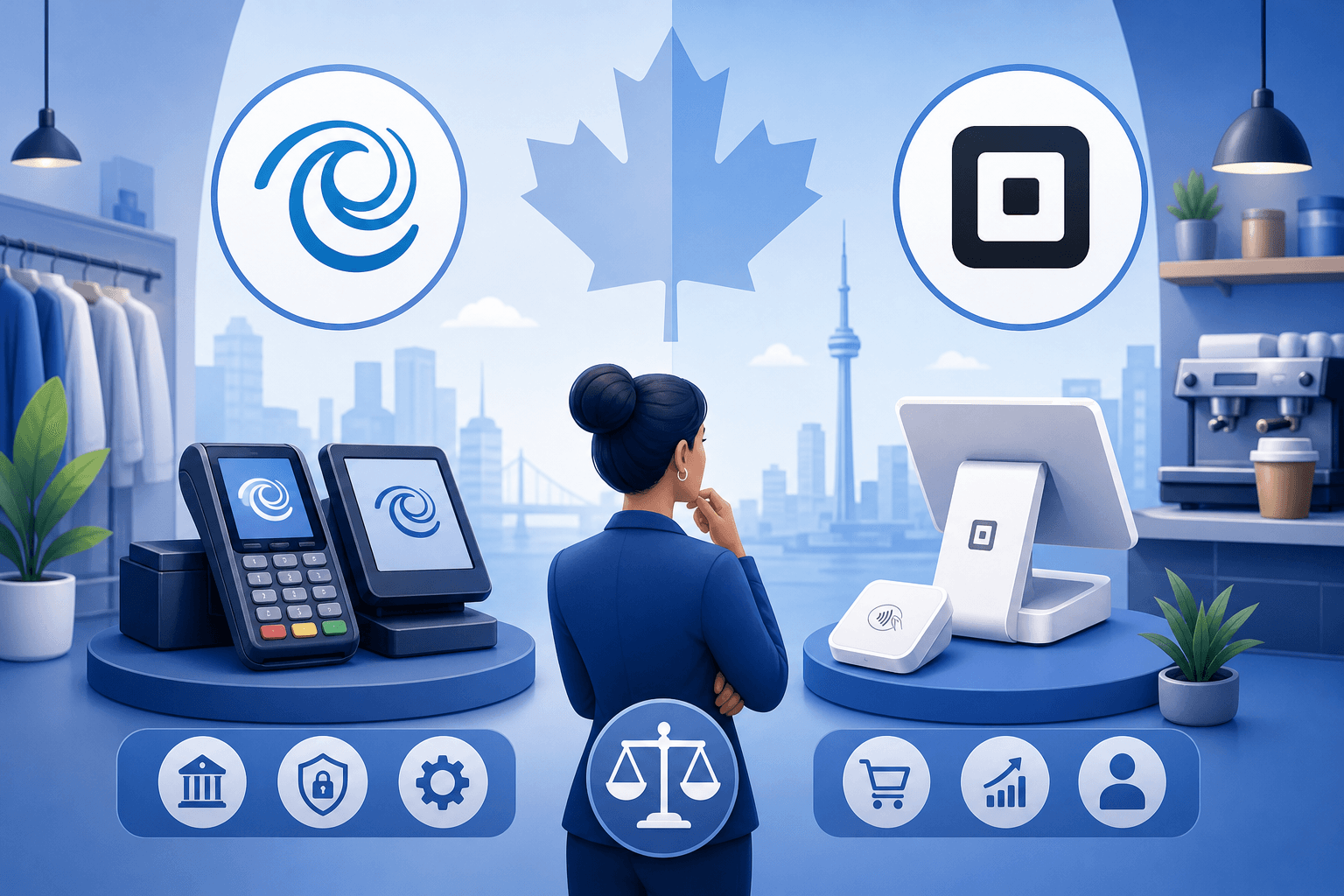
Moneris vs Square: Which Payment Processor Wins for Canadian Small Businesses
If you've been shopping around for a way to accept credit and debit cards in Canada, you've almost certainly come across two big names: Moneris and Square. One is a homegrown Canadian institution backed by two of the country's biggest banks. The other is a Silicon Valley disruptor that made its name with a tiny white card reader and dead-simple pricing. Both are popular, both have loyal fans, and both have very different approaches to serving small businesses.
Choosing between them isn't just about brand recognition - it's about fees, hardware costs, contract terms, and how well each platform fits your specific business model. A busy Toronto café has very different needs than a Calgary contractor invoicing clients remotely or a Vancouver boutique running an online store alongside its physical location.
In this guide, we'll break down the Moneris vs Square debate in plain language, compare real costs in CAD, and help you figure out which processor actually makes sense for your business - or whether a third option might serve you even better.
Moneris vs Square: The Basics
What is Moneris?
Moneris is Canada's largest payment processor, jointly owned by RBC and BMO. It's been around since 2000 and processes billions of transactions annually for Canadian merchants of every size, from independent retailers to national chains. Moneris offers a wide range of terminals, integrated POS systems, and e-commerce gateways, with dedicated Canadian customer support and deep familiarity with Interac debit, provincial tax rules, and Canadian banking infrastructure.
What is Square?
Square entered Canada in 2012 and built its reputation on radical simplicity: flat-rate pricing, no long-term contracts, and inexpensive hardware you can set up in minutes. It's especially popular with mobile businesses, food trucks, pop-up shops, and freelancers who want to start accepting payments without a complicated setup process or a merchant account application.
Both companies serve Canadian businesses well in different scenarios - but the right choice depends heavily on your transaction volume, average sale size, and how much you value personalized support versus self-serve simplicity.
Pricing Comparison: Fees That Actually Matter
Pricing is usually the deciding factor for small business owners, and it's also where Moneris and Square differ the most.
Square's Flat-Rate Pricing
Square uses a simple, published flat-rate model:
- Around 2.65% per tapped, dipped, or swiped transaction
- Slightly higher rates for manually keyed-in transactions
- No monthly fees on its basic plans
- No long-term contract or early termination fee
This transparency is Square's biggest selling point. You always know exactly what you're paying, and there's no need to decode a statement full of interchange categories and surcharges.
Moneris's Interchange-Plus and Tiered Options
Moneris offers more varied pricing structures, including:
- Interchange-plus pricing, where you pay the actual card network interchange rate plus a fixed markup
- Flat-rate plans similar to Square for very small merchants
- Tiered pricing bundled with hardware/software packages
For low-volume businesses, Square's flat rate is often cheaper and easier to understand. But for businesses processing more than roughly $10,000-$15,000 per month, Moneris's interchange-plus pricing can work out significantly less expensive, because you're not paying a flat markup on every single transaction - you're paying closer to the true wholesale rate.
This is exactly the kind of math that's hard to do in your head but easy to run through a calculator. Use our savings calculator to see what you'd actually pay in CAD with each provider based on your real transaction volume.
Hardware and POS Systems
Square Hardware
Square's hardware lineup is famously approachable:
- Square Reader (magstripe/chip) - inexpensive and portable
- Square Terminal - an all-in-one standalone device
- Square Register - a full point-of-sale system with a built-in screen
You can order hardware online, have it delivered in days, and be processing payments the same afternoon. This makes Square popular with mobile vendors, farmers' market sellers, and new businesses that don't want to commit to expensive equipment.
Moneris Hardware
Moneris offers a broader range of terminals designed for different business types, from countertop units to wireless and mobile readers, plus fully integrated POS solutions for restaurants and retail. Moneris terminals are widely compatible with major Canadian POS software, and the company has invested heavily in integrated solutions for businesses that need more than a simple card reader - think inventory management, multi-location reporting, and detailed sales analytics.
If you're also evaluating dedicated POS hardware providers, it's worth taking a look at how Clover comparison and Lightspeed comparison options stack up against both Moneris and Square, since many Canadian businesses end up mixing a POS system with their payment processor rather than using an all-in-one bundle.
Which Industries Favour Which Processor?
Where Square Shines
Square tends to be the better fit for:
- New businesses testing an idea before committing to equipment
- Mobile and seasonal businesses (food trucks, markets, pop-ups)
- Very low-volume retailers or service providers
- Businesses that want e-commerce and in-person payments under one simple dashboard
Where Moneris Shines
Moneris tends to be the better fit for:
- Established restaurants and retailers with consistent, higher transaction volumes
- Multi-location businesses needing centralized reporting
- Businesses that want dedicated Canadian account support and in-person service
- Companies needing integrations with existing Canadian banking relationships
Industry matters too. A restaurant handling tips, split bills, and table-side payments has different needs than an e-commerce shop shipping across Canada. Our Restaurant solutions, Retail solutions, and E-commerce solutions pages break down what to look for in a processor based on how your business actually operates day to day.
Contract Terms and Customer Support
This is where the two companies diverge sharply.
Square operates on a self-serve, no-contract model. Support is primarily through online chat, email, and phone queues, which works fine for straightforward issues but can be frustrating if you're dealing with a complex dispute, a chargeback, or an urgent equipment failure during a busy service.
Moneris typically involves account representatives, phone-based Canadian support, and (depending on your plan) contract terms that may include equipment leases or minimum terms. Some merchants find this old-fashioned; others find it reassuring to have a dedicated point of contact who understands their specific business and can resolve issues quickly, especially for larger operations where even a short processing outage is costly.
Neither approach is objectively "better" - it depends on how hands-on you want your provider relationship to be, and how much you value having a real person to call versus a chat window.
The Case for Looking Beyond Moneris and Square
Here's something most comparison articles won't tell you: Moneris and Square aren't the only two options, and for many Canadian small businesses, neither is actually the cheapest or best-fitting choice.
Independent processors and payment facilitators often beat both companies' published rates - especially for established businesses with consistent monthly volume - because they can offer true interchange-plus pricing without the overhead of a massive consumer brand, and because pricing can be negotiated rather than fixed. Businesses in Toronto, Vancouver, Calgary, Montreal, and Ottawa in particular have a wide range of processors competing for their business, which creates real opportunities for savings if you know where to look.
- Toronto payment processing
- Vancouver payment processing
- Calgary payment processing
- Montreal payment processing
- Ottawa payment processing
It's also worth comparing against other common alternatives before committing to either Moneris or Square. If flat-rate simplicity is what appeals to you about Square, it's worth also reading our Stripe comparison, since Stripe offers similar simplicity with stronger developer tools for online businesses. If you're currently with a bank-bundled processor, our TD comparison and Desjardins comparison pages explain how those options compare on fees and flexibility. Larger operations evaluating enterprise-grade processing should also check our Chase comparison.
For a side-by-side look at all the major players at once, Compare processors to see how Moneris, Square, and several alternatives stack up on fees, contracts, and hardware.
How to Actually Decide: A Practical Checklist
Before signing up with either provider, run through this checklist:
- Calculate your real monthly card volume. Flat-rate pricing is usually better under roughly $10,000/month; interchange-plus often wins above that.
- List your must-have features. Tipping, split payments, inventory tracking, invoicing, recurring billing - not every plan includes everything.
- Check contract terms carefully. Understand cancellation fees, equipment leases, and minimum terms before signing anything.
- Factor in support needs. If downtime would hurt your business badly, prioritize a processor with real phone support in your time zone.
- Get numbers in writing. Ask for an actual rate sheet in CAD, not just a marketing percentage.
This last point matters more than people realize. Published rates are a starting point, not the final word - many businesses are able to negotiate better terms once a provider sees their actual processing history. Get a free quote to see what a tailored rate would look like for your business, rather than relying on generic advertised numbers.
Final Verdict: Moneris vs Square
So, who wins the Moneris vs Square debate? Honestly, it depends on your business:
- Choose Square if you're a new, mobile, or low-volume business that values simplicity, fast setup, and transparent flat-rate pricing.
- Choose Moneris if you're an established Canadian business with steady volume, need dedicated support, or want deep integration with Canadian banking and POS systems.
- Consider alternatives if you want the best of both worlds - competitive interchange-plus pricing with the kind of personalized Canadian support that neither giant always delivers consistently.
The only way to know for sure which option saves you the most money is to look at your actual numbers side by side. Contact our team for a no-obligation review of your current processing statement, and we'll show you exactly how Moneris, Square, and other Canadian options compare for your specific business - in real dollars, not just marketing percentages.