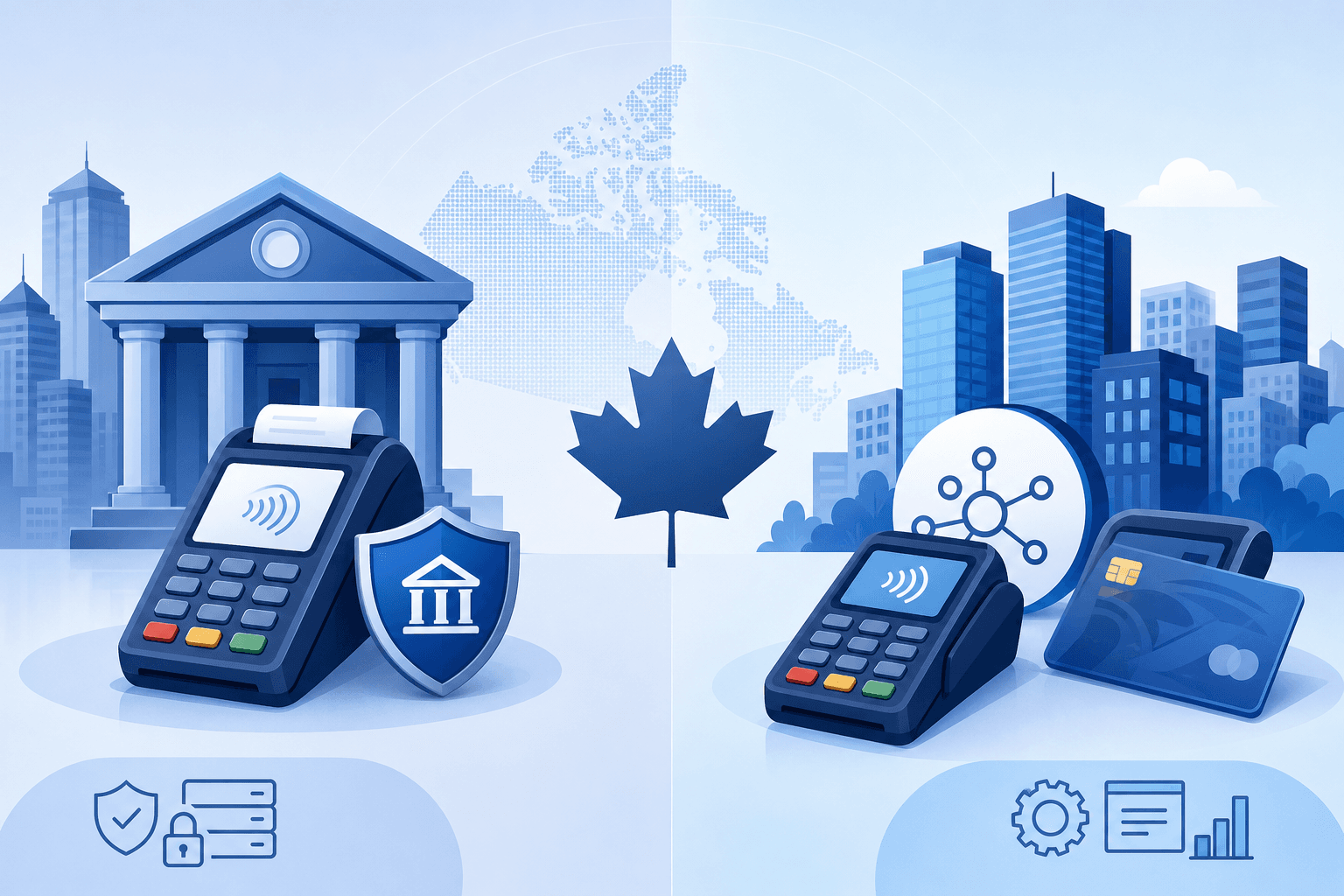
If you've started shopping around for a merchant account in Canada, you've probably noticed two very different types of companies pitching you: the big banks you already know (RBC, TD, Scotiabank, BMO, Desjardins) and a growing list of independent processors you may never have heard of. Both promise lower fees, faster deposits, and better service. So how do you actually decide?
This is one of the most common questions we hear from Canadian small and medium business owners, and for good reason. Your payment processor isn't just a line item on your statement - it affects your cash flow, your customer experience, and how much of every sale you actually keep. Choosing poorly can cost you thousands of dollars a year in unnecessary fees.
In this guide, we'll break down the real differences in the bank-owned vs independent payment processors in Canada debate, covering pricing, contracts, customer service, technology, and more, so you can make an informed decision for your business.
What Are Bank-Owned Payment Processors?
Bank-owned payment processors are merchant services offered directly by Canada's major financial institutions. If you have a business bank account with TD, RBC, Scotiabank, or Desjardins, there's a good chance they've already offered to "bundle" your payment processing with your banking relationship.
These solutions are typically run through the bank itself or a closely affiliated processing arm, and they're marketed heavily to existing business banking customers as a convenient, one-stop option.
Pros of Bank-Owned Processors
- Familiarity and trust - you already bank with them, so onboarding can feel simpler
- Single relationship - banking and payments appear on one dashboard or statement
- Perceived stability - backed by a large, regulated Canadian institution
Cons of Bank-Owned Processors
- Pricing is often tiered and opaque, making true costs hard to calculate
- Less flexibility to negotiate rates, especially for smaller merchants
- Customer support is frequently routed through general call centres rather than payments specialists
- Contracts can include long terms and early termination fees
- Technology and POS integrations tend to lag behind independent providers
If you currently process with a major bank, it's worth reading our detailed TD comparison to see how a bank-bundled processor stacks up against alternatives.
What Are Independent Payment Processors?
Independent payment processors are companies that specialize exclusively in payment processing and merchant services. They aren't tied to a specific bank, which means they can work across multiple banking relationships and often build more flexible, modern solutions.
Examples of independent and third-party processors Canadian businesses commonly compare include Stripe, Clover, Lightspeed, and dedicated merchant services providers like PaymentsPlus.
Pros of Independent Processors
- Competitive, often interchange-plus pricing that's more transparent than bank tiers
- Dedicated support teams who understand the payments industry inside and out
- Flexible contracts, including month-to-month options with no long-term lock-in
- Modern technology - better POS integrations, e-commerce tools, and reporting
- Customization for your specific industry, whether that's retail, restaurants, or healthcare
Cons of Independent Processors
- Less brand recognition than a major bank
- Quality varies significantly between providers, so due diligence matters
- Some newer entrants (like flat-rate processors) can actually cost more for higher-volume businesses
If you're evaluating platforms like Stripe, our Stripe comparison breaks down how flat-rate pricing compares to interchange-plus models for Canadian merchants.
Bank-Owned vs Independent Payment Processors in Canada: Key Differences
When you line them up side by side, the bank-owned vs independent payment processors in Canada comparison usually comes down to five factors: pricing structure, contract flexibility, customer service, technology, and settlement speed.
1. Pricing Structure
Banks typically use tiered pricing, which bundles different card types into "qualified," "mid-qualified," and "non-qualified" buckets. This sounds simple, but it often hides markups on specific transaction types, especially rewards and corporate cards, which are common in Canada.
Independent processors are more likely to offer interchange-plus pricing, where you pay the actual interchange rate set by Visa or Mastercard plus a transparent markup. This structure is generally better for businesses that want to know exactly what they're paying and why.
2. Contract Terms
Bank processing agreements can run three to five years, with equipment leases that are notoriously difficult to exit. Independent processors are increasingly offering month-to-month agreements with free or low-cost equipment, which reduces your risk if the relationship doesn't work out.
3. Customer Service
This is where many Canadian business owners see the biggest difference. Bank call centres handle a massive volume of unrelated banking issues, and payment processing questions can get lost in the queue. Independent processors - especially local and regional ones - tend to offer dedicated account managers who actually understand merchant processing and can resolve issues quickly.
4. Technology and Integrations
Independent processors generally move faster on technology. Whether it's integrating with your point-of-sale system, connecting to accounting software, or supporting online checkout, independents tend to offer broader compatibility. For example, if you run Odoo as your ERP, our Odoo Clover integration makes it possible to sync your payments and business management in one place - something most bank-owned processors simply don't support.
5. Settlement Speed
Deposit timing can vary significantly. Some bank processors settle in one to two business days, but others are slower, especially for new merchant accounts. Independent processors often offer next-day or even same-day funding options, which matters a lot when you're managing payroll and supplier payments in CAD.
How to Choose the Right Processor for Your Business
There's no single right answer for every business - the best choice depends on your industry, transaction volume, and how much time you want to spend managing the relationship. Here's a practical framework:
- Calculate your true current costs. Pull your last three statements and identify your effective rate (total fees divided by total processing volume). Use our savings calculator to see how your current setup compares to alternatives.
- Consider your industry's specific needs. A restaurant needs tableside payments and tip adjustment; an e-commerce store needs secure online checkout and fraud tools; a healthcare clinic needs PCI-compliant, patient-friendly solutions.
- Review contract length and cancellation fees. If a provider won't let you leave easily, that's a red flag regardless of whether it's a bank or independent processor.
- Ask about Canadian-specific support. Make sure your provider understands Canadian regulations, CAD settlement, and cross-border considerations if you sell to U.S. customers.
- Compare total cost, not just the headline rate. Monthly fees, PCI compliance fees, batch fees, and equipment rental can add up quickly.
If you want a side-by-side look at how different providers stack up, our compare processors page is a great starting point, and our Clover comparison is especially useful if you're also shopping for POS hardware.
Industry-Specific Considerations
Different types of Canadian businesses often lean one way or the other depending on their needs:
- Restaurants benefit from independent processors with integrated POS and tipping tools - see our restaurant solutions
- Retail stores often need flexible inventory and omnichannel support - explore our retail solutions
- Healthcare providers require strict compliance and patient data protection - check out our healthcare solutions
- E-commerce businesses need robust online gateways and fraud prevention - see our e-commerce solutions
- Construction companies often need mobile and invoice-based payment options - our construction solutions cover this
- Salons and spas benefit from appointment-integrated payment tools - see our salon & spa solutions
- Nonprofits need low-cost donation processing - our nonprofit solutions are built for this
Regional Considerations Across Canada
Payment processing needs can also vary by region. Businesses in high-cost urban centres like Toronto and Vancouver often process higher transaction volumes and can negotiate better interchange-plus rates. Merchants in Calgary frequently deal with seasonal fluctuations tied to the energy sector, while Montreal businesses should pay close attention to Quebec-specific consumer protection rules - our Desjardins comparison is particularly relevant for Quebec merchants. In Ottawa, many businesses serve government and public-sector clients, which can bring unique invoicing and compliance requirements.
Making the Switch
If you've concluded that an independent processor is the better fit - or you simply want to confirm your bank isn't overcharging you - switching is usually easier than business owners expect. Most reputable independent processors will:
- Review your current statements at no cost
- Handle most of the account setup and equipment transition for you
- Offer a transition period so there's no disruption to your cash flow
The hardest part is often just making the call. Get a free quote to see exactly how much you could save, or contact our team if you have questions specific to your industry or province.
Final Verdict: Which Is Better?
So, bank-owned vs independent payment processors in Canada - which one actually wins? In most cases, independent processors offer better pricing transparency, more flexible contracts, and stronger dedicated support, which makes them the better choice for most small and medium Canadian businesses. Bank-owned processors can still make sense if you strongly value having everything under one banking roof and your transaction volume is low enough that fee differences are minor.
The best way to know for sure is to compare your actual numbers rather than relying on marketing claims from either side. Take the time to review your statements, understand your effective rate, and get quotes from more than one provider before committing.
Conclusion
Choosing between a bank-owned and an independent payment processor is one of the most impactful financial decisions a Canadian small business owner can make. While bank processors offer convenience through an existing relationship, independent processors generally deliver better pricing transparency, more modern technology, and more responsive customer service - all of which matter more as your business grows.
Don't leave money on the table by sticking with a processor just because it's bundled with your bank account. Take a few minutes to use our savings calculator, compare your options, and get a free quote to see what a better-fit processor could save your business this year.