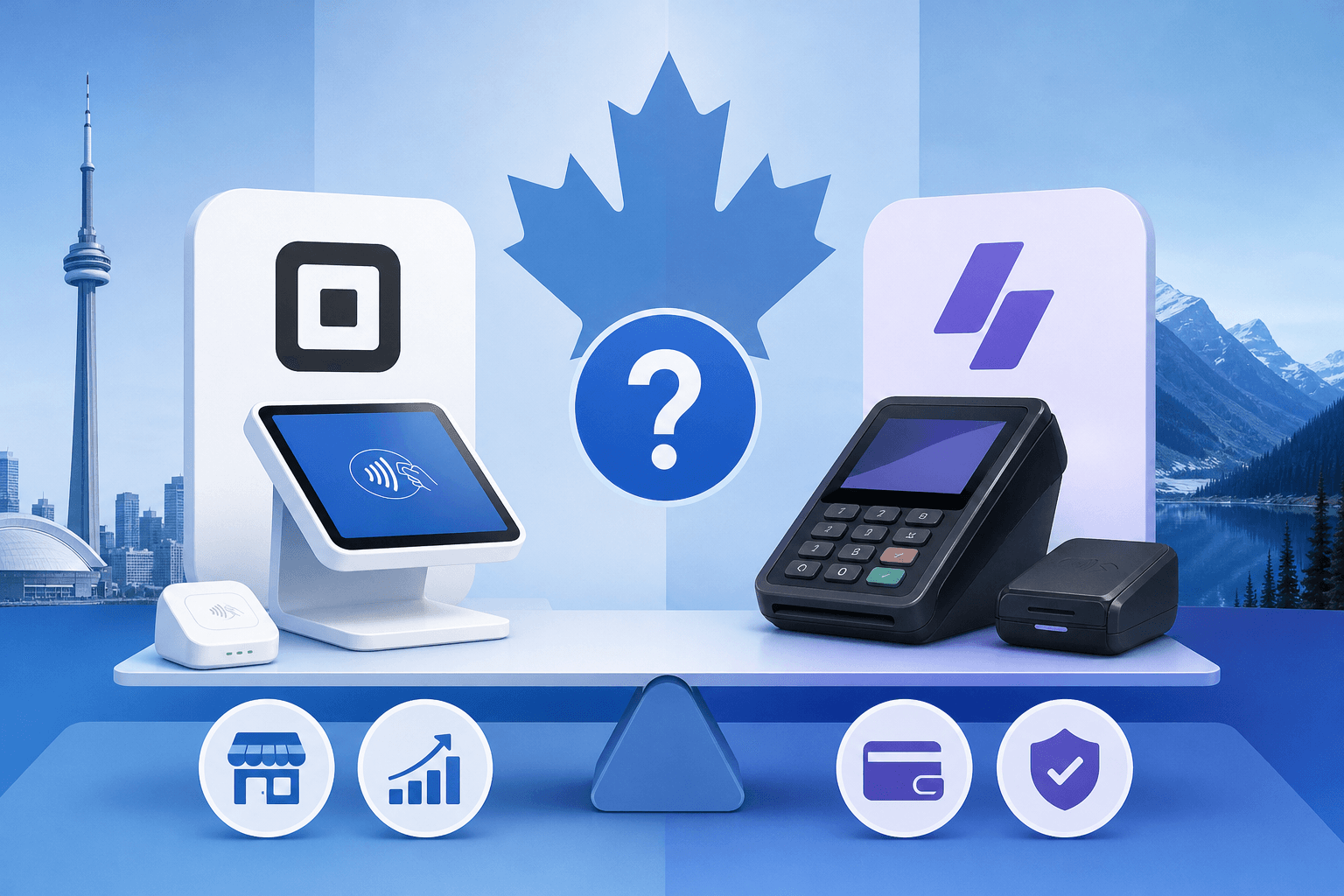
Square vs Helcim: Which Payment Processor Wins for Canadian Small Businesses?
If you're running a small business in Canada and shopping for a new way to accept payments, you've probably come across Square and Helcim. Both are popular with entrepreneurs, both offer hardware and software bundles, and both market themselves as straightforward alternatives to traditional bank processing. But "popular" and "right for your business" aren't always the same thing.
Choosing a payment processor affects more than just how customers tap their cards. It touches your monthly costs, how quickly you get access to your own money, how flexible your contract is, and how well the system fits into the platform you already use, whether that's a POS at the counter or an online store built on Shopify or WooCommerce. The Square vs Helcim decision comes down to understanding how each company prices its services and what that means for your specific sales volume and business type.
In this guide, we'll break down the key differences between Square and Helcim, explain what Canadian business owners should be asking before they sign up with either, and show you how an interchange-plus pricing model, like the one PaymentsPlus offers, stacks up against both.
How Square and Helcim Price Their Services
Pricing structure is usually the first thing business owners compare, and it's also the most misunderstood part of payment processing.
Square has built its reputation on flat-rate pricing: a simple, published percentage per transaction regardless of card type. That simplicity is appealing, especially for businesses just starting out, because you always know the rate going in. Helcim, on the other hand, uses interchange-plus pricing, where you pay the actual cost set by the card networks (Visa, Mastercard, etc.) plus a defined markup. Helcim also publishes volume-based discount tiers that reduce the markup as your monthly processing increases.
Because pricing details, tiers, and fees change over time, we won't quote specific numbers for either company here. Before making a decision, check Square's and Helcim's current published pricing pages directly, since rates and structures are subject to change.
What's important to understand is the difference between the two pricing philosophies:
- Flat-rate pricing (Square's model) is predictable but can cost more for businesses with a lot of debit or lower-cost card transactions, since you pay the same rate no matter what card is used.
- Interchange-plus pricing (Helcim's model, and ours at PaymentsPlus) means you pay what the card networks actually charge, plus a transparent markup shown separately on your statement. For many businesses with consistent volume, this structure is more cost-efficient, but it does mean your effective rate varies month to month depending on your card mix.
If you're trying to figure out which structure actually costs less for your business, the only reliable way is to look at your own processing statement. Use our savings calculator to see how your current numbers compare, or get a free quote built directly from your existing statement, showing the dollar difference rather than a generic estimate.
Funding Speed and Cash Flow
For small businesses, especially those in retail, restaurants, or service industries, how fast you receive your money matters almost as much as what you pay to process it.
Funding timelines vary by processor and can depend on your account history, risk profile, and banking setup. Rather than guessing, ask each provider directly what their standard funding schedule looks like and whether faster options are available for established merchants.
At PaymentsPlus, next-day funding is our standard, and same-day funding is available for qualified merchants. That distinction matters: a lot of providers advertise fast funding as if it applies to everyone, when in reality it's often tied to account standing, transaction history, or risk review. When you're comparing Square and Helcim, ask the same direct question: what is the standard funding timeline, and what has to be true about your business to qualify for anything faster?
Contracts, Fees, and Flexibility
One of the biggest frustrations business owners run into with payment processing isn't the rate, it's getting locked into terms they didn't fully understand upfront.
Before signing with Square, Helcim, or any processor, it's worth asking:
- Is there a long-term contract, and if so, how long?
- Are there fees for cancelling early?
- What does PCI compliance cost, and is it included or billed separately?
- Are there monthly minimums or inactivity fees?
- What happens to leased or purchased hardware if you switch providers?
These are the kinds of details that don't show up in marketing copy but absolutely show up in year-two invoices. Check Square's and Helcim's current published terms for specifics, since contract structures can change and may vary by province or business type.
For comparison, PaymentsPlus operates with no long-term contracts and no cancellation fees, and PCI compliance is included. That structure is designed to put the decision to stay or leave back in the merchant's hands rather than tying it to a multi-year commitment.
Hardware and POS Considerations
Square is well known for its countertop readers and tablet-based POS systems, which appeal to businesses that want an all-in-one setup out of the box. Helcim also offers card readers and terminal options designed to work with its platform. If you're comparing hardware, look closely at whether the terminal is proprietary to that processor, because that can limit your options if you decide to switch providers later.
This is one area where it pays to think a few years ahead, not just about today's setup. If a processor's hardware only works with its own software, moving to a different provider down the road could mean replacing your equipment entirely.
PaymentsPlus offers hardware placement options for qualified merchants, which means the equipment conversation is handled based on your specific business needs rather than a one-size-fits-all package. If you're running a restaurant that needs tableside payment, a retail counter that needs a fast checkout flow, or a salon that books and charges clients in one motion, the right hardware setup looks different in each case. Our restaurant solutions, retail solutions, and salon & spa solutions pages go into more detail on what tends to work well for each industry.
Online Payments and Platform Integration
Plenty of Canadian businesses aren't just processing payments in person, they're also selling online through Shopify, WooCommerce, Odoo, or another platform. Both Square and Helcim offer their own online payment tools, but how well they integrate with your specific e-commerce platform, and what that costs, varies.
If you're running or planning an online store, don't evaluate a processor purely on in-person rates. Ask specifically:
- Does the processor support the e-commerce platform you're using or planning to use?
- What payment methods does that platform support through the processor (credit cards, Interac, digital wallets)?
- Who handles the technical setup and testing before you go live?
This is where PaymentsPlus offers something distinct from simply picking a processor off a shelf: our integration service. We set up the merchant account for online payments and connect it to your platform, whether that's Shopify, WooCommerce, or Odoo, working directly with you or your developer using the payment options that platform supports. We test the setup with you before go-live, so you're not troubleshooting a broken checkout flow after launch. If you're specifically running Odoo as your ERP, our Odoo Clover integration page covers how that connection works in more detail. For businesses focused on online sales generally, our e-commerce solutions page is a good starting point.
Which One Actually Wins for Canadian Small Businesses?
Here's the honest answer: in the Square vs Helcim comparison, there isn't a universal winner, because the right choice depends on your transaction volume, your average sale size, your card mix, and how much you value pricing predictability versus potentially lower costs at scale.
- If you process a low volume of transactions and want the simplicity of one flat rate with no surprises, flat-rate pricing can be appealing, even if it's not always the cheapest option as you grow.
- If you have consistent or growing volume and want your rate tied directly to actual card network costs, interchange-plus pricing tends to reward that consistency over time.
- If your business operates across provinces, keep in mind that Canadian payment processing, GST/HST handling, and Interac debit rules are specific to our market, so make sure whichever provider you choose is set up to handle Canadian regulations and currency properly, not just a Canadian-facing version of a U.S. product.
Rather than guessing which structure fits, the most reliable method is pulling your actual processing statement and comparing it line by line against what each provider would charge. That's exactly what a free quote from PaymentsPlus is built to do: we use your own statement to show the dollar difference, not a hypothetical savings percentage.
If you want a broader look at how multiple processors stack up, not just Square and Helcim, our compare processors page, along with specific breakdowns like our Stripe comparison and Clover comparison, can help round out the picture. And if location-specific processing questions are part of your decision, our city guides for Toronto, Vancouver, Calgary, Montreal, and Ottawa cover regional considerations that national comparisons often miss.
Making the Final Decision
Before you commit to either Square or Helcim, or decide to look elsewhere entirely, take these steps:
- Pull your last three months of processing statements. You need real numbers, not estimates, to compare pricing structures accurately.
- Check both providers' current published pricing and contract terms directly. Don't rely on secondhand summaries, including this one, since terms change.
- Ask about funding timelines explicitly, including what qualifies a business for faster funding versus the standard schedule.
- Map out your hardware needs for the next few years, not just your opening setup.
- Confirm platform compatibility if you sell online, and ask who handles setup and testing before launch.
- Get a comparison quote built from your actual statement so you're comparing real dollars, not advertised rates.
Payment processing isn't a decision to make on marketing copy alone. The fine print, funding schedule, and integration support matter just as much as the headline rate.
Ready to Compare Your Real Numbers?
The Square vs Helcim debate matters less than what the numbers say for your specific business. The best way to settle it is to look at your own processing statement side by side with alternative pricing. Get a free quote from PaymentsPlus, built from your actual statement, and see the dollar difference for yourself. If you have questions about funding, hardware, or setting up online payments, contact our team and we'll respond within 24 hours. You can also explore our services to see the full picture of how we support Canadian businesses.