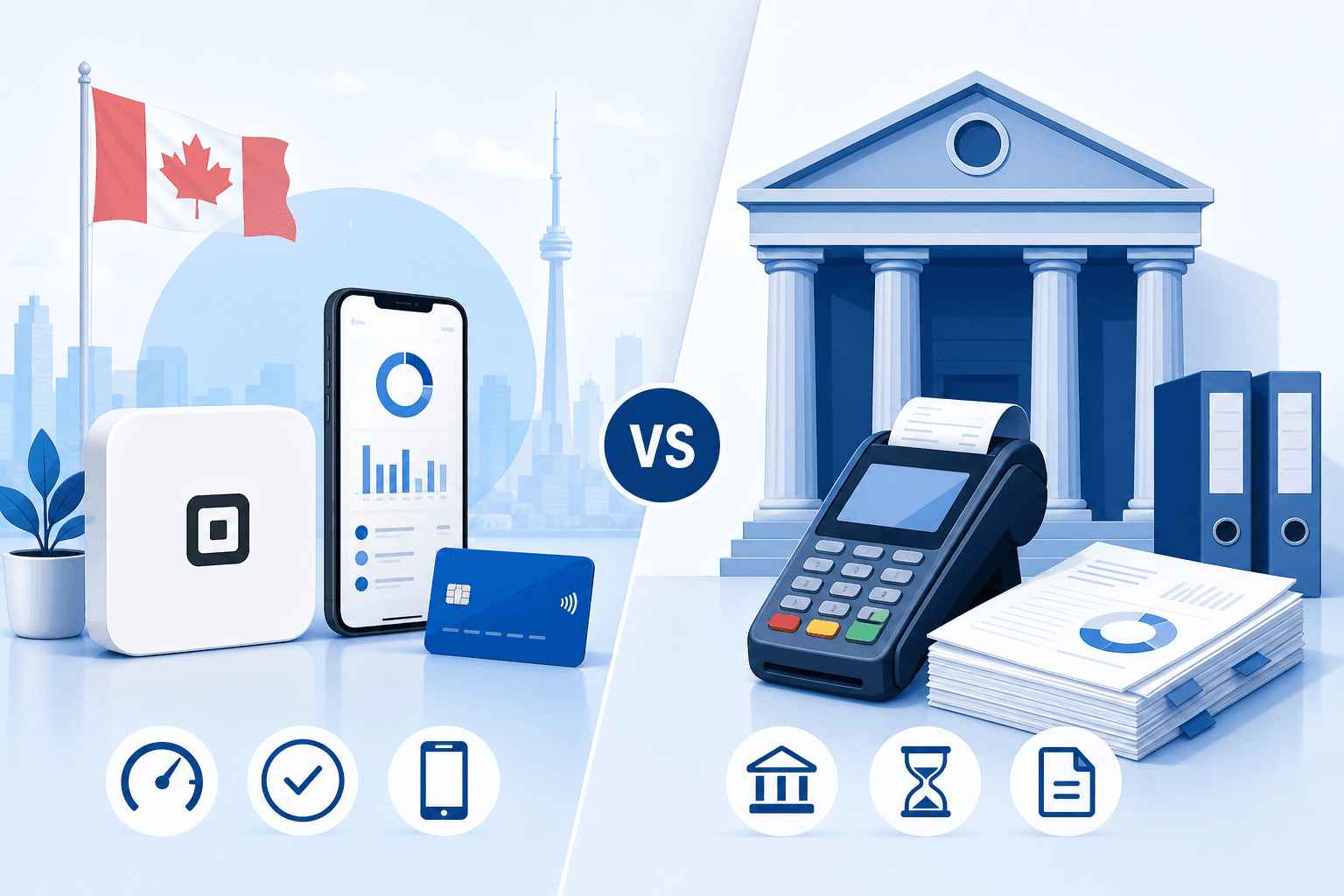
Square vs Traditional Merchant Account Canada: Which Is Right for Your Business?
If you've been researching payment processing options for your Canadian business, you've likely landed on two very different paths: sign up for Square in an afternoon, or set up a traditional merchant account through a bank or independent processor. Both let you accept credit cards. Both work in CAD. But the similarities mostly end there.
This decision matters more than most business owners realize. Payment processing fees quietly eat into your margins every single day, and the wrong choice can cost you thousands of dollars a year - or lock you into equipment and contracts that don't fit how your business actually operates. The Square vs traditional merchant account Canada debate isn't about which option is universally "better." It's about which one matches your sales volume, your industry, and your growth trajectory.
In this guide, we'll break down exactly how Square and traditional merchant accounts differ, what each one actually costs Canadian businesses, and how to decide which path makes sense for you.
What Is Square, and How Does It Work?
Square is a flat-rate payment processor built for simplicity. You sign up online, get a card reader or terminal shipped to your door, and start accepting payments within days - no lengthy application, no business credit check, and no long-term contract.
Square charges a flat percentage per transaction (currently around 2.65% for in-person tap/chip/swipe transactions in Canada, with different rates for online and keyed-in payments). That's it. No monthly fees, no PCI compliance fees, no statement fees. For a very small business processing a few thousand dollars a month, this simplicity is genuinely appealing.
Where Square Shines
- Fast setup - you can be processing payments the same day
- No contracts - cancel anytime with no early termination penalty
- Predictable pricing - one flat rate regardless of card type
- Built-in POS software - inventory, invoicing, and reporting come standard
- Good for mobile and pop-up businesses - food trucks, markets, and seasonal vendors
What Is a Traditional Merchant Account?
A traditional merchant account is a business account set up specifically to accept card payments, typically through a bank, an independent sales organization (ISO), or a dedicated payment processor like PaymentsPlus. Instead of a single flat rate, you're usually offered interchange-plus pricing - where you pay the actual interchange rate set by Visa/Mastercard plus a small, transparent markup.
This structure requires a bit more setup: an application, sometimes a soft credit check, and account approval. But once established, it typically becomes significantly cheaper than flat-rate processing as your volume grows, and it offers far more flexibility in hardware, software, and contract terms.
Where Traditional Merchant Accounts Shine
- Lower effective rates at volume - interchange-plus pricing rewards higher processing volumes
- Customizable hardware and software - choose terminals and POS systems suited to your industry
- Dedicated support - a real account manager instead of a call centre queue
- Better for complex needs - multi-location businesses, recurring billing, or industry-specific integrations
- Often includes next-day funding - important for cash-flow-sensitive businesses
Comparing the Real Costs
This is where the Square vs traditional merchant account Canada decision really comes down to numbers. Square's flat rate is easy to understand, but "easy" doesn't always mean "cheapest."
Here's a simplified example. Say your business processes $30,000/month in card payments:
- With Square at ~2.65%: roughly $795/month in fees
- With a well-negotiated interchange-plus account: often 1.6%-2.2% blended, or roughly $480-$660/month, depending on your card mix and industry
That difference - potentially $2,000-$4,000 per year - is real money for a small business. The gap widens further as volume increases, since Square's flat rate doesn't improve with scale, while interchange-plus rates and negotiated markups often do.
Of course, if you're processing under $2,000-$3,000 a month, the flat monthly fees sometimes attached to traditional accounts can outweigh the savings, and Square's no-frills model may genuinely cost you less overall.
The only way to know for sure is to run your own numbers. Use our savings calculator to see how your current processing costs stack up, or get a free quote based on your actual transaction volume and average ticket size.
Contracts, Hardware, and Flexibility
Contract Terms
Square's month-to-month, no-contract model is a genuine advantage for brand-new or seasonal businesses that don't want to commit. Traditional merchant accounts have historically been associated with multi-year contracts and early termination fees - but that's changed significantly. Many modern Canadian processors, including PaymentsPlus, now offer flexible, no-long-term-contract agreements with transparent pricing, combining the best of both worlds.
Hardware Options
Square requires you to use Square-branded hardware and software. That's fine if their ecosystem fits your business, but it becomes limiting if you need industry-specific features - like table management for restaurants, appointment booking for salons, or inventory depth for retail. Traditional merchant accounts typically offer a wider range of POS options, including systems like Clover, allowing you to pick hardware built for your specific industry.
Integration Needs
If your business relies on accounting software, inventory systems, or an ERP platform, traditional processors generally offer more integration flexibility. For example, businesses running Odoo can connect directly to Clover hardware through our Odoo Clover integration, something Square's closed ecosystem doesn't support.
Which Businesses Should Choose Square?
Square tends to make sense for:
- Brand-new businesses still testing product-market fit
- Very low-volume or seasonal operations (farmers markets, pop-ups, food trucks)
- Solopreneurs who want an all-in-one invoicing and payments tool
- Businesses that value zero commitment over long-term savings
Which Businesses Should Choose a Traditional Merchant Account?
A traditional merchant account is usually the better fit for:
- Restaurants and cafés processing consistent daily volume - see our Restaurant solutions
- Retail stores with inventory and staff management needs - see our Retail solutions
- Healthcare and wellness practices requiring secure, compliant billing - see our Healthcare solutions
- E-commerce businesses scaling online sales volume - see our E-commerce solutions
- Construction and trades businesses taking large-ticket payments - see our Construction solutions
- Auto shops and dealerships with higher average transactions - see our Automotive solutions
- Hotels and hospitality businesses needing PMS integrations - see our Hospitality solutions
- Salons and spas managing bookings and recurring clients - see our Salon & spa solutions
- Nonprofits processing donations at lower cost - see our Nonprofit solutions
If your business falls into any of these categories and you're processing more than a few thousand dollars a month, it's worth exploring whether a traditional account could save you money. Compare processors side by side to see how Square stacks up against interchange-plus pricing models.
Beyond Square: Other Alternatives Worth Comparing
Square isn't the only flat-rate option Canadian businesses consider. It's also worth comparing against Stripe for online businesses, Clover for flexible POS hardware, Lightspeed for retail and restaurant management, and bank-bundled options like TD or Desjardins if you're a Quebec-based business. Larger operations may also want to look at enterprise-level processing through Chase.
Regardless of where you're located - Toronto, Vancouver, Calgary, Montreal, or Ottawa - local support and understanding of Canadian interchange rates and regulations matter more than most business owners expect when comparing providers.
Making the Right Choice for Your Business
There's no universal winner in the Square vs traditional merchant account Canada comparison - only the right fit for your specific volume, industry, and growth plans. If you're just starting out and need something simple, Square is a perfectly reasonable place to begin. But if you're an established business processing meaningful monthly volume, a traditional merchant account with interchange-plus pricing will very likely save you money, often without sacrificing flexibility or requiring a rigid long-term contract.
The best way to know which side of that line you fall on is to actually compare your numbers. Contact our team for a no-obligation review of your current processing costs, or explore our services to see the full range of Canadian payment solutions available to your business.