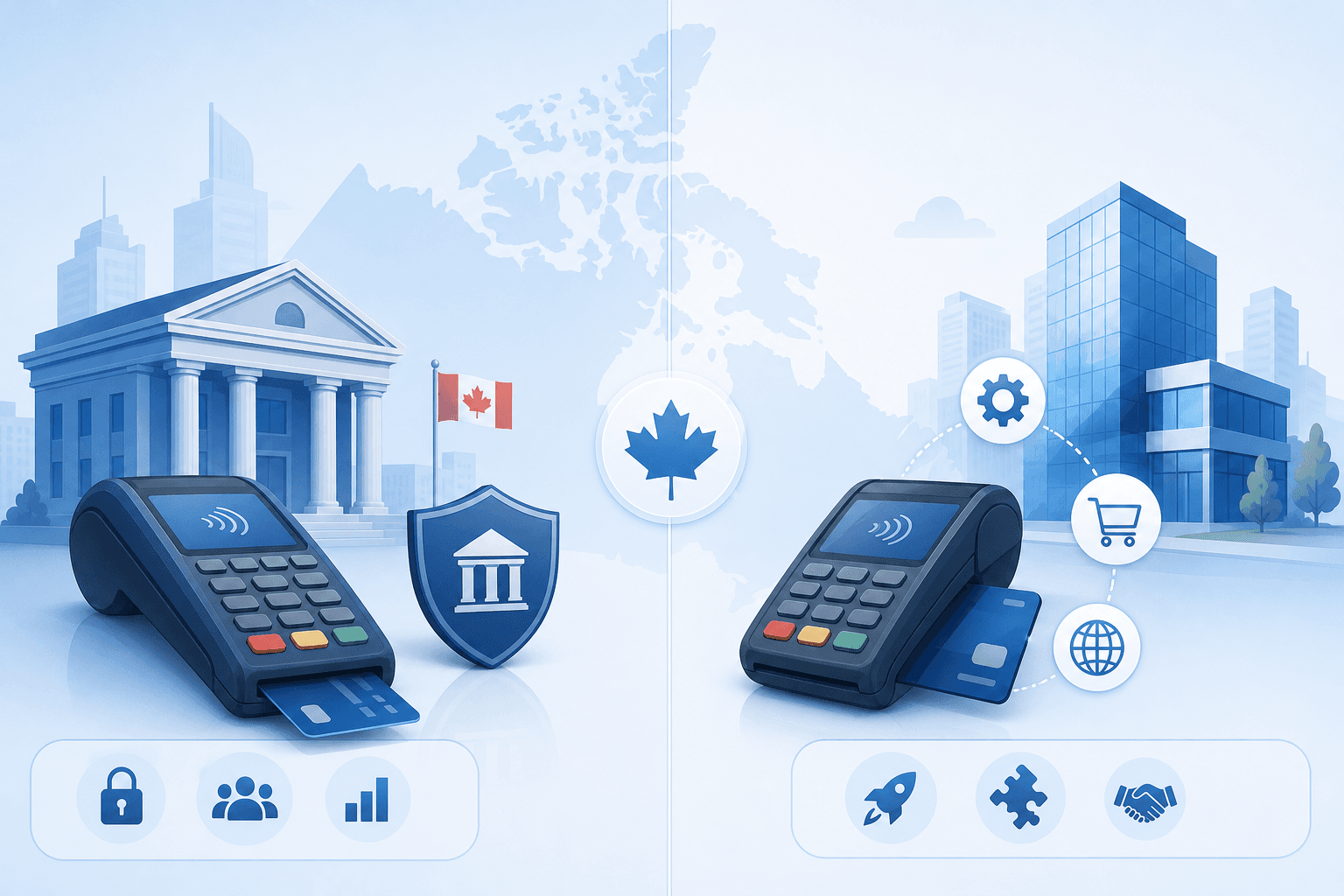
When Canadian business owners start shopping for credit card processing, they quickly discover two very different paths: sticking with the payment processing arm of their bank, or working with an independent payment processor. Both options can get you a terminal, an online checkout, and the ability to accept Visa, Mastercard, and Interac - but the similarities often end there.
Choosing between them isn't just a technical decision. It affects your monthly costs, how quickly problems get resolved, what hardware and software you can use, and how much flexibility you have as your business grows. Yet many business owners simply default to whatever processor their bank offers, without realizing there's a whole market of independent alternatives built specifically to compete on price and service.
This guide breaks down the real differences between bank-owned vs independent payment processors in Canada, so you can make an informed decision instead of an automatic one. Whether you run a restaurant in Toronto, a retail shop in Calgary, or an e-commerce business shipping across the country, understanding these options could save you thousands of dollars a year.
What Are Bank-Owned Payment Processors?
Bank-owned payment processors are merchant services divisions operated directly by Canada's major financial institutions - think RBC, Scotiabank, BMO, CIBC, and TD. If you have a business bank account with one of the Big Five, there's a good chance you were offered payment processing as a bundled add-on.
How They Work
Bank-owned processors integrate directly with your existing business banking relationship. Funds from card transactions typically deposit into your account at the same institution, often with same-day or next-day availability. For business owners who value simplicity and already trust their bank, this can feel like the path of least resistance.
Common Characteristics
- Bundled pricing: Processing fees are often wrapped into a broader banking relationship, making it harder to isolate true costs.
- Standardized contracts: Less room for negotiation, especially for smaller merchants.
- Legacy technology: Terminals and reporting portals can lag behind what independent providers offer.
- Customer service through call centers: Support is typically centralized and may not be payments-specialist staff.
If you want to see how a specific bank stacks up, our TD comparison breaks down how bank-bundled processing compares to other options in detail.
What Are Independent Payment Processors?
Independent payment processors are companies that specialize exclusively in payment processing - it's their entire business, not a side offering. In Canada, this includes companies like PaymentsPlus, as well as global players and fintech platforms that have entered the Canadian market.
How They Work
Independent processors build their business around merchant acquiring, which means they often invest more heavily in technology, transparent pricing models, and dedicated support teams. They work with a variety of banking partners to settle funds, so you're not limited to one institution's infrastructure.
Common Characteristics
- Specialized pricing models: Interchange-plus pricing is common, giving you visibility into exactly what you're paying and why.
- Negotiable rates: Because processing is their core business, independents often have more flexibility to customize pricing for your volume and industry.
- Modern hardware and software: Many independents offer current-generation POS systems, integrated online payment gateways, and reporting dashboards.
- Dedicated account support: Smaller, specialized teams often mean faster, more knowledgeable support when issues arise.
Key Differences: Bank-Owned vs Independent Payment Processors in Canada
Let's get into the specifics that actually matter for your bottom line and day-to-day operations.
1. Pricing Transparency
Bank-owned processors frequently use flat-rate or tiered pricing structures that bundle interchange fees, assessments, and markup into a single rate. This is simple to understand but often more expensive, especially for businesses with higher transaction volumes or larger average tickets.
Independent processors are more likely to offer interchange-plus pricing, where you pay the actual interchange rate set by Visa/Mastercard plus a transparent, fixed markup. This structure almost always saves money for established businesses, though it requires a bit more effort to understand your statement.
If you're not sure how your current rates compare, use our savings calculator to see the potential difference in real CAD terms.
2. Contract Flexibility
Bank-owned processors often require longer-term contracts tied to your broader banking relationship, with cancellation fees or early termination penalties. Negotiating isn't always straightforward since rates are frequently set by internal policy rather than a relationship manager with discretion.
Independent processors generally offer:
- Month-to-month options or shorter contract terms
- More willingness to negotiate rates based on your processing volume
- Clearer terms around equipment leases vs. purchases
3. Technology and Integrations
This is one of the biggest differentiators. Bank-owned processors often rely on older terminal hardware and may be slower to support newer POS ecosystems, e-commerce plugins, or software integrations.
Independent processors tend to partner with (or build) modern POS platforms. For example, if you're evaluating hardware, our Clover comparison and Lightspeed comparison pages dig into how popular POS systems handle inventory, reporting, and multi-location management - options that aren't always available through a bank's standard terminal offering.
If your business runs on an ERP system like Odoo, independent processors are also more likely to support direct integrations - see our Odoo Clover integration for an example of how that connects payment data directly to your back office.
4. Customer Support
When a terminal goes down on a Saturday afternoon, who do you call? Bank-owned processors route you through general banking call centers, which may not have payments specialists available after hours. Independent processors - particularly Canadian-based ones - often provide dedicated merchant support lines staffed by people who understand processing issues specifically, not just general banking.
5. Industry-Specific Solutions
Independent processors are often more willing to tailor solutions to your specific industry. For example:
- Restaurants need tableside payments and tip adjustment workflows - see our restaurant solutions
- Retailers need inventory-linked POS systems - explore our retail solutions
- Healthcare providers need PIPEDA-compliant payment handling - check our healthcare solutions
- E-commerce businesses need seamless gateway integrations - see our e-commerce solutions
Bank-owned processors typically offer a more one-size-fits-all terminal setup, which can leave gaps for specialized industries like construction, automotive, hospitality, or salons and spas. If your business has unique needs, it's worth exploring construction solutions, automotive solutions, hospitality solutions, or salon & spa solutions to see how a specialized processor can better fit your workflow.
Regional Considerations for Canadian Businesses
Payment processing needs can vary by region, especially when it comes to language requirements, local regulations, and regional banking preferences.
- Businesses in Quebec often need bilingual support and provincial compliance considerations - our Desjardins comparison and Montreal payment processing page address this directly.
- Businesses in Ontario's major hubs can review our Toronto payment processing and Ottawa payment processing resources for local rate benchmarks.
- Western Canadian businesses can check out Vancouver payment processing and Calgary payment processing for region-specific guidance.
Regardless of where you're located in Canada, the core comparison between bank-owned vs independent payment processors in Canada holds true - independents typically offer more competitive, transparent pricing, while banks offer convenience through an existing relationship.
Which Option Is Right for Your Business?
There's no universal answer, but here's a practical framework:
Consider a bank-owned processor if:
- You process a low volume of transactions monthly
- You strongly prefer having all banking services under one roof
- Simplicity matters more to you than optimizing costs
Consider an independent processor if:
- You process a moderate to high volume of transactions
- You want transparent, interchange-plus pricing
- You need modern POS hardware or software integrations
- You want dedicated support and more contract flexibility
- You're comparing multiple providers to find the best fit - our compare processors page is a good place to start
For most growing Canadian businesses, the savings and flexibility of an independent processor outweigh the convenience of bundled banking. Even a seemingly small difference in processing rates can add up to thousands of dollars annually once you factor in transaction volume.
How to Make the Switch
If you're currently with a bank-owned processor and considering a change, the process is usually simpler than business owners expect:
- Review your current statement to understand your effective rate and fee structure.
- Compare quotes from independent processors against your current costs.
- Check contract terms for early termination fees or equipment buyouts.
- Plan the transition with minimal downtime - most independent processors handle hardware setup and staff training.
- Confirm settlement timelines so you know when to expect deposits in your CAD account.
Switching processors doesn't have to mean switching banks - you can keep your existing business bank account while moving your payment processing to a provider that better serves your needs.
Final Thoughts
The decision between bank-owned vs independent payment processors in Canada ultimately comes down to what you value most: the simplicity of bundled banking, or the transparency, flexibility, and potential savings of a dedicated payments specialist. For many Canadian small and medium businesses, independent processors offer a meaningful edge - particularly in pricing clarity, technology, and customer support.
Before renewing your current contract or settling for the default option your bank offers, take the time to compare your options. The difference could be substantial, both in dollars saved and in day-to-day operational ease.
Ready to see where you stand? Get a free quote to compare your current rates against a transparent, Canadian-built alternative, or contact our team if you have questions about making the switch.