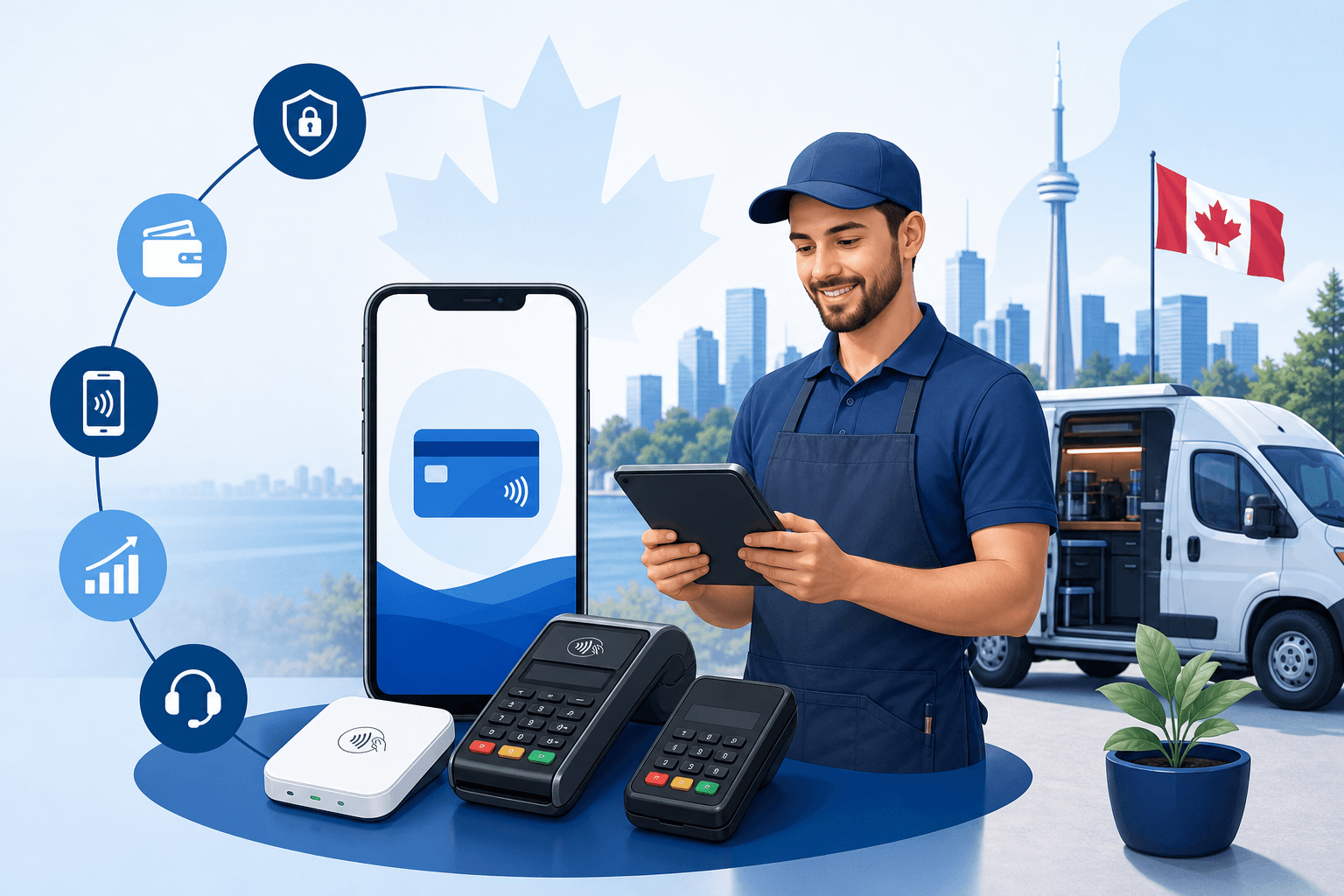
Best Payment Processors for Mobile Businesses in Canada
If your business doesn't operate out of a fixed storefront, you already know that accepting payments can be more complicated than it looks. Food trucks, mobile mechanics, landscapers, home service contractors, market vendors, and traveling salon professionals all need a way to take payments wherever the job happens to be, whether that's a driveway in Calgary, a farmers market in Ottawa, or a client's home in Vancouver. A payment processor built for a fixed retail counter doesn't always translate well to a business that moves.
Choosing among the best payment processors for mobile businesses in Canada means thinking about more than just the rate on a brochure. You need reliable connectivity, hardware that actually works outdoors or on the road, transparent pricing you can audit, and fast access to your money so cash flow doesn't stall between jobs. Canadian business owners also have to account for CAD settlement, Canadian card network rules, and PCI compliance requirements that apply regardless of where the transaction physically happens.
This guide breaks down what to look for, the common pitfalls mobile business owners run into, and how to evaluate your options so you can make a confident decision.
What Makes a Payment Processor Right for a Mobile Business
Mobile businesses have a different risk and operational profile than a retail store with a fixed terminal. Here's what matters most.
Reliable Connectivity Options
Not every job site has strong WiFi or even consistent cell coverage. Look for a processor that supports multiple connection types, such as cellular data and WiFi, so a dead zone in one area doesn't mean you can't process a sale. If you frequently work in rural areas outside major centres like Toronto, Calgary, or Montreal, ask specifically how the hardware performs with inconsistent signal.
Portable, Durable Hardware
A terminal or mobile card reader needs to survive being tossed in a toolbox, exposed to weather, or used dozens of times a day outdoors. Battery life matters too. If you're processing payments all day without easy access to an outlet, a device that dies by early afternoon isn't going to cut it.
Transparent Pricing You Can Actually Read
Mobile businesses often have tighter margins and more variable transaction volumes than a retail shop with steady foot traffic. That makes transparent pricing even more important. With interchange-plus pricing, you see the actual card network cost plus a clearly disclosed markup on every statement, rather than a blended rate that hides how much you're really paying per transaction. This matters whether you're running a food truck doing dozens of small transactions a day or a contractor invoicing a handful of large jobs per week.
Fast Access to Your Funds
Cash flow is often tighter for mobile and seasonal businesses. Waiting several business days for funds to land can create real problems when you need to buy materials or fuel for the next job. Next-day funding should be the standard you expect, with same-day funding available for qualified merchants who need faster access.
No Long-Term Lock-In
Mobile businesses sometimes scale up, slow down seasonally, or change how they operate entirely. A contract that locks you in for years, with penalties if you leave, doesn't fit that reality. Look for providers with no long-term contracts and no cancellation fees so you can adjust as your business changes.
Comparing Your Options
When you start to compare processors, you'll find a mix of Canadian bank-bundled offerings, standalone fintech providers, and POS-centric companies that happen to also process payments.
Bank-Bundled Processing
Many Canadian business owners default to whatever their bank offers because it's convenient to have everything under one roof. If you're weighing a bank option, check out our breakdown on TD comparison or, for Quebec-based businesses, our Desjardins comparison. Bank processors can work, but mobile business owners should pay close attention to how pricing is structured and what hardware options are actually available for on-the-go use, since banks don't always publish these details clearly. Always check that provider's current published pricing before assuming it fits a mobile use case.
Flat-Rate Fintech Processors
Flat-rate providers like Stripe are popular with online and app-based businesses, but mobile in-person businesses should understand how flat-rate pricing compares to interchange-plus, especially at higher volumes. See our Stripe comparison for more detail on how that pricing model works.
POS-Centric Providers
If your mobile business also needs inventory tracking, appointment booking, or multi-location reporting, a POS-first provider might appeal to you. Our Clover comparison and Lightspeed comparison pages walk through what those platforms offer so you can weigh features against processing costs.
Whichever direction you lean, the goal is the same: understand the full cost structure, not just the headline rate, and confirm the hardware actually suits mobile use before you commit.
Industries Where Mobile Processing Matters Most
Mobile payment needs look different depending on your industry.
- Food trucks and mobile catering: need durable, weatherproof hardware and fast transaction speed during rush periods. Our restaurant solutions page covers considerations that apply to mobile food service too.
- Home services and contractors: often invoice larger amounts on-site and need reliable connectivity in areas with weak cell signal. Our construction solutions page goes into more detail.
- Mobile automotive services: including mobile detailing and repair, benefit from quick checkout at the customer's location. See automotive solutions.
- Mobile salon and spa professionals: who travel to clients need lightweight, reliable card readers. Check out salon & spa solutions.
- Pop-up retail and market vendors: need hardware that can process quickly during busy market hours. Our retail solutions page has more on this.
- Mobile health practitioners: have the added responsibility of handling payments in a way that respects patient privacy and PCI compliance. See healthcare solutions.
- Nonprofits running mobile fundraising events: such as walkathons or pop-up donation drives, also benefit from portable, reliable processing. Our nonprofit solutions page covers this use case.
If your mobile business also runs an online store or takes deposits through a website, it's worth thinking about both sides of the business together. Our e-commerce solutions page covers what to look for when you're processing both in-person and online payments under one business.
Regional Considerations Across Canada
Mobile businesses often work across a wider geographic area than a fixed storefront, which means it helps to understand regional payment landscapes.
- Businesses operating in and around the GTA can review our Toronto payment processing page for local context.
- If you're based in British Columbia, our Vancouver payment processing guide covers considerations specific to that market.
- Alberta-based mobile businesses, including those serving rural areas outside the city, can check our Calgary payment processing resource.
- Quebec businesses should also review our Montreal payment processing page, particularly around French-language receipt and terminal requirements.
- Businesses in the National Capital Region can find relevant detail on our Ottawa payment processing page.
Regardless of where you operate, Canadian card networks and PCI compliance requirements apply the same way, so make sure any processor you choose includes PCI compliance as part of the service rather than as an add-on you have to manage yourself.
How to Actually Compare Costs Before You Switch
The fastest way to find out if you're paying too much is to look at your actual processing statement rather than guessing based on an advertised rate. Processing statements can be dense and hard to interpret, which is exactly why so many mobile business owners end up on pricing that doesn't fit their transaction pattern.
A practical approach:
- Pull your last one to two months of processing statements.
- Note your total transaction volume, average ticket size, and how many transactions you process per week.
- Use our savings calculator to get a general sense of how your current costs stack up.
- Request a free quote built directly from your own statement, which shows the dollar difference rather than a generic estimate.
This matters more for mobile businesses than fixed storefronts because transaction patterns tend to be less predictable, seasonal swings are common, and hardware and connectivity costs can add up differently than they would in a retail setting.
What to Ask Before You Sign Up
Before committing to any processor, mobile business owners should ask:
- What hardware placement options are available for qualified merchants, and does the device work reliably outdoors or in areas with weak signal?
- Is pricing interchange-plus, with the markup disclosed separately from the card network cost, or is it blended into a single rate?
- How fast are funds deposited, and is same-day funding available for qualified merchants if cash flow is tight?
- Is PCI compliance included, or is that something the business has to arrange separately?
- Are there long-term contracts or cancellation fees if the business needs to change providers later?
- If the business also sells online, does the provider offer a way to connect that side of the business too?
For businesses selling through a platform like Shopify, WooCommerce, or Odoo alongside their mobile operations, it's worth asking how the integration actually works. PaymentsPlus offers an integration service where we set up the merchant account for online payments and connect it to the platform with the merchant or their developer, using the payment options that platform supports, and test everything before go-live. If your mobile business runs on Odoo specifically, our Odoo Clover integration page has more detail.
Making the Right Choice for Your Mobile Business
There's no single answer to which processor is "best" for every mobile business in Canada, because the right fit depends on your transaction volume, how often you're in areas with weak connectivity, and whether you also need online payment capability. What matters is comparing providers on the factors that actually affect a mobile operation: connectivity, durable hardware, transparent interchange-plus pricing, fast funding, and flexible terms without long-term lock-in.
At PaymentsPlus, we work with mobile businesses across Canada and offer hardware placement options for qualified merchants, next-day funding as standard with same-day funding available for qualified merchants, and interchange-plus pricing shown clearly on every statement. There are no long-term contracts and no cancellation fees, and PCI compliance is included. We respond within 24 hours if you have questions along the way.
If you want a clear picture of where your business actually stands, get a free quote built from your own processing statement, or contact our team to talk through what your mobile operation needs.