Introduction
Whether you're running a food truck in Calgary, selling handmade jewelry at a Toronto farmers' market, or offering mobile grooming services across the GTA, accepting card payments on the go is no longer optional - it's expected. Canadian consumers increasingly carry less cash, and a business that can't tap, swipe, or insert a chip card is a business leaving money on the table.
The challenge is that the mobile card reader market has exploded with options, and not all of them are built with Canadian businesses in mind. Fees are quoted in USD, some devices don't support Interac debit, and others lock you into long-term contracts that don't make sense for a seasonal or mobile operation. Choosing the wrong reader can mean higher processing costs, clunky checkout experiences, and frustrated customers.
In this guide, we're breaking down Mobile Card Readers Compared: Best Options for Canadian Small Businesses, looking specifically at what matters for Canadian merchants - Interac compatibility, CAD pricing, contract terms, and integration with the POS systems you already use. By the end, you'll know exactly which type of reader fits your business model and how to avoid overpaying for the privilege of getting paid.
What to Look for in a Mobile Card Reader
Before diving into specific options, it helps to understand the criteria that actually matter for Canadian small businesses.
Interac Debit Support
This is non-negotiable in Canada. Debit remains one of the most popular payment methods nationwide, and a reader that only processes credit cards will frustrate customers and cost you sales. Always confirm Interac Flash and chip debit support before committing to a device.
Transaction Fees in CAD
Many mobile readers marketed in Canada are actually American products with fees quoted in USD or converted awkwardly at checkout. Look for providers that price transparently in Canadian dollars, with flat or interchange-plus rates that make sense for your transaction volume. If you're unsure how your current rates stack up, use our savings calculator to see what you could be paying instead.
Connectivity and Reliability
Mobile businesses often operate in areas with spotty Wi-Fi or cellular service - think farmers' markets, construction sites, or rural service calls. Bluetooth readers paired with a smartphone app are common, but some devices also offer built-in SIM cards for standalone connectivity when Wi-Fi isn't available.
Hardware and Software Costs
Some providers give away the reader for free but make up for it with higher processing rates. Others charge upfront for hardware but offer better long-term rates. Understanding the total cost of ownership - not just the sticker price of the device - is essential.
Integration With Your Existing Systems
If you already use a POS system, accounting software, or inventory management tool, your mobile reader should integrate smoothly. A reader that creates double entry work or siloed sales data will cost you time and introduce errors.
Types of Mobile Card Readers Available in Canada
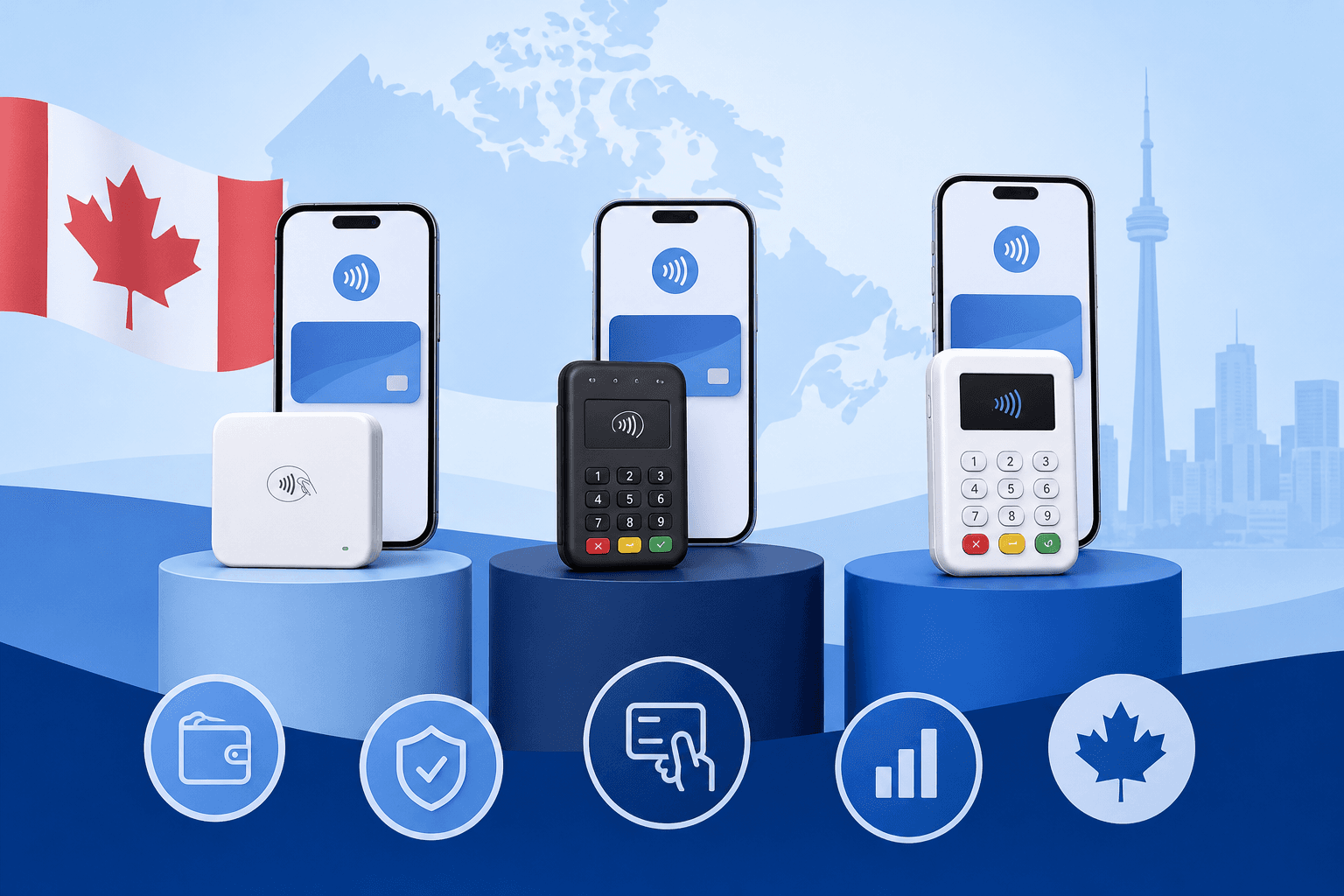
Smartphone-Attached Readers
These small dongles plug into your phone's headphone jack or charging port and pair with a companion app. They're inexpensive and portable, making them popular with very small or seasonal businesses. The downside is that they often have limited functionality - no receipt printing, limited reporting, and sometimes unreliable connections.
Bluetooth Standalone Terminals
These are self-contained devices that pair with a smartphone or tablet via Bluetooth but have their own screen and keypad. They typically support chip, tap, and Interac debit, and many include built-in battery life for a full day of use. This category represents the sweet spot for most Canadian small businesses that need reliability without the bulk of a full countertop terminal.
All-In-One Smart Terminals
Devices like Clover Go or similar smart terminals combine card acceptance with built-in POS software, inventory tracking, and reporting. These are ideal for businesses that want a mobile reader today but may expand into a full POS setup later. If you're evaluating this category, our Clover comparison breaks down how Clover's mobile and countertop options stack up against competitors.
Tablet-Based POS With Mobile Card Reader Add-On
For businesses running a hybrid model - say, a retail shop with occasional pop-up events - a tablet-based POS with a companion mobile reader lets you sync inventory and sales data between your fixed location and mobile operations. Systems like Lightspeed fall into this category; see our Lightspeed comparison for more detail on how it performs for Canadian retailers.
Comparing the Top Options for Canadian Small Businesses
Best for Low Transaction Volume: Flat-Rate Dongle Readers
If you process a handful of transactions per week - think craft fair vendors or hobby businesses - a basic Bluetooth or dongle reader with flat-rate pricing is often the simplest option. You avoid monthly fees entirely, though your per-transaction rate will be higher than what a higher-volume merchant could negotiate. Stripe's mobile reader falls into this category for many Canadian e-commerce sellers expanding into in-person sales; our Stripe comparison covers how its flat-rate model compares to interchange-plus pricing.
Best for Growing Businesses: Smart Terminals With POS Features
Businesses that are scaling - adding staff, tracking inventory, or managing multiple locations - benefit from a smart terminal that doubles as a lightweight POS. These devices cost more upfront or carry a monthly software fee, but the operational efficiency often pays for itself quickly. This is where providers like Clover shine, offering mobile hardware that connects to the same backend as countertop and kitchen-display systems.
Best for Bank-Bundled Simplicity: Big Bank Mobile Terminals
Several Canadian banks offer mobile card readers bundled with a business banking package. These can be convenient if you want one monthly statement, but they often come with higher effective rates and less flexibility than independent processors. We've broken down the tradeoffs in our TD comparison and Desjardins comparison if you're currently banking with either institution and considering a switch.
Best for Multi-Location or Franchise Operations: Enterprise-Grade Mobile Solutions
Larger operations with multiple mobile units - delivery fleets, multi-location service businesses, or franchises - need centralized reporting and enterprise support. Our Chase comparison looks at how enterprise processing options handle this scale, though many Canadian SMBs find a mid-market provider offers similar functionality at a lower cost.
Matching the Right Reader to Your Industry
Different industries have different mobile payment needs, and the "best" reader really depends on your use case.
- Restaurants and food trucks need durable readers that work outdoors and integrate with kitchen workflows - see our restaurant solutions for tailored recommendations.
- Retail pop-ups and markets benefit from readers that sync inventory with a main store system - check our retail solutions page for options.
- Home healthcare and mobile wellness providers need secure, PIPEDA-compliant payment handling; our healthcare solutions page covers compliance-friendly setups.
- Mobile mechanics and auto detailers often work in low-connectivity environments and need rugged, standalone terminals - our automotive solutions page has specifics.
- Contractors and trades collecting deposits or final payments on-site should look at our construction solutions guide.
- Mobile hairstylists, estheticians, and spa professionals want fast, discreet checkout - our salon & spa solutions page outlines reader options suited to house calls.
- Hotels, event venues, and hospitality businesses running mobile check-in or poolside service should review our hospitality solutions page.
- Charities running mobile donation drives have unique processing needs covered in our nonprofit solutions resource.
- Online sellers expanding into markets or trade shows can find guidance in our e-commerce solutions page on blending online and in-person payments.
Regional Considerations Across Canada
Payment processing needs can vary slightly depending on where you operate. Businesses in dense urban markets like Toronto payment processing or Vancouver payment processing often deal with high transaction volumes and need readers that can keep up with fast-paced checkout lines. Meanwhile, businesses in Calgary payment processing and other Alberta markets may prioritize rugged, weather-resistant devices for outdoor and agricultural use cases.
Quebec businesses have additional considerations, including bilingual receipt requirements and French-language customer service - our Montreal payment processing page addresses these specifics. And if you're based in the capital region, our Ottawa payment processing resource covers local processor options and government-sector considerations.
How to Choose the Right Mobile Card Reader for Your Business
When narrowing down your options, work through these steps:
- Estimate your monthly transaction volume and average ticket size. This determines whether flat-rate or interchange-plus pricing saves you more.
- List your must-have features. Receipt printing, offline mode, inventory sync, and tipping prompts aren't universal across devices.
- Check contract terms carefully. Avoid multi-year leases on hardware that may be obsolete in two years.
- Confirm Canadian dollar pricing and Interac support before signing anything.
- Compare total cost, not just the headline rate. Monthly fees, PCI compliance fees, and batch fees add up.
If you want a side-by-side look at how different processors handle mobile acceptance, our compare processors page is a good starting point, and our broader services overview outlines how we support mobile, countertop, and online payment needs under one roof.
Conclusion
Choosing between the many Mobile Card Readers Compared: Best Options for Canadian Small Businesses ultimately comes down to understanding your transaction volume, your industry's unique demands, and how much flexibility you need as your business grows. A dongle reader might be perfect for a seasonal market vendor, while a smart terminal with full POS features makes more sense for a growing service business juggling inventory and staff.
The most important step is comparing actual costs in Canadian dollars rather than relying on advertised rates that don't reflect your real processing volume. Get a free quote to see what you'd actually pay with a transparent, Canadian-focused processor, or contact our team to talk through which mobile reader fits your specific business model. We're happy to walk through the numbers with you - no pressure, just clarity.