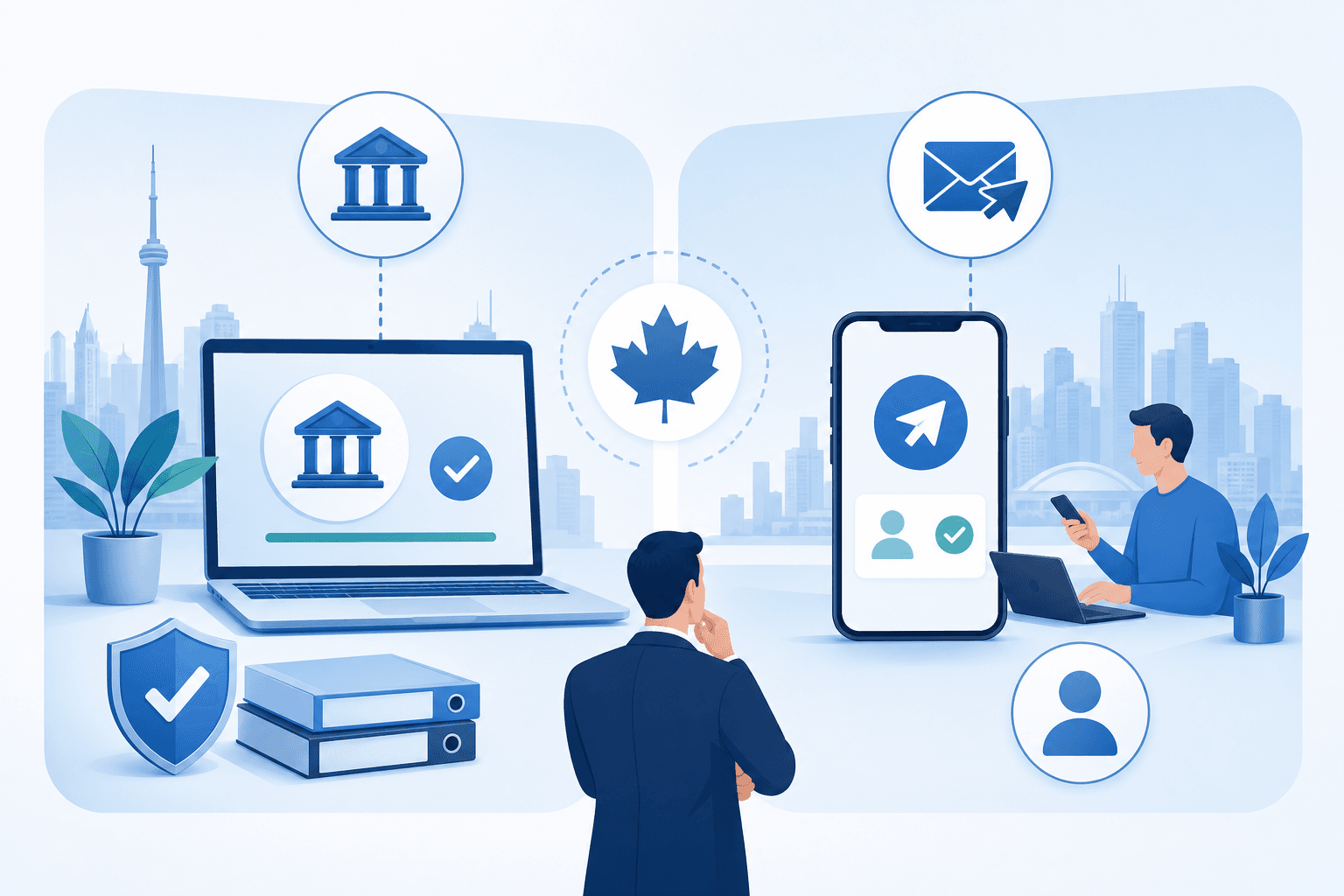
Introduction
Every Canadian business owner eventually faces the same practical question: how should money move in and out of the business? Whether you're paying suppliers, reimbursing employees, or collecting payments from customers, the method you choose affects your cash flow, your bookkeeping, and your bottom line. Two of the most common options in Canada are direct deposit and Interac e-Transfer - and while they might seem interchangeable at first glance, they work very differently behind the scenes.
The debate over direct deposit vs e-Transfer for business payments in Canada isn't just a matter of preference. It touches on transaction limits, processing speed, security protocols, and fees that can add up significantly over a year of business operations. Choosing the wrong method for the wrong use case can mean delayed payroll, frustrated vendors, or unnecessary banking fees eating into your margins.
In this guide, we'll break down exactly how direct deposit and e-Transfer work for Canadian businesses, where each one shines, and how to decide which fits your specific payment needs. We'll also look at how these methods compare to modern payment processing solutions that many growing businesses are adopting instead.
What Is Direct Deposit for Business?
Direct deposit is an electronic funds transfer (EFT) that moves money directly between bank accounts using the Automated Clearing Settlement System (ACSS) in Canada. It's the standard method businesses use for:
- Payroll deposits to employees
- Recurring vendor or supplier payments
- Government remittances and refunds
- Business-to-business (B2B) transactions
How Direct Deposit Works
Direct deposit requires pre-authorized banking information - typically a void cheque or electronic banking details including institution number, transit number, and account number. Once set up, funds can be pushed automatically on a schedule, which makes it ideal for payroll and recurring payments.
Pros of Direct Deposit
- Lower cost at scale: Bulk payroll runs and batch payments are typically cheaper per transaction than individual e-Transfers.
- No dollar limit: Unlike e-Transfer, direct deposit isn't capped at a few thousand dollars per transaction.
- Automation-friendly: Easily integrates with accounting and payroll software for recurring payments.
- Widely trusted for payroll: Most Canadian employees expect and prefer direct deposit for wages.
Cons of Direct Deposit
- Slower processing: Transactions can take 1-3 business days to clear, compared to near-instant e-Transfers.
- Setup complexity: Requires collecting and securely storing banking details for every payee.
- Less flexible for one-off payments: Not ideal for ad hoc or urgent transactions.
What Is Interac e-Transfer for Business?
Interac e-Transfer is the electronic payment network most Canadians use personally, but it also has robust business applications. Businesses use e-Transfer for:
- Paying small or one-time vendor invoices
- Refunding customers
- Collecting payments from clients
- Peer-to-peer style reimbursements between partners
How e-Transfer Works
e-Transfer uses an email address or phone number linked to a bank account, with funds moving between financial institutions almost instantly - often within minutes. Many Canadian banks now offer Autodeposit, which removes the need for security questions and speeds up the process further.
Pros of e-Transfer
- Speed: Funds often arrive within minutes, a major advantage over the multi-day clearing of direct deposit.
- Simplicity: No need to collect sensitive banking details - just an email or phone number.
- Accessibility: Available through virtually every Canadian bank and credit union, including Desjardins for Quebec-based businesses.
- Great for low-volume, high-urgency payments: Perfect for one-off supplier payments or urgent reimbursements.
Cons of e-Transfer
- Transaction limits: Most business accounts cap e-Transfers between $3,000 and $25,000 per transaction, depending on the institution.
- Per-transaction fees: While personal e-Transfers are often free, business e-Transfers frequently carry a fee per transaction ($1-$1.50+ is common).
- Not ideal for payroll at scale: Sending e-Transfers to dozens of employees individually is time-consuming and expensive compared to a batch direct deposit run.
- Manual reconciliation: Without integration into accounting software, e-Transfers can create more manual bookkeeping work.
Direct Deposit vs E-Transfer for Business Payments in Canada: Key Differences
When comparing direct deposit vs e-Transfer for business payments in Canada, the decision usually comes down to four factors: speed, cost, volume, and purpose.
| Factor | Direct Deposit | e-Transfer |
|---|---|---|
| Speed | 1-3 business days | Minutes to hours |
| Transaction limit | Typically no hard cap | $3,000-$25,000 (institution dependent) |
| Best for | Payroll, recurring B2B payments | One-off payments, customer refunds |
| Setup | Requires banking details on file | Just email/phone number |
| Cost at scale | Lower per-transaction cost in bulk | Higher per-transaction fees |
For most Canadian businesses, the real answer isn't "either/or" - it's using both strategically. Payroll and recurring vendor payments are generally better suited to direct deposit, while e-Transfer fills the gap for speed-sensitive, lower-volume transactions.
Which Option Is Right for Your Business?
Retail and E-Commerce Businesses
If you're running a retail storefront or online shop, you're less likely to be using either method for customer-facing payments - credit and debit processing through a POS or online gateway is far more common there. But for supplier payments and refunds, e-Transfer's speed is often preferred. Businesses in this space should also look closely at their overall retail solutions or e-commerce solutions to ensure payment collection and back-office transfers work together smoothly.
Restaurants and Hospitality
Restaurants juggling payroll for part-time and full-time staff typically rely on direct deposit for consistency and lower costs at scale, while e-Transfer might cover emergency supplier payments. Explore our restaurant solutions and hospitality solutions for a full picture of how payment flows should be structured in food service.
Healthcare, Salons, and Service-Based Businesses
Clinics, salons, and spas often deal with a mix of recurring staff payroll and occasional contractor payments. Direct deposit handles the former efficiently, while e-Transfer can work well for smaller contractor or supplier payments. Check out our healthcare solutions and salon & spa solutions for tailored guidance.
Construction and Trades
Contractors frequently pay subtrades and suppliers in varying amounts, sometimes urgently. e-Transfer's speed is valuable here, though larger recurring payments to regular subcontractors may be more cost-effective through direct deposit. Our construction solutions page covers more on managing irregular payment cycles.
Nonprofits
Nonprofits managing both staff payroll and donor refunds often need both tools: direct deposit for employees and grant disbursements, e-Transfer for smaller, time-sensitive transactions. See our nonprofit solutions for more.
Fees, Limits, and Regulatory Considerations in Canada
Canadian financial institutions set their own limits and fee structures for both direct deposit and e-Transfer, and these can vary significantly between banks like TD, RBC, Scotiabank, and Desjardins. If your business operates in Quebec, it's worth comparing how Desjardins structures its business e-Transfer and EFT fees against national banks - see our Desjardins comparison for details.
It's also worth noting:
- Business accounts almost always have different (often higher) e-Transfer fees than personal accounts.
- Direct deposit setup through payroll providers may include per-employee monthly fees in addition to transaction costs.
- Large or frequent CAD transfers may trigger additional reporting under FINTRAC regulations, particularly for amounts over $10,000.
- Reconciling either method manually can create hidden labour costs - something many business owners underestimate until they add it up over a year.
If you're unsure how much you're currently spending on transfers and transaction fees combined, use our savings calculator to see where the money is actually going.
Beyond Direct Deposit and E-Transfer: Modern Payment Processing
While direct deposit and e-Transfer are essential for internal and B2B payments, they aren't designed to replace a full payment processing setup for customer transactions. If your business accepts payments from customers - in person, online, or both - you need a dedicated solution for credit and debit processing, which operates on entirely different rails than direct deposit or Interac.
This is where comparing providers matters. Businesses often default to whatever their bank offers, but bank-bundled processing isn't always the most competitive option. It's worth taking the time to compare processors side by side, including options like our TD comparison, Clover comparison, Stripe comparison, and Lightspeed comparison, to see how pricing and features stack up for your specific volume and industry.
For businesses in major Canadian markets, local processing considerations matter too. Check out our resources for Toronto payment processing, Vancouver payment processing, Calgary payment processing, Montreal payment processing, and Ottawa payment processing to understand regional banking relationships and typical processing rates in your area.
Making the Right Choice for Your Business
There's no universal winner in the direct deposit vs e-Transfer for business payments in Canada comparison - the right choice depends on your transaction volume, urgency, and the relationships you're managing (employees vs. vendors vs. customers). Here's a quick decision framework:
- Use direct deposit for payroll, recurring vendor payments, and any transaction where automation and lower per-transaction cost matter more than speed.
- Use e-Transfer for urgent, lower-volume payments where speed and simplicity outweigh the higher per-transaction fee.
- Use dedicated payment processing for all customer-facing transactions, whether in-store, online, or over the phone.
- Review your fee structure annually, since banks periodically adjust limits and pricing on both direct deposit and e-Transfer services.
Getting this mix right can meaningfully reduce friction in your day-to-day operations and free up time better spent running your business rather than chasing down payments.
Conclusion
Direct deposit and e-Transfer both have a place in a well-run Canadian business, but they solve different problems. Direct deposit is your workhorse for payroll and recurring payments, while e-Transfer is your quick-response tool for urgent, smaller transactions. Neither, however, is designed to handle customer payment acceptance at scale - that's where a dedicated payment processing partner makes the difference.
If you're ready to see how much you could save by optimizing both your internal transfer methods and your customer payment processing, get a free quote from PaymentsPlus today, or contact our team to talk through the best setup for your business.