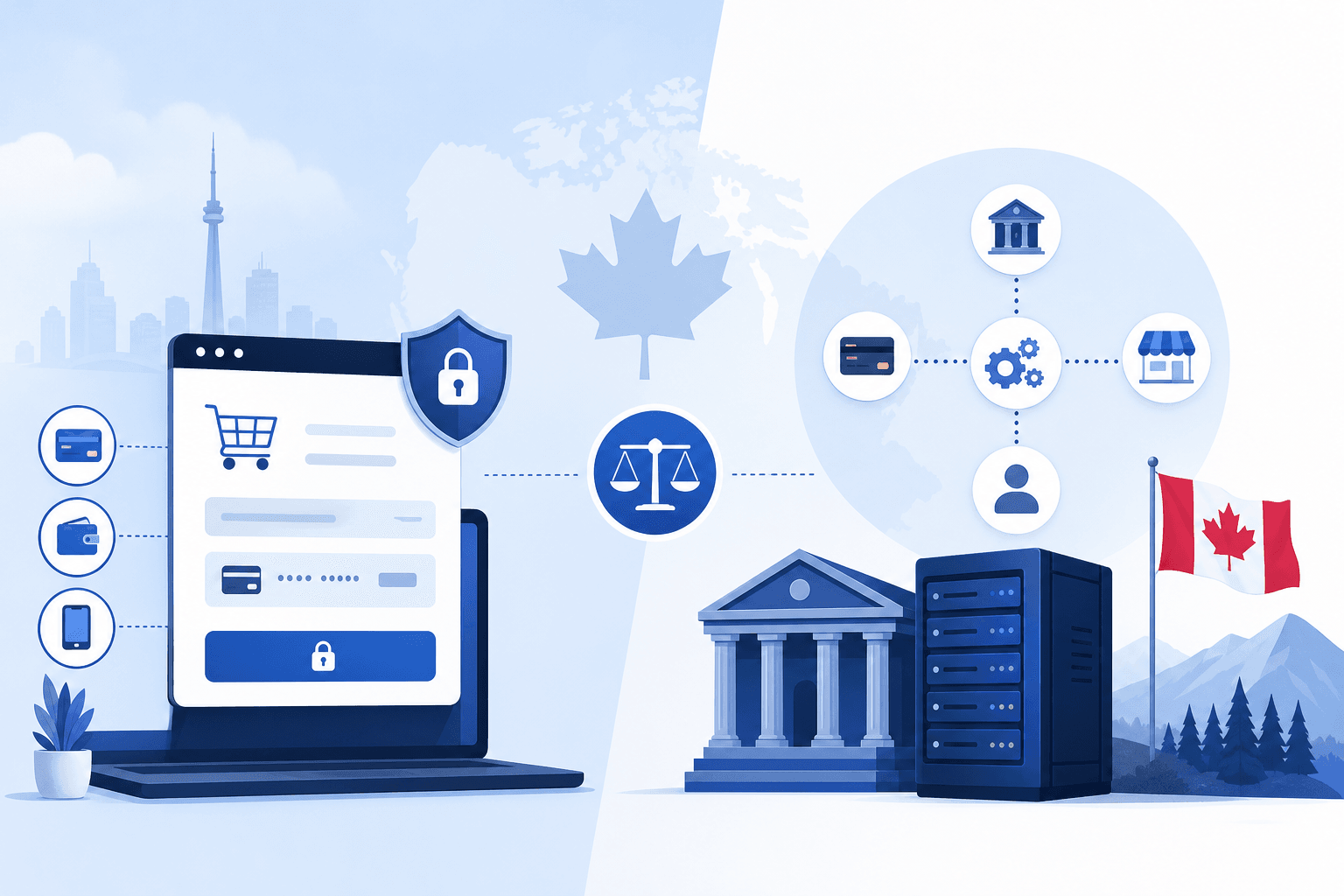
If you've started researching how to accept credit cards for your Canadian business, you've probably run into two terms that get used interchangeably - and that's a problem, because they're not actually the same thing. Understanding payment gateways vs payment processors: what's the difference in Canada is one of the most important first steps you can take before signing a merchant agreement, choosing a POS system, or building out an online store.
Get this wrong, and you could end up paying for redundant services, choosing a platform that doesn't integrate properly, or signing a contract that doesn't fit how your business actually operates. Get it right, and you'll have a payment setup that's fast, secure, and cost-effective - whether you're running a café in Toronto, a boutique in Vancouver, or an online shop shipping across the country.
In this guide, we'll break down exactly what each piece does, how they work together, and what Canadian business owners need to know about choosing the right combination for their needs.
What Is a Payment Processor?
A payment processor is the behind-the-scenes engine that handles the actual movement of money between your customer's bank and your business bank account. When a customer taps, swipes, inserts, or enters their card, the processor is the party responsible for:
- Communicating with the card networks (Visa, Mastercard, Amex, Interac)
- Verifying that funds are available
- Facilitating the transfer of funds from the customer's issuing bank to your merchant account
- Managing fraud checks and risk assessment on the transaction
- Settling funds into your business bank account, typically in CAD
Think of the processor as the logistics company of the payments world. It doesn't matter whether the sale happened in person at a terminal, over the phone, or through an online checkout - the processor is what makes sure the money actually gets from point A to point B.
In Canada, processors also need to account for Interac debit transactions, which work differently than in the U.S. and are a major part of how Canadians pay in-store. A good processor will have strong Interac support built in, along with transparent CAD settlement and pricing that reflects Canadian interchange rates rather than a one-size-fits-all model built for the U.S. market.
What Is a Payment Gateway?
A payment gateway, on the other hand, is the technology layer that captures and encrypts payment information before it ever reaches the processor. If the processor is the logistics company, the gateway is the secure courier that picks up the package and makes sure it's sealed properly before handing it off.
Gateways are most relevant for:
- E-commerce stores and online checkouts
- Businesses taking phone or mail orders (card-not-present transactions)
- Recurring billing and subscription models
- Invoicing platforms with embedded "pay now" buttons
A gateway's main job is to securely transmit encrypted card data from your website or app to the payment processor, then relay the approval or decline back to the customer in real time. It's also responsible for tokenization - converting sensitive card details into a secure token so your business never has to store raw card numbers, which significantly reduces your PCI compliance burden.
For in-person retail, restaurants, and other brick-and-mortar businesses, a gateway is often baked directly into the POS terminal or system, so business owners don't always interact with it separately. But for anyone selling online, choosing the right gateway is just as important as choosing the right processor.
Payment Gateways vs Payment Processors: What's the Difference in Canada?
Now that you understand each piece individually, let's get specific about payment gateways vs payment processors and what's the difference in Canada in practical terms.
They Solve Different Problems
A gateway handles data transmission and security - capturing card details and encrypting them. A processor handles money movement - actually settling the transaction and moving funds into your account. You generally need both working together for any transaction to be completed successfully.
How They're Bundled in Canada
In the Canadian market, many providers bundle gateway and processing services into a single package, especially for small and medium businesses. This is common with platforms like Shopify Payments, Square, and Clover, where the gateway and processor are tightly integrated and invisible to the merchant. Other providers, like Stripe, operate more explicitly as a combined gateway-and-processor solution built primarily for developers and online businesses.
Larger or more specialized businesses sometimes choose to separate the two - using a dedicated gateway (like Moneris' gateway products or Authorize.net) connected to a different processor, which can offer more flexibility and potentially better rates, but requires more technical setup.
Regulatory and Banking Considerations
Canadian businesses also need to consider:
- CAD settlement timing - how quickly funds move from processor to your bank account
- Interac integration - essential for in-person Canadian retail
- PCI DSS compliance - gateways reduce your scope of liability by tokenizing data
- Cross-border fees - if your gateway or processor is U.S.-based, you may face currency conversion fees that erode your margins
This is why it's worth taking the time to compare processors rather than assuming the first option your bank offers is the best fit.
Why This Distinction Matters for Your Bottom Line
Many Canadian business owners don't realize they could be paying two separate sets of fees - a gateway fee and a processing fee - without understanding why, or whether a bundled alternative would save them money.
Common cost structures include:
- Per-transaction gateway fees (often $0.05-$0.30 per transaction)
- Monthly gateway access fees ($10-$50/month)
- Processing fees based on interchange-plus or flat-rate pricing
- PCI compliance fees charged by either party
If you're currently stacking a third-party gateway on top of a separate processor, you might be paying more than necessary. Use our savings calculator to see how a consolidated solution could reduce your monthly payment processing costs.
It's also worth noting that flat-rate providers like Stripe often fold gateway costs into a single transaction percentage, which is simple but can be more expensive at higher volumes. If you're doing significant online sales, it may be worth looking at our Stripe comparison to see how the numbers stack up against an interchange-plus model.
Choosing the Right Setup for Your Business Type
The right combination of gateway and processor depends heavily on how your business operates.
Brick-and-Mortar Retail
If you're running a storefront, your POS system likely bundles the gateway and processor together already. The priority here is choosing hardware and software that fits your workflow - our Retail solutions and Clover comparison are good starting points.
Restaurants and Hospitality
Restaurants need fast, reliable in-person processing along with tableside or online ordering integration. Check out our Restaurant solutions and Hospitality solutions pages for setups designed specifically around these needs.
E-commerce Businesses
If you're selling exclusively online, your gateway choice matters enormously - it affects checkout speed, cart abandonment rates, and fraud protection. Explore our E-commerce solutions to find a setup built for Canadian online retailers.
Healthcare, Salons, and Service-Based Businesses
Recurring billing and appointment-based payments require gateways with strong tokenization and subscription support. Our Healthcare solutions and Salon & spa solutions pages outline options tailored to these industries.
Construction and Automotive
Mobile invoicing and on-site payment capture are critical for Construction solutions and Automotive solutions businesses, where card-present and card-not-present transactions often need to coexist in the same system.
Nonprofits
Donation platforms need gateways that support recurring giving and tax receipt generation - our Nonprofit solutions page covers what to look for.
Regional Considerations Across Canada
Payment processing needs can vary slightly depending on where your business operates. Businesses in Toronto and the GTA often deal with higher transaction volumes and need processors that scale well. Vancouver businesses frequently deal with tourism-driven, seasonal payment spikes. Calgary merchants may prioritize robust field-service and mobile payment options given the prevalence of trades and energy-sector businesses. Montreal and Quebec businesses should pay close attention to bilingual support and provincial regulations - our Desjardins comparison is particularly useful here. And Ottawa businesses, with a mix of government, retail, and hospitality clients, often benefit from flexible, multi-use processing setups.
If your business currently banks with a major institution, it's also worth reviewing our TD comparison or Chase comparison to understand whether a bank-bundled solution is actually competitive, or whether an independent processor could offer better rates and more modern gateway technology.
Making the Switch: What to Look For
If you've realized your current setup isn't serving you well, switching doesn't have to be disruptive. Here's a simple checklist:
- Confirm whether your new provider offers a combined gateway-processor solution or requires separate integration
- Ask about CAD settlement times and whether funds land in 1-2 business days
- Check PCI compliance support and whether tokenization is included
- Compare interchange-plus pricing against flat-rate models for your actual transaction volume
- Ensure Interac debit support for in-person Canadian sales
- Ask about contract terms, early termination fees, and equipment costs
Taking the time to evaluate these factors now can save you thousands of dollars a year and prevent painful mid-contract surprises.
Final Thoughts
Understanding payment gateways vs payment processors and what's the difference in Canada isn't just a technical exercise - it directly impacts your fees, your customer checkout experience, and how quickly you get paid. Whether you need a fully bundled solution or a more customized setup with separate gateway and processor components, the right choice depends on your business model, sales channels, and growth plans.
Our Our services page outlines the full range of payment solutions we offer to Canadian businesses, from simple in-store terminals to fully integrated e-commerce gateways. If you're ready to see what you could be saving, get a free quote today, or contact our team to talk through your specific setup with a Canadian payments expert.