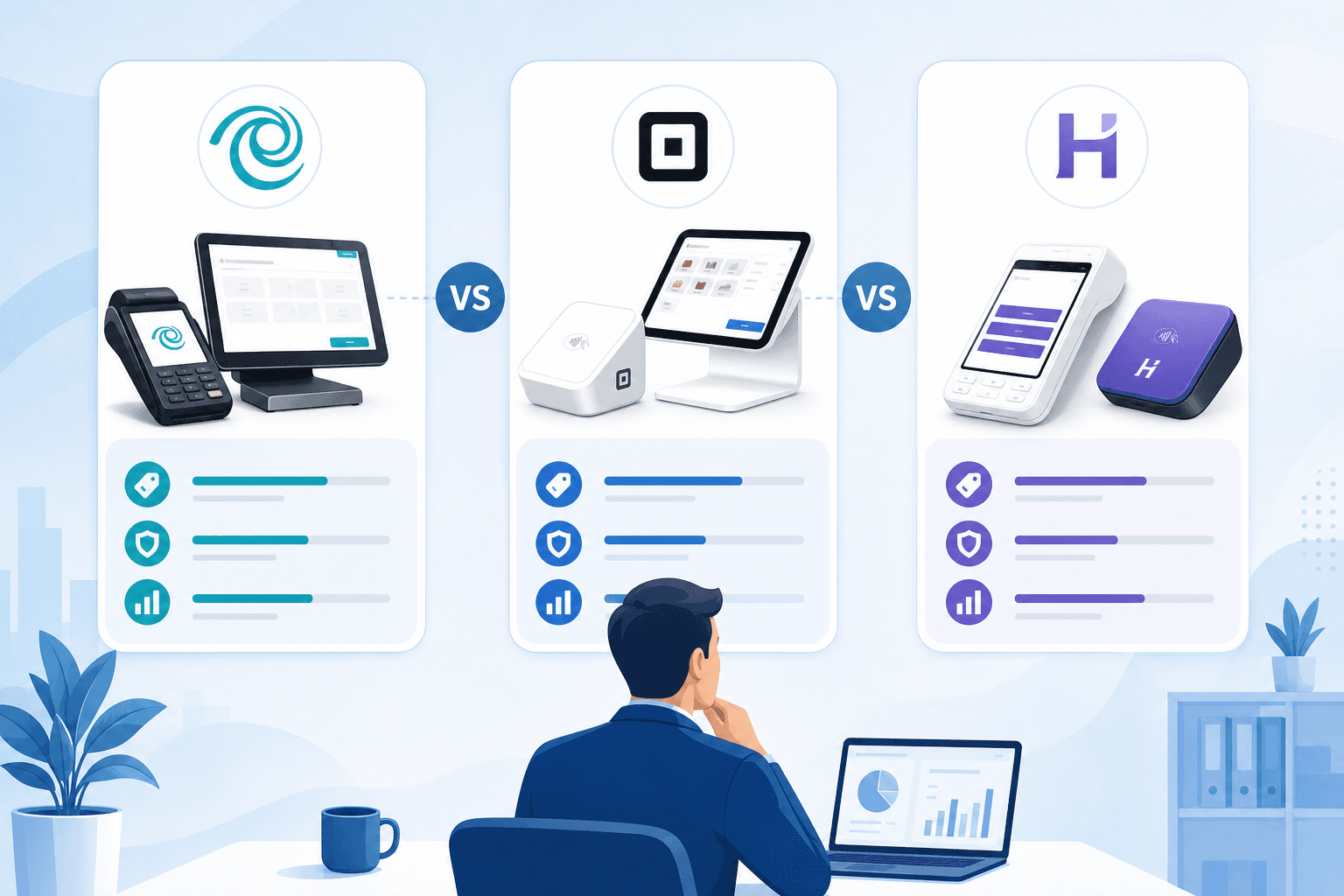
If you run a business in Canada and have started shopping for a payment processor, you have probably landed on the same three names over and over: Moneris, Square, and Helcim. All three are legitimate, widely used options, but they are built for different kinds of businesses and priced in very different ways. Picking the wrong one does not usually mean you get a bad processor, it means you pay more than you need to, or you end up fighting a system that was not designed for how you actually operate.
This comparison is meant to help you understand the real differences between Moneris vs Square vs Helcim, so you can ask the right questions before you sign anything. We will walk through pricing structures, contract terms, hardware, and the kinds of businesses each tends to suit, then show you what to check before you commit to any processor, including the option of interchange-plus pricing through a provider like PaymentsPlus.
Why This Comparison Matters for Canadian Businesses
Payment processing is one of those recurring costs that quietly affects your margins every single month, yet many business owners pick a processor once and never revisit it. In Canada, we also have our own considerations that do not always come up in U.S.-focused reviews: CAD settlement, interchange rates set by Visa and Mastercard Canada, provincial sales tax handling, and PCI compliance expectations that apply no matter which processor you use.
Because Moneris, Square, and Helcim each take a different approach to pricing and contracts, the "best" option really depends on your transaction volume, average sale size, and how you take payments, in person, online, or both. Rather than declaring a single winner, this article breaks down what each processor is generally known for, so you can match it against your own numbers. For specifics on current fees, you should always check each provider's own published pricing, since rates and terms change over time.
Moneris: The Established Canadian Bank-Affiliated Option
Moneris is one of the most recognizable names in Canadian payment processing, in part because it grew out of a partnership between major Canadian banks. That history means Moneris has broad brand recognition and a long-standing presence in retail and hospitality across the country.
What to Know About Moneris
- Moneris offers a range of hardware and software options, from countertop terminals to integrated POS systems.
- Pricing structures and contract terms vary by plan, so you will want to review Moneris's current published pricing directly before comparing it to other quotes.
- As a long-established provider, Moneris is often bundled with business banking relationships, which can be convenient but is also worth comparing against standalone processors.
If your business already banks with one of the major Canadian banks, you may have encountered Moneris through that relationship. That is not necessarily a reason to choose it, or to avoid it, but it is worth confirming that the pricing structure and contract terms actually fit your business rather than defaulting to it because it is familiar.
Square: Simple Flat-Rate Pricing for Small and Mobile Businesses
Square built its reputation on simplicity. Its flat-rate pricing model and easy-to-use hardware made it popular with small businesses, mobile vendors, and anyone who wanted to start accepting cards quickly without a complicated application process.
Where Square Tends to Fit
- Businesses with lower or inconsistent transaction volume that value predictable, flat per-transaction pricing.
- Mobile businesses, pop-ups, and service providers who need a simple card reader and point-of-sale app.
- Businesses that want software and hardware from a single vendor with minimal setup friction.
Where Square May Cost More as You Grow
Flat-rate pricing is easy to understand, but it does not adjust as your volume grows or as your transaction mix shifts toward lower-cost card types. This is a common pattern with flat-rate processors generally, not just Square, so it is worth comparing against Stripe comparison if you are also weighing other flat-rate providers. As always, check Square's current published pricing directly, since rates can vary by plan and transaction type.
Helcim: Interchange-Plus Pricing With a Software Focus
Helcim has positioned itself as a more transparent alternative to flat-rate processors, using interchange-plus pricing and offering built-in tools like invoicing and customer management. For businesses that have outgrown simple flat-rate pricing but are not ready for a fully customized merchant account setup, Helcim is often mentioned as a middle option.
What to Know About Helcim
- Helcim uses interchange-plus pricing, which can be more transparent than flat-rate models since it separates the underlying card network cost from the processor's markup.
- It includes software features such as invoicing and recurring billing alongside payment processing.
- As with any provider, you should review Helcim's current published pricing and contract terms directly, since volume discounts and account requirements can affect what you actually pay.
Comparing the Three: What Actually Matters
When you put Moneris vs Square vs Helcim side by side, the differences that matter most to a Canadian business owner usually come down to a handful of factors.
Pricing Structure
- Flat-rate (common with Square): one rate per transaction type, simple to predict, but it does not reflect the actual cost of each card.
- Interchange-plus (used by Helcim and by PaymentsPlus): the card network's interchange cost plus a clearly stated markup, so you can see exactly what you are paying for.
- Tiered or bundled plans (common with bank-affiliated processors like Moneris): pricing may bundle hardware, software, and processing together, which can make it harder to isolate your actual processing cost.
Contract Terms and Fees
Contract length, early termination fees, and equipment costs vary significantly across providers and even across plans within the same provider. Before signing with any processor, Moneris, Square, Helcim, or otherwise, ask directly:
- Is there a minimum contract term?
- Is there a fee to cancel or switch providers later?
- Is PCI compliance included, or billed separately?
- How quickly are funds deposited, and is that the standard timeline or a premium option?
- What happens to leased or purchased hardware if you switch processors?
Hardware and Integration Needs
If you are running a retail counter, a restaurant floor, or an e-commerce store, your hardware and integration needs are different. Square and Moneris both offer their own hardware ecosystems, while Helcim leans more toward software and online tools. If you need a solution that connects to a specific platform, such as Shopify, WooCommerce, or Odoo, ask any provider you are considering exactly how that integration is set up and tested before you commit.
Where PaymentsPlus Fits Into the Decision
Comparing Moneris vs Square vs Helcim is a useful exercise, but it should not be the end of your research. Many Canadian businesses find that a dedicated interchange-plus provider gives them more transparency and flexibility than either a bank-bundled plan or a flat-rate app-based processor.
Here is what PaymentsPlus offers as part of that comparison:
- Interchange-plus pricing: you see the card network cost and our markup separately on every statement, rather than a blended rate that hides the breakdown.
- Next-day funding as the standard, with same-day funding available for qualified merchants.
- No long-term contracts and no cancellation fees, so you are not locked in if your needs change.
- PCI compliance included, so that cost is not a surprise line item.
- Hardware placement options for qualified merchants, matched to how you actually take payments.
- An integration service, where we set up your merchant account for online payments and connect it to your platform, whether that is Shopify, WooCommerce, or Odoo, working with you or your developer and testing everything before go-live.
- A team that responds within 24 hours when you have questions.
Rather than asking you to guess at potential savings, we build a free quote from your actual processing statement, so you can see the dollar difference compared to what you are paying now. If you want to see how your current provider stacks up, Use our savings calculator or Get a free quote based on your real numbers.
Matching the Processor to Your Business Type
Different business models tend to lean toward different priorities in this comparison:
- Retail stores with steady foot traffic often benefit from transparent interchange-plus pricing once volume grows past the point where flat-rate fees add up. See our Retail solutions for more on this.
- Restaurants and cafes need fast, reliable hardware and funding timelines that keep cash flow moving. Check out Restaurant solutions and Hospitality solutions for industry-specific considerations.
- E-commerce businesses care most about integration quality and how well the processor connects to their platform. Our E-commerce solutions page covers what to look for.
- Healthcare, salon and spa, automotive, construction, and nonprofit organizations each have their own mix of in-person and invoice-based payments; see Healthcare solutions, Salon & spa solutions, Automotive solutions, Construction solutions, and Nonprofit solutions for more detail.
If you are based in a specific city, local considerations like regional competition and support availability can matter too. We work with businesses in Toronto payment processing, Vancouver payment processing, Calgary payment processing, Montreal payment processing, and Ottawa payment processing, among other Canadian markets.
Making Your Final Decision
Before you commit to any processor, take these steps:
- Pull your last three to six months of processing statements. You cannot compare pricing structures meaningfully without real numbers.
- Check each provider's current published pricing directly on their website, since rates and plans change.
- Ask about contract length and cancellation fees in writing, not just verbally.
- Confirm PCI compliance costs are included or clearly disclosed.
- Test the integration with your platform before fully committing, especially for e-commerce.
If you want a side-by-side look at how other providers compare, you can Compare processors or review specific match-ups like Clover comparison, TD comparison, Desjardins comparison, Lightspeed comparison, and Chase comparison.
Conclusion
There is no single answer to Moneris vs Square vs Helcim that applies to every Canadian business. Moneris brings bank-affiliated familiarity, Square offers simplicity for smaller or mobile operations, and Helcim brings interchange-plus transparency with built-in software tools. The right choice depends on your transaction volume, your sales channels, and how much you value contract flexibility.
Whatever you decide, do not skip the step of reviewing your actual statement against a real quote. Contact our team or Get a free quote built from your own processing numbers, so you can see the dollar difference for your business, not a generic estimate.