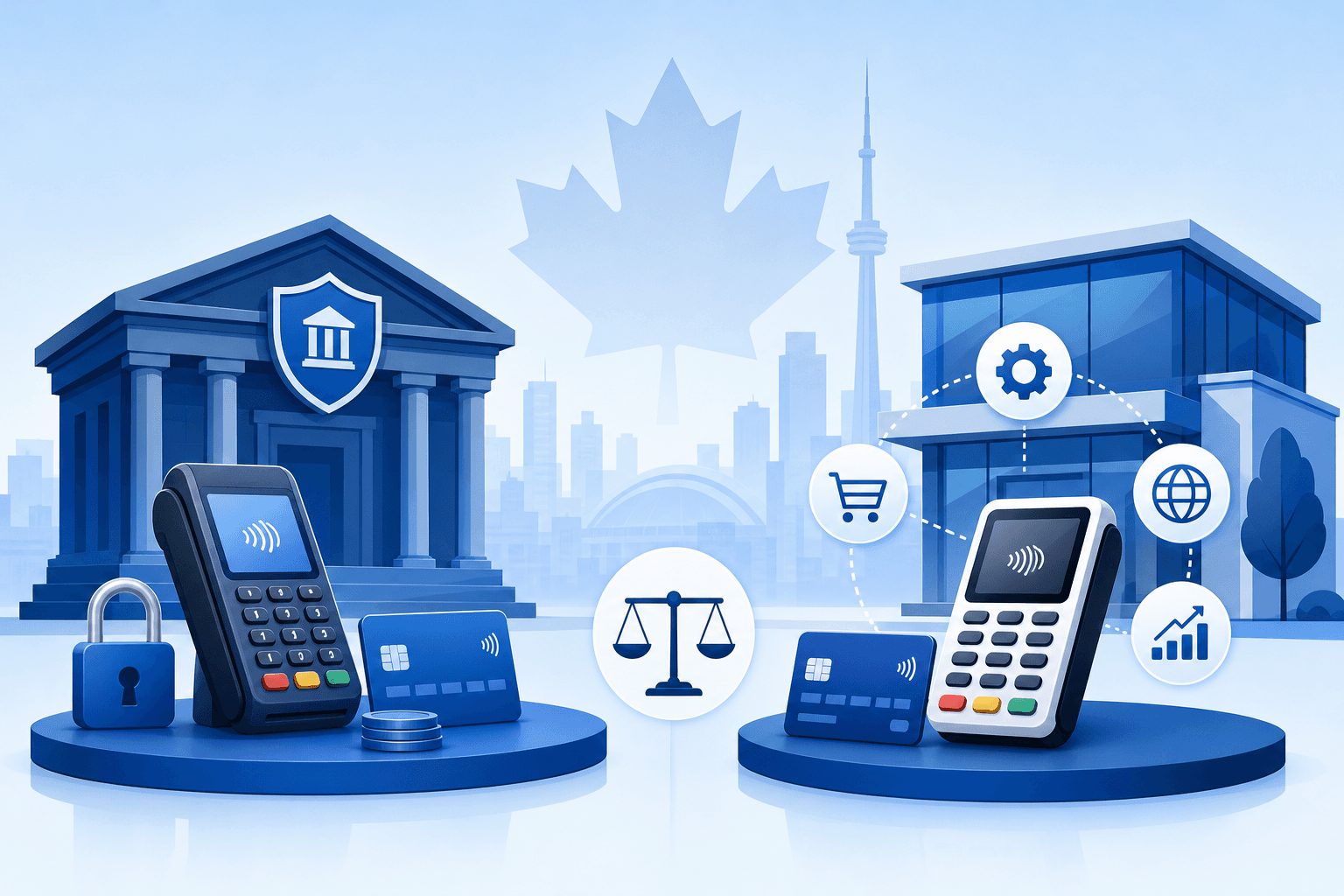
If you've ever sat across from your bank manager and been offered a "convenient" payment processing bundle alongside your business account, you've already encountered one side of a debate that affects nearly every Canadian business owner: should you process payments through your bank, or through an independent payment processor?
It's a decision that seems simple on the surface but can have a real impact on your bottom line, your customer experience, and how much support you get when something goes wrong. With interchange fees, monthly statements full of confusing line items, and long-term contracts, many Canadian business owners simply default to whatever their bank offers without exploring other options.
This guide breaks down the real differences between bank-owned and independent payment processors in Canada, so you can make an informed decision based on your specific business needs - not just convenience. Whether you run a restaurant in Toronto, a retail shop in Vancouver, or an e-commerce store shipping across the country, understanding these options could save you thousands of dollars a year.
What Are Bank-Owned Payment Processors?
Bank-owned payment processors are merchant services offered directly by Canada's major financial institutions - think TD, RBC, Scotiabank, BMO, CIBC, and Desjardins. When you open a business account, these banks often pitch their in-house payment processing as a bundled, "one-stop-shop" solution.
How They Work
With a bank-owned processor, your business banking and your payment processing live under one roof. Funds from card transactions are often deposited faster since everything flows through the same institution, and you typically have a single point of contact for account issues - at least in theory.
Common Examples in Canada
- TD Merchant Solutions - bundled with TD business banking
- RBC Payment Solutions - tied to RBC business accounts
- Desjardins Payment Solutions - popular with Quebec businesses
- Scotiabank and BMO merchant services - similar bundled offerings
If you're currently using one of these, it's worth taking a closer look at how their pricing stacks up. Our TD comparison and Desjardins comparison pages break down exactly what Canadian businesses are paying through these bank-bundled plans.
What Are Independent Payment Processors?
Independent payment processors are third-party companies that specialize exclusively in payment processing - it's their entire business, not a side offering. Companies like PaymentsPlus, Stripe, and various ISOs (Independent Sales Organizations) operate separately from traditional banks, giving them more flexibility in pricing, technology, and customer service models.
How They Work
Independent processors partner with acquiring banks behind the scenes to move money, but your day-to-day relationship is with the processor itself. This means dedicated account management, more competitive and often transparent pricing, and faster-moving customer support that isn't buried in a massive banking bureaucracy.
Common Examples in Canada
- PaymentsPlus - Canadian-focused, transparent pricing, personalized support
- Stripe - developer-friendly, popular for online businesses
- Square and Lightspeed - POS-centric solutions for retail and restaurants
If you're evaluating software-driven options, our Stripe comparison and Lightspeed comparison pages can help clarify where these tools fit for different business types.
Bank-Owned vs Independent Payment Processors in Canada: Key Differences
When weighing bank-owned vs independent payment processors in Canada, the differences typically come down to five core areas: pricing, flexibility, customer service, technology, and contract terms.
1. Pricing Structure
Banks often use tiered pricing models that bundle different card types into categories like "qualified," "mid-qualified," and "non-qualified" rates - a structure that can obscure your true costs and make it hard to know what you're actually paying per transaction. Independent processors, on the other hand, are more likely to offer interchange-plus pricing, which is more transparent and often cheaper for businesses processing meaningful volume.
Since Canadian interchange fees are regulated but still vary by card network and card type, understanding your effective rate matters. Use our savings calculator to see exactly how much you could save by switching from a tiered bank model to a transparent processor.
2. Customer Service and Support
This is where many business owners feel the biggest difference. Bank call centres often route merchant service issues through general support lines, meaning long hold times and representatives who aren't specialists in payment processing. Independent processors tend to offer dedicated account managers and specialized support teams who understand the nuances of POS systems, chargebacks, and integrations.
3. Technology and Equipment
Independent processors frequently offer more modern, flexible hardware and software options - including cloud-based POS systems, mobile card readers, and e-commerce integrations. Banks can be slower to roll out new technology and may lock you into older or proprietary terminals.
If you're running a POS-dependent business, it's worth comparing options directly. Our Clover comparison page outlines what to expect from one of the most popular POS ecosystems used by independent processors.
4. Contract Flexibility
Bank merchant agreements often come with longer contract terms, early termination fees, and equipment leases that can be difficult to exit. Independent processors - especially Canadian-focused ones - are increasingly offering month-to-month agreements with no long-term lock-in, which gives your business more room to adapt as it grows.
5. Industry-Specific Solutions
Independent processors often build specialized solutions tailored to specific industries, while banks tend to offer one-size-fits-all packages. For example, a restaurant needs tip adjustment and tableside payment features that differ significantly from what a healthcare clinic or construction business needs.
Which Option Is Right for Your Business?
There's no universal answer - the right choice depends on your business type, transaction volume, and priorities.
Consider a Bank-Owned Processor If:
- You strongly value having everything under one financial institution
- Your transaction volume is very low and pricing differences are minimal
- You already have a long-standing relationship with a bank-assigned representative you trust
Consider an Independent Processor If:
- You want transparent, competitive pricing with no hidden fees
- You need modern POS technology or e-commerce integrations
- You want dedicated support instead of a general bank call centre
- You're growing and need flexible contract terms
- You operate in a specialized industry with unique payment needs
For most small and medium Canadian businesses, the flexibility and cost savings of independent processors make them the more attractive long-term option - particularly as your transaction volume grows and those percentage-point differences start adding up to real dollars.
Industry-Specific Considerations
Your industry plays a major role in which processing option makes sense.
- Restaurants need fast, tip-friendly terminals and integrations with kitchen systems - see our restaurant solutions for tailored options.
- Retail stores benefit from inventory-integrated POS systems - check out our retail solutions page.
- E-commerce businesses need seamless online checkout and fraud protection - our e-commerce solutions cover what to look for.
- Healthcare providers require secure, compliant payment handling - see our healthcare solutions.
- Salons and spas benefit from appointment-integrated payments - our salon & spa solutions page has more detail.
- Construction companies often need mobile and invoice-based processing - our construction solutions outlines the best fit.
- Hotels and hospitality businesses need flexible, high-volume processing - our hospitality solutions page can help.
- Nonprofits often need low-cost donation processing - our nonprofit solutions are built for that.
No matter your sector, comparing your options side-by-side is the best way to avoid overpaying. Compare processors to see how bank-owned and independent options stack up for your specific business type.
Regional Considerations for Canadian Businesses
Payment processing needs can also vary by region, especially when it comes to local support and in-person service availability.
- Businesses in the GTA can explore Toronto payment processing options tailored to the local market.
- In British Columbia, check out Vancouver payment processing for region-specific insights.
- Alberta business owners can review Calgary payment processing for local rates and support.
- Quebec businesses should look at Montreal payment processing, especially given Desjardins' strong presence in the province.
- Businesses in the capital region can explore Ottawa payment processing for localized options.
Making the Switch: What to Expect
If you've decided an independent processor is the better fit, switching is often easier than business owners expect. Most reputable Canadian processors will:
- Review your current statements to identify savings opportunities
- Help you understand your current contract and any exit terms
- Set up new equipment or integrate with your existing POS
- Provide training for you and your staff
- Offer ongoing support as your business evolves
The key is working with a provider who understands Canadian regulations, interchange structures, and the specific needs of your industry - not a generic international provider unfamiliar with the Canadian market.
Final Thoughts
The decision between bank-owned vs independent payment processors in Canada ultimately comes down to what your business values most: convenience within an existing banking relationship, or transparency, flexibility, and cost savings from a specialized provider. For most growing Canadian small and medium businesses, independent processors tend to offer a better combination of pricing, technology, and personalized support.
Before you renew your next merchant agreement or sign up for a bank's bundled offering, take the time to compare your options. The savings and service improvements can be significant - and switching is often simpler than you think.
Ready to see what you could be saving? Get a free quote today, or contact our team to talk through your specific business needs with a Canadian payment processing specialist.