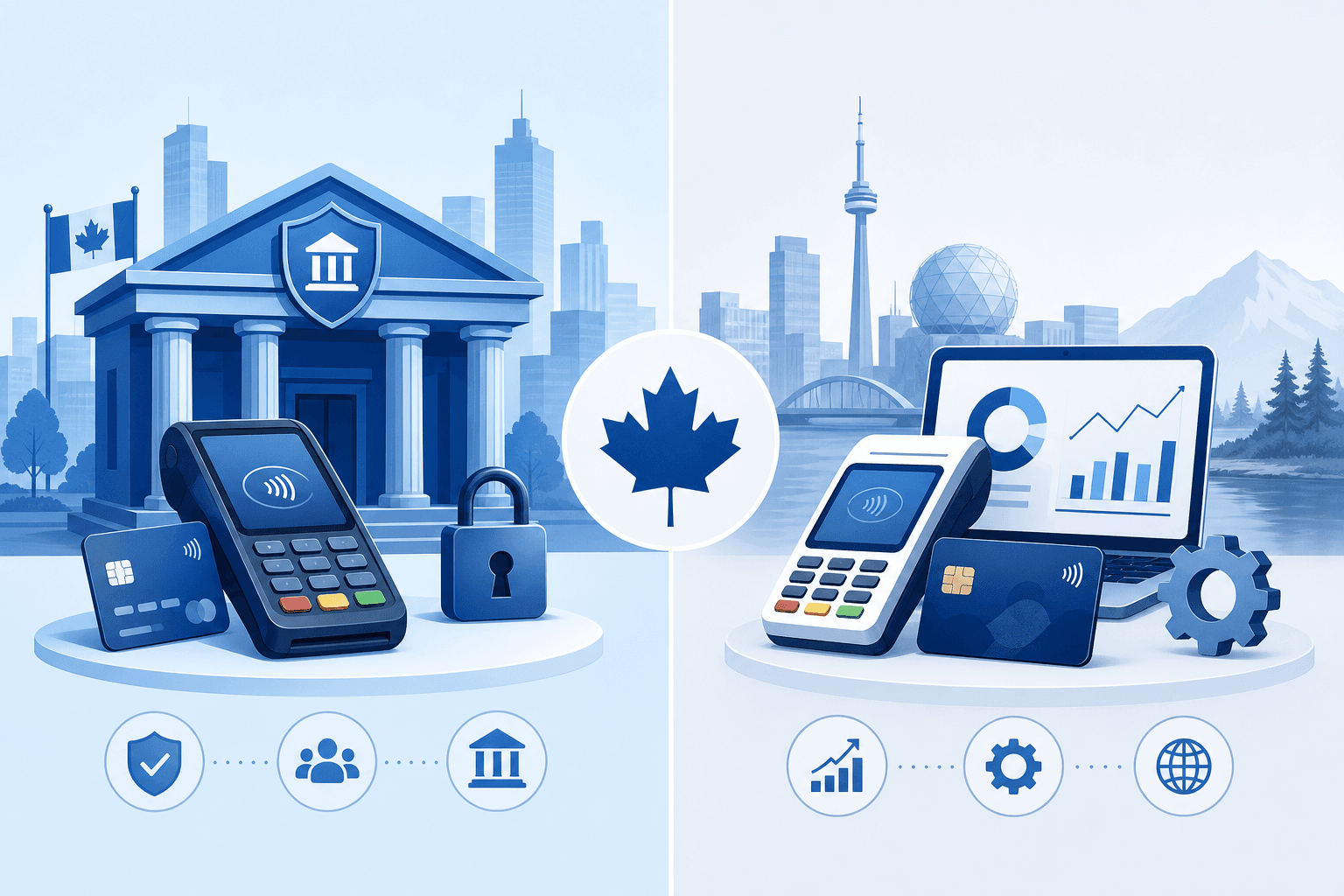
If you've ever sat down with a stack of merchant statements trying to figure out why your processing costs keep creeping up, you're not alone. One of the first decisions every Canadian business owner faces when choosing how to accept payments is whether to go with a bank-owned processor or an independent one. It sounds like a minor technical distinction, but it can shape your pricing, your contract terms, your funding speed, and how quickly someone picks up the phone when something goes wrong.
This decision matters more in Canada than many business owners realize. Our market is dominated by a handful of major banks that bundle payment processing with business banking, alongside a growing number of independent processors competing on transparency and service. Understanding bank-owned vs independent payment processors in Canada can mean the difference between a processing relationship that quietly drains your margins and one that works with you as your business grows.
In this article, we'll break down how each model works, where they differ in practice, and what questions to ask before you sign anything.
What Is a Bank-Owned Payment Processor?
A bank-owned payment processor is exactly what it sounds like: a merchant services division operated directly by one of Canada's major banks. If you've ever been offered "free" payment processing when you opened a business bank account, there's a good chance it was a bank-owned processing product.
These processors are typically bundled with business banking packages. The appeal is convenience: one institution, one relationship manager, one login for your banking and your merchant account. For some business owners, especially those who value having everything under one roof, this simplicity is attractive.
However, bundling doesn't always mean better pricing or service. Bank-owned processors often use tiered or blended pricing models that can obscure the actual cost of accepting a card. They may also have less flexibility around contract terms, since the processing product is designed to fit within the bank's broader suite of services rather than being tailored to your specific transaction mix. If you're currently with a major bank and want to see how your rates stack up, our TD comparison breaks down how bank-bundled processing tends to work.
What Is an Independent Payment Processor?
An independent payment processor operates separately from any single bank. These companies focus exclusively on payment processing and often compete by offering more transparent pricing, more flexible contracts, and dedicated customer support.
Independent processors in Canada range widely in size and business model. Some operate as resellers of larger processing networks, while others build more direct relationships with merchants. What tends to set the better independent processors apart is pricing transparency and responsiveness, areas where large banking institutions, with their layered organizational structures, can struggle to compete.
At PaymentsPlus, for example, we operate on interchange-plus pricing: the card network's actual interchange cost plus our markup, shown as separate line items on every statement. That structure means you can always see exactly what you're paying for the transaction itself versus what you're paying us. Compare processors to see how this stacks up against other pricing models you might encounter.
Key Differences: Bank-Owned vs Independent Payment Processors in Canada
Pricing Structures
This is often where the biggest gap shows up. Bank-owned processors commonly use tiered pricing, where transactions are grouped into categories like "qualified," "mid-qualified," and "non-qualified," each with different rates. The problem is that it's not always clear which transactions fall into which tier, and the bank decides the categorization.
Independent processors, particularly those using interchange-plus pricing, separate the card network's cost from the processor's markup. This doesn't guarantee a lower cost for every business, but it does mean you can actually see what you're being charged and why. If you want to know where your business currently stands, use our savings calculator or request a free quote built directly from your existing processing statement, which shows the dollar difference rather than a vague estimate.
Contract Terms and Flexibility
Bank-owned processing products are often tied to broader banking relationships, which can mean longer commitments and less room to negotiate. Switching processors later, even if your needs change, may involve more friction if your merchant account is woven into your overall banking setup.
Independent processors vary in their contract terms, but many, including PaymentsPlus, operate with no long-term contracts and no cancellation fees. That matters for a growing business: your payment needs in year one may look very different in year three, and you shouldn't have to pay a penalty to adapt.
Funding Speed
How quickly funds land in your account affects your cash flow, particularly for businesses with tight margins or seasonal demand. Bank-owned processors have their own funding schedules, and you should check their current published terms directly.
At PaymentsPlus, next-day funding is the standard, with same-day funding available for qualified merchants. If consistent, predictable access to your funds is a priority, this is worth asking about directly when comparing providers.
Customer Support and Responsiveness
This is an area where size can work against larger institutions. A call to a major bank's merchant services line may route through several departments before you reach someone who can actually resolve your issue. Independent processors, particularly smaller ones, often have more direct lines of communication.
At PaymentsPlus, we respond within 24 hours, which matters when a terminal goes down on a Saturday or a deposit looks off. Check any provider's current published support channels and response commitments before you sign, since this varies significantly across the industry.
Equipment and Integration Support
Both bank-owned and independent processors offer hardware and software options, but the setup experience differs. Independent processors tend to offer more flexibility in hardware placement options for qualified merchants, and many provide more hands-on help connecting your merchant account to the platforms you already use.
For example, if you're running an online store, our integration service involves setting up your merchant account and connecting it to your platform, whether that's Shopify, WooCommerce, or Odoo, using the payment options that platform supports, and testing everything with you before go-live. If you're on Odoo specifically, take a look at our Odoo Clover integration page for details on how that connection works.
Which Option Makes Sense for Your Business?
There's no universal answer here. The right choice depends on your industry, your transaction volume, how you like to bank, and how much you value pricing transparency versus one-stop convenience.
When Bank-Owned Might Seem Appealing
- You strongly prefer having banking and processing under a single login
- Your transaction volume is very low and pricing differences matter less to you
- You already have a long-standing relationship with a specific bank and value that continuity
When Independent Processors Tend to Fit Better
- You want to see exactly what you're paying in interchange costs versus markup
- You're growing and don't want to be locked into long-term contracts
- You operate an online business and need help integrating payments into a specific platform
- You want faster, more direct support when something goes wrong
- You're comparing hardware options and want more flexibility in your point-of-sale setup
Business type matters too. A restaurant juggling tableside payments and delivery apps has different needs than a construction company invoicing large jobs, or a salon booking recurring appointments. Our restaurant solutions, construction solutions, and salon & spa solutions pages go into more detail on how processing needs shift by industry, and our retail solutions, healthcare solutions, and e-commerce solutions pages cover other common business types.
How to Compare Offers Side by Side
Regardless of which type of processor you're evaluating, bring the same questions to every conversation:
- What is the pricing model? Ask specifically whether it's interchange-plus, tiered, or flat-rate, and request a sample statement.
- What are the contract terms? Confirm the length, renewal terms, and whether cancellation fees apply.
- How fast is funding? Ask whether next-day funding is standard and whether same-day options exist for qualified merchants.
- What does PCI compliance cost? Some processors charge extra for this; at PaymentsPlus, PCI compliance is included.
- How is hardware handled? Ask about hardware placement options and whether you're locked into specific equipment.
- How responsive is support? Ask directly what their response time commitment looks like.
The best way to compare is with real numbers. Pull your last few processing statements and ask each provider, bank-owned or independent, to show you exactly how their pricing would apply to your actual transaction mix. That's the same approach we use when building a free quote: it's based on your own statement, not a generic estimate, so you see the dollar difference clearly.
Regional Considerations for Canadian Businesses
Payment processing needs can also vary by region. Businesses in Quebec may want to compare options like our Desjardins comparison given that institution's strong regional presence. Business owners in major metro areas can also find location-specific guidance through our Toronto payment processing, Vancouver payment processing, Calgary payment processing, Montreal payment processing, and Ottawa payment processing pages.
Making the Switch
If you're currently with a bank-owned processor and considering a change, the process typically starts with a statement review. This lets you see, in dollar terms, how your current costs compare to an interchange-plus model. From there, you can weigh that against contract terms, funding speed, and support responsiveness to decide if switching makes sense for your business.
Many business owners assume switching processors is disruptive, but a well-run transition should involve minimal downtime, particularly when your new provider handles the setup and testing before you go live with customers.
Final Thoughts
The debate between bank-owned vs independent payment processors in Canada doesn't have a single right answer, but it does have a right answer for your business. Bank-owned processors offer convenience through bundling, while independent processors tend to compete on transparency, flexibility, and responsiveness. The best way to decide is to look at your own numbers rather than general assumptions about either model.
If you want to see exactly where your business stands, get a free quote built from your own processing statement, or contact our team to talk through your specific setup. You can also explore our services to see the full range of solutions available for Canadian businesses of every size.