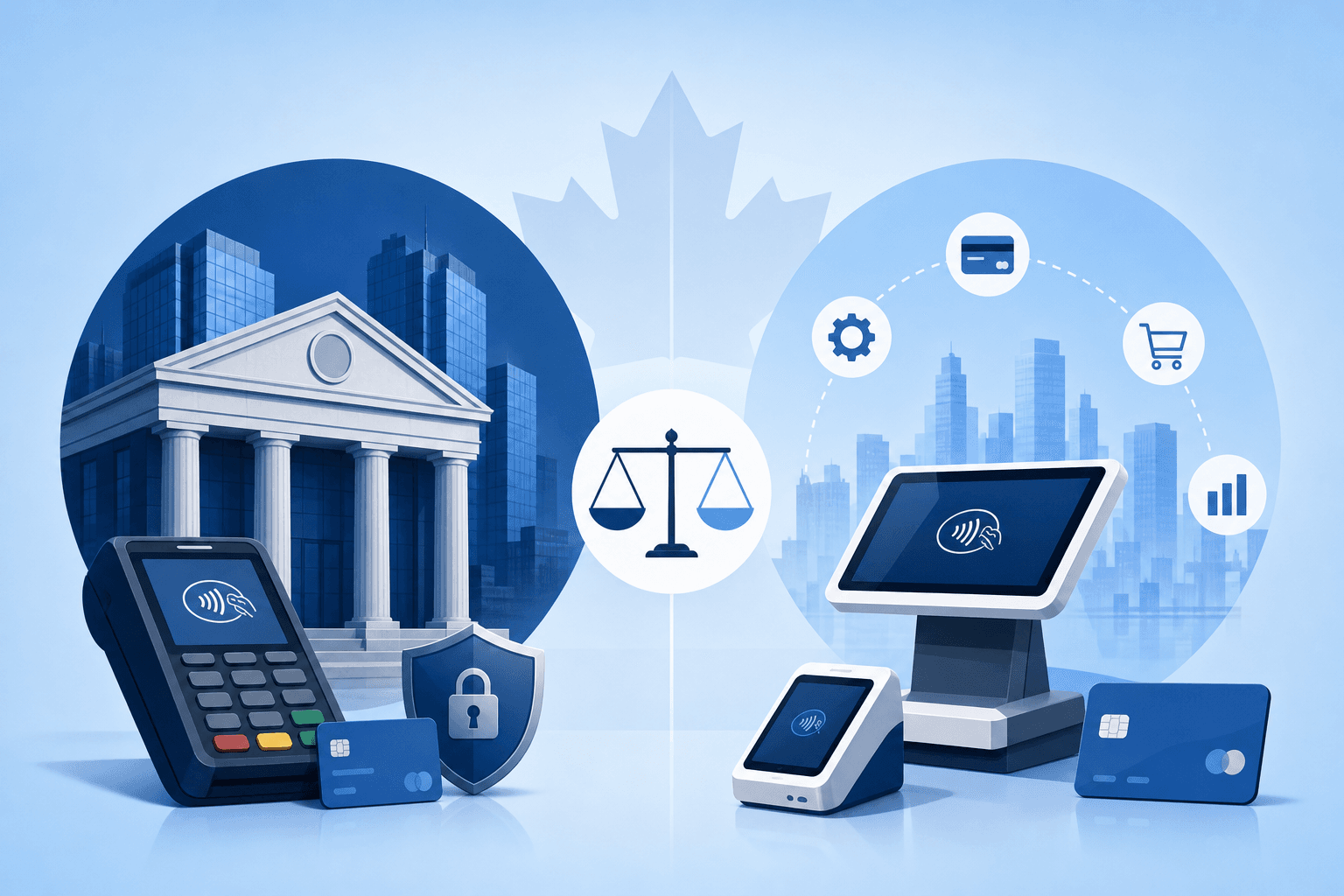
If you've shopped around for payment processing in Canada, you've likely noticed two very different kinds of providers competing for your business: the big banks and a growing field of independent processors. Both can accept Visa, Mastercard, and Interac transactions. Both will get money into your account. But how they price, support, and structure their services can look quite different once you dig into the details.
For Canadian small and medium business owners, this choice matters more than it might seem at first glance. Payment processing fees are a recurring cost that touches every sale, and the terms attached to your merchant account can affect your flexibility for years. Understanding Bank-Owned vs Independent Payment Processors in Canada is the first step toward making a decision that fits your business rather than one that just happens to be convenient.
In this guide, we'll break down how each model works, where they tend to differ on pricing and contracts, and what questions to ask before you commit. Whether you run a restaurant in Toronto, a retail shop in Vancouver, or an e-commerce store shipping across the country, the goal is the same: clarity on what you're actually paying for.
How Bank-Owned Payment Processors Work
Canada's major banks, including the familiar national names, have historically offered merchant services bundled alongside business banking. If you already have a business chequing account, it's often an easy conversation to add card processing through the same institution.
The Appeal of Staying With Your Bank
There's a comfort factor here. You already have a relationship, a branch to visit, and a single login for banking. Some business owners like consolidating services with one institution for simplicity, and bank-owned processing can integrate smoothly with existing business accounts.
Where It Can Get Complicated
The tradeoff is that bank-owned processing has traditionally come with less transparency and less flexibility. Pricing structures can be harder to decode, contracts have often included longer terms, and customer support can route through general banking lines rather than payments specialists. If you want specifics on a particular bank's current rates or contract terms, check that provider's published pricing directly, since terms change and vary by business type. For a closer look at one major bank's offering, see our TD comparison.
How Independent Payment Processors Work
Independent processors are companies that focus solely on payment processing rather than offering it as one piece of a broader banking relationship. They still move transactions through the same Visa and Mastercard networks and the same Interac rails as the banks, but they build their own pricing, support, and contract structures around merchants specifically.
Flexibility and Transparency
Because payments are the core business, independents often compete on clarity and flexibility rather than bundling. At PaymentsPlus, for example, we use interchange-plus pricing, which means you see the actual card network cost plus our markup listed separately on every statement, rather than a blended rate that obscures what you're really paying. We also don't lock merchants into long-term contracts or charge cancellation fees, so you're not stuck if your business needs change.
Funding and Support
Independent processors also tend to be built around merchant operations day to day. PaymentsPlus offers next-day funding as the standard, with same-day funding available for qualified merchants. PCI compliance is included, and our team responds within 24 hours when you reach out. For businesses that need physical terminals, hardware placement options are available for qualified merchants.
Comparing the Two Models Side by Side
When you line up Bank-Owned vs Independent Payment Processors in Canada, a few consistent themes tend to emerge, though specifics vary by provider and by business.
- Pricing structure: Banks have historically favored tiered or blended pricing models that can be harder to break down. Independents more commonly offer interchange-plus pricing, where the markup is disclosed separately.
- Contract terms: Bank merchant agreements have often included multi-year terms and cancellation fees. Many independents, including PaymentsPlus, operate without long-term contracts or cancellation fees.
- Support focus: Bank support often routes through general business banking channels. Independent processors typically have support built specifically around payments and merchant accounts.
- Funding speed: This varies by provider and should be confirmed directly, since funding timelines are one of the more commonly advertised differentiators.
- Integration with other services: Banks may tie processing to broader banking products. Independents often focus on connecting processing to the platforms you already use, like a POS system or online store.
If you want to see how specific providers stack up feature by feature, you can compare processors directly, including names like Chase Paymentech for larger or enterprise-style processing needs. See our Chase comparison for more detail, or our Desjardins comparison if you're a Quebec-based business weighing a regional bank option.
What Actually Matters for Your Business
Rather than assuming one model is universally better, it helps to think through what your business actually needs.
Transaction Volume and Type
A high-volume e-commerce store processing thousands of transactions a month has very different needs than a seasonal retail shop. Higher volume businesses tend to feel pricing differences more acutely, since even small percentage differences compound quickly across many transactions. If you run an online store, our e-commerce solutions page covers what to look for in online payment setups specifically.
How You Accept Payments
Do you need in-person terminals, an online checkout, or both? Restaurants and hospitality businesses often need POS systems that handle tableside payments and tipping. See our restaurant solutions and hospitality solutions pages for examples. Retailers may prioritize integrated POS and inventory tools, covered in our retail solutions page. Healthcare providers, salons, spas, and nonprofits all have their own common patterns worth reviewing on our healthcare solutions, salon & spa solutions, and nonprofit solutions pages.
Growth and Flexibility
If your business is growing or your needs might change, long-term contracts and cancellation fees can become a real constraint. Ask any provider you're considering, bank-owned or independent, what happens if you want to switch providers or renegotiate terms down the road.
Platform Integrations
If you sell online or run your operations through a platform like Shopify, WooCommerce, or Odoo, it's worth asking how a processor handles that connection. PaymentsPlus offers an integration service where we set up the merchant account for online payments and connect it to your platform, using the payment options that platform supports, working directly with you or your developer and testing everything before go-live. If you use Odoo specifically, see our Odoo Clover integration page for details.
How to Evaluate Your Current Processing Costs
Whether you're currently with a bank or an independent processor, the clearest way to know if you're getting a fair deal is to look at your actual statement rather than a general rate sheet.
Here's a simple process:
- Pull your last one or two months of processing statements.
- Identify whether your current pricing is blended, tiered, or interchange-plus.
- Look for the total effective rate you're paying, not just the headline rate advertised when you signed up.
- Check for monthly fees, PCI fees, statement fees, or early termination clauses.
- Compare that against what a transparent, interchange-plus structure would look like for your actual transaction mix.
This is exactly what a statement review is designed to do. PaymentsPlus can build a free quote directly from your existing processing statement, showing the dollar difference rather than a generic estimate. You can get a free quote to see where you stand, or use our savings calculator for a quick first look at the numbers.
Regional Considerations Across Canada
Payment processing needs can vary slightly depending on where you operate, particularly when it comes to local business mix and typical transaction types.
- Businesses in Toronto and the GTA often deal with high transaction volumes across retail and hospitality; see our Toronto payment processing page.
- Vancouver businesses, especially in retail and services, can review our Vancouver payment processing page.
- Calgary business owners in construction, automotive, and retail sectors can check our Calgary payment processing page.
- Montreal and Quebec businesses, where Desjardins has a strong regional presence, may want to review our Montreal payment processing page alongside the Desjardins comparison above.
- Ottawa businesses, including many service-based and government-adjacent companies, can see our Ottawa payment processing page.
Construction and automotive businesses, which often deal with larger average transaction sizes and sometimes mobile payment needs on job sites, can review our construction solutions and automotive solutions pages for sector-specific considerations.
Making the Decision: Bank-Owned vs Independent Payment Processors in Canada
There's no single right answer for every business. A bank-owned processor might make sense if you strongly value having everything under one roof and you've confirmed the current rates and terms work for your transaction volume. An independent processor tends to make more sense if you want transparent, itemized pricing, more contract flexibility, and support built specifically around payments.
If you're currently evaluating bank-owned vs independent payment processors in Canada and aren't sure which direction fits your business, the most useful next step is usually a direct comparison using your own numbers rather than general pricing pages. You can also contact our team with questions about your specific setup, whether that's a single retail location, a multi-location restaurant group, or an online store integrating with a new platform.
Conclusion
Choosing between a bank-owned and an independent payment processor comes down to transparency, flexibility, and fit. Banks offer convenience through an existing relationship, while independent processors like PaymentsPlus are built around clear, interchange-plus pricing, no long-term contracts, no cancellation fees, and support focused specifically on payments. The best way to know which model actually saves your business money is to look at your real statement rather than a generic rate comparison.
Ready to see where your business stands? Get a free quote built from your own processing statement, or explore our services to see how PaymentsPlus can support your business day to day.