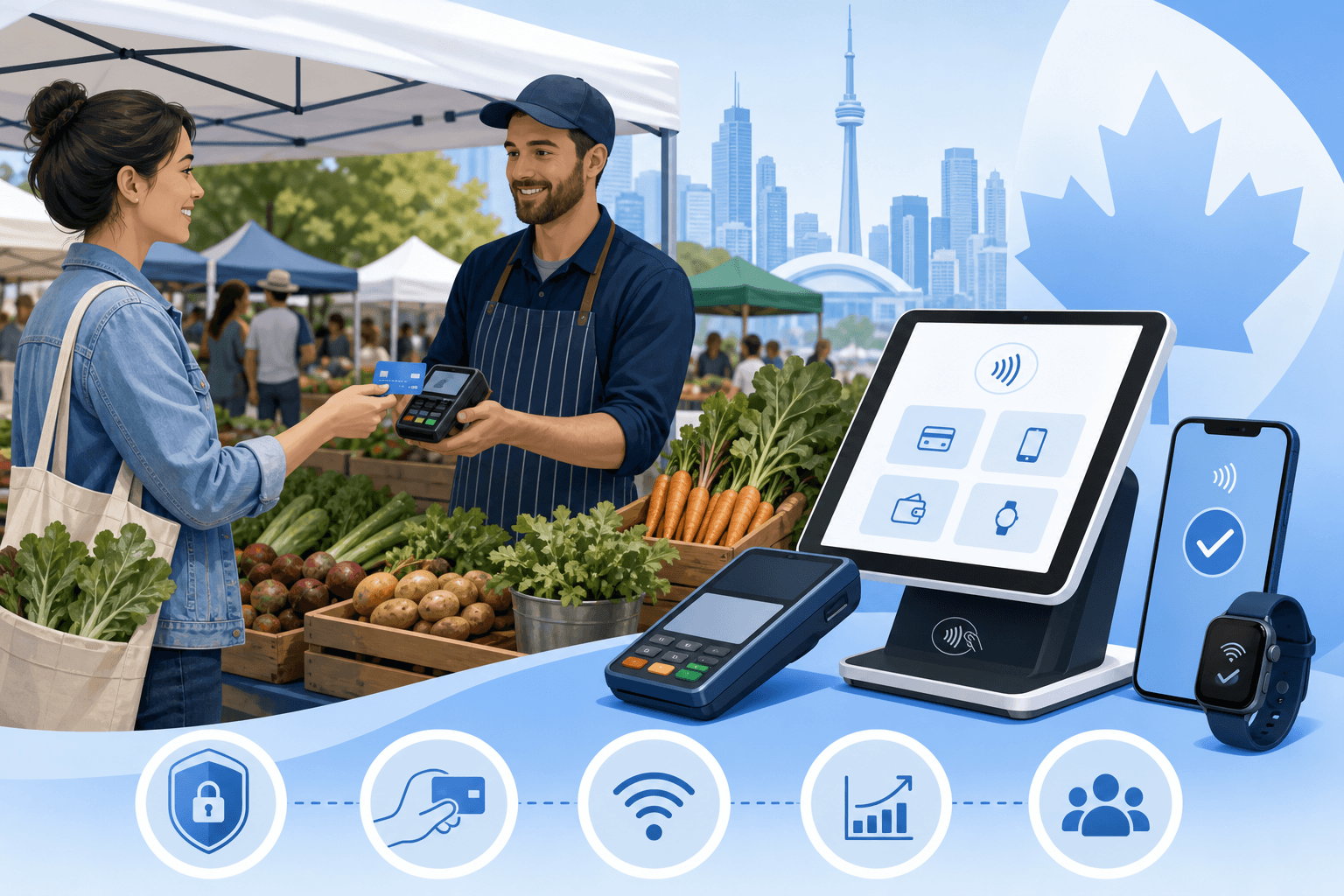
Why Farmers Markets and Seasonal Businesses Need a Different Approach
If you sell produce at a Saturday market in Ottawa, run a Christmas tree lot in December, or operate a lakeside ice cream stand that's open only from May to September, your payment processing needs look nothing like a storefront that's open year-round. You need equipment that works outdoors and off reliable Wi-Fi, pricing that doesn't punish you during slow months, and the flexibility to pause or scale without getting locked into a contract that assumes twelve months of steady revenue.
Many payment processors are built with permanent retail locations in mind: fixed monthly fees, long-term agreements, and hardware that assumes a stable power outlet and internet connection. For a vendor who only processes transactions seasonally, that model can be expensive and impractical. Finding the best payment processing solutions for farmers markets and seasonal businesses in Canada means looking at a different set of priorities: mobility, contract flexibility, transparent pricing, and fast access to your funds.
This guide breaks down what to look for, the common pitfalls seasonal vendors run into, and how to evaluate processors so you keep more of every sale, whether you're processing $200 or $20,000 in a weekend.
What Makes a Payment Processor "Good" for Seasonal Sellers
Mobility and Connectivity
Farmers markets, craft fairs, and pop-up events rarely offer dependable internet. Your processing solution needs to work reliably in a tent, a parking lot, or a rural fairground. Look for:
- Mobile or portable card readers that connect via cellular data or Bluetooth
- Battery life that can get you through a full market day
- Offline transaction capability where available, so a dead zone doesn't mean a lost sale
Flexible Contracts, Not Year-Round Commitments
A business that only operates four to six months a year shouldn't be locked into a processing agreement that charges as though you're open in January. This is one of the biggest traps seasonal vendors fall into: signing up with a provider during a busy summer season, then finding out there's a long-term contract with penalties if you want to switch or cancel once the season ends.
This is where it pays to ask direct questions before signing anything:
- Is there a long-term contract?
- Are there cancellation fees if you stop processing for the off-season?
- What happens to your account if you don't process transactions for several months?
PaymentsPlus offers no long-term contracts and no cancellation fees, which matters a great deal to a business that might be dormant from October through April.
Transparent, Interchange-Plus Pricing
Pricing structure matters even more for seasonal businesses because margins at a market stall are often thinner than in a traditional retail setting. Flat-rate pricing can look simple on the surface, but it often bundles in a markup that isn't visible on your statement. Interchange-plus pricing, by contrast, shows the actual card network cost plus the processor's markup separately, so you can see exactly what you're paying and why.
With PaymentsPlus, that markup is itemized on every statement. If you want to see how your current processor's pricing compares, you can get a free quote built directly from your own processing statement, showing the dollar difference rather than a generic estimate.
Fast Access to Your Funds
Cash flow is critical when your entire season's revenue is compressed into a few months. Waiting several business days for funds to land in your account can create real strain, especially if you're also paying for booth fees, inventory, and seasonal staff. PaymentsPlus provides next-day funding as the standard, with same-day funding available for qualified merchants.
Comparing Processor Types for Farmers Markets and Seasonal Businesses
Traditional Bank-Bundled Processing
Some seasonal vendors default to processing through their business bank, assuming it's the simplest route. That can work, but bank-bundled processing is often less flexible on contract terms and pricing transparency. If you currently process through a bank like TD, it's worth checking their published pricing and terms directly, or reviewing our TD comparison to understand how bank-bundled processing generally differs from independent processors.
Flat-Rate Processors
Flat-rate providers like Stripe are popular with online and app-based sellers because of their simplicity, but flat-rate pricing can work against low-margin, high-volume sellers like market vendors. Before committing, check the provider's current published rates and compare them against an interchange-plus quote. See our Stripe comparison for more on how flat-rate and interchange-plus models differ.
POS-Based Systems
If you also sell at a brick-and-mortar shop or a seasonal pop-up store in addition to a market booth, a point-of-sale system that handles both in-person and online sales might make sense. Systems like Clover or Lightspeed are built for retail environments, and it's worth comparing their published pricing and hardware options. Check our Clover comparison and Lightspeed comparison if a hybrid retail and market setup fits your business.
Independent Processors Built for Flexibility
Independent processors that specialize in small and seasonal business needs, like PaymentsPlus, typically offer more negotiating room on pricing and contract terms than a bank or a one-size-fits-all platform. If you're trying to decide between options, our compare processors page breaks down the differences across providers so you can weigh them side by side.
Practical Tips for Choosing Equipment and Setup
Match Your Hardware to Your Selling Environment
A busy downtown Toronto farmers market has different needs than a rural pumpkin patch outside Calgary. Consider:
- Portable card readers for walking vendors or small booths with limited counter space
- Countertop terminals with battery backup for larger stalls with steady foot traffic
- Tablet-based POS setups if you also want to track inventory across a market season
PaymentsPlus offers hardware placement options for qualified merchants, so it's worth discussing your specific setup, whether that's a single weekend market or a multi-location seasonal operation, with a payments specialist before the season starts.
Plan for Connectivity Gaps
Rural markets and fairgrounds often have spotty cell coverage. Ask any processor you're considering how their equipment handles offline or low-signal transactions, and have a backup plan (such as manually keyed entries or a secondary device) for your busiest sales days.
Think About Your Off-Season
If your business closes for part of the year, ask what happens to your merchant account during that downtime. Some processors charge inactivity fees or require minimum monthly processing volumes. Because PaymentsPlus doesn't lock merchants into long-term contracts or charge cancellation fees, seasonal vendors have more room to pause and resume without added cost.
Online Sales and Pre-Orders for Seasonal Businesses
Many farmers market vendors and seasonal businesses now take pre-orders online, whether that's a CSA box subscription, holiday wreath orders, or a seasonal pop-up shop built on Shopify or WooCommerce. If online sales are part of your business, you'll need a payment setup that connects cleanly to whatever platform you use.
PaymentsPlus offers an integration service where our team sets up your merchant account for online payments and connects it to your platform, whether that's Shopify, WooCommerce, or Odoo, working directly with you or your developer using the payment options your platform supports. We test the setup with you before go-live so there are no surprises when your pre-order window opens. If you run your back office on Odoo, our Odoo Clover integration page has more detail on connecting that system to in-person and online payments.
If your seasonal business also has a retail or e-commerce component beyond market sales, our retail solutions and e-commerce solutions pages cover payment setups for those models specifically.
Regional Considerations Across Canada
Farmers markets and seasonal businesses operate differently depending on where you are in the country, and so do the payment processing options available to you.
- Vendors in major hubs like Toronto, Vancouver, and Calgary often deal with high foot traffic and multiple weekly markets, which makes fast funding and reliable connectivity especially important.
- Seasonal businesses in Ottawa frequently deal with a mix of tourist and local traffic tied to events and festivals.
- Quebec-based vendors should also factor in provincial considerations; our Montreal payment processing and Desjardins comparison pages are useful starting points if you're based in the province.
Wherever you operate, PCI compliance is included with PaymentsPlus accounts, which matters no matter how small or seasonal your operation is, since Canadian payment card data security standards apply regardless of business size.
How to Evaluate Your Options Before the Season Starts
Before your next market season opens, take these steps:
- Pull your processing statements from last season and look closely at the fees charged, not just the headline rate.
- Use a savings calculator to see how your current costs stack up against interchange-plus pricing.
- Ask any processor you're considering directly about contract length, cancellation fees, and what happens during your off-season.
- Confirm funding timelines in writing, since this affects your cash flow between market days.
- Test hardware and connectivity in an environment similar to where you'll actually be selling.
Taking the time to do this before your season kicks off can save you from being locked into a poor fit when you're already busy running a booth.
Finding the Right Fit for Your Season
Choosing among the best payment processing solutions for farmers markets and seasonal businesses in Canada comes down to matching the provider to how and when you actually sell: mobile, flexible, transparent on pricing, and not tied to a contract that assumes year-round operation. Whether you're running a single weekend market stand or a seasonal operation with both in-person and online sales, the right setup should flex with your calendar, not fight against it.
If you want a clear picture of what you're currently paying versus what interchange-plus pricing would look like, get a free quote built from your actual statement. Our team can also walk through hardware placement options for qualified merchants and talk through what a seasonal setup looks like for your specific market schedule. Contact our team and we'll respond within 24 hours to help you get ready for your next season. You can also browse our services page for a full overview of what we offer seasonal and year-round merchants alike.