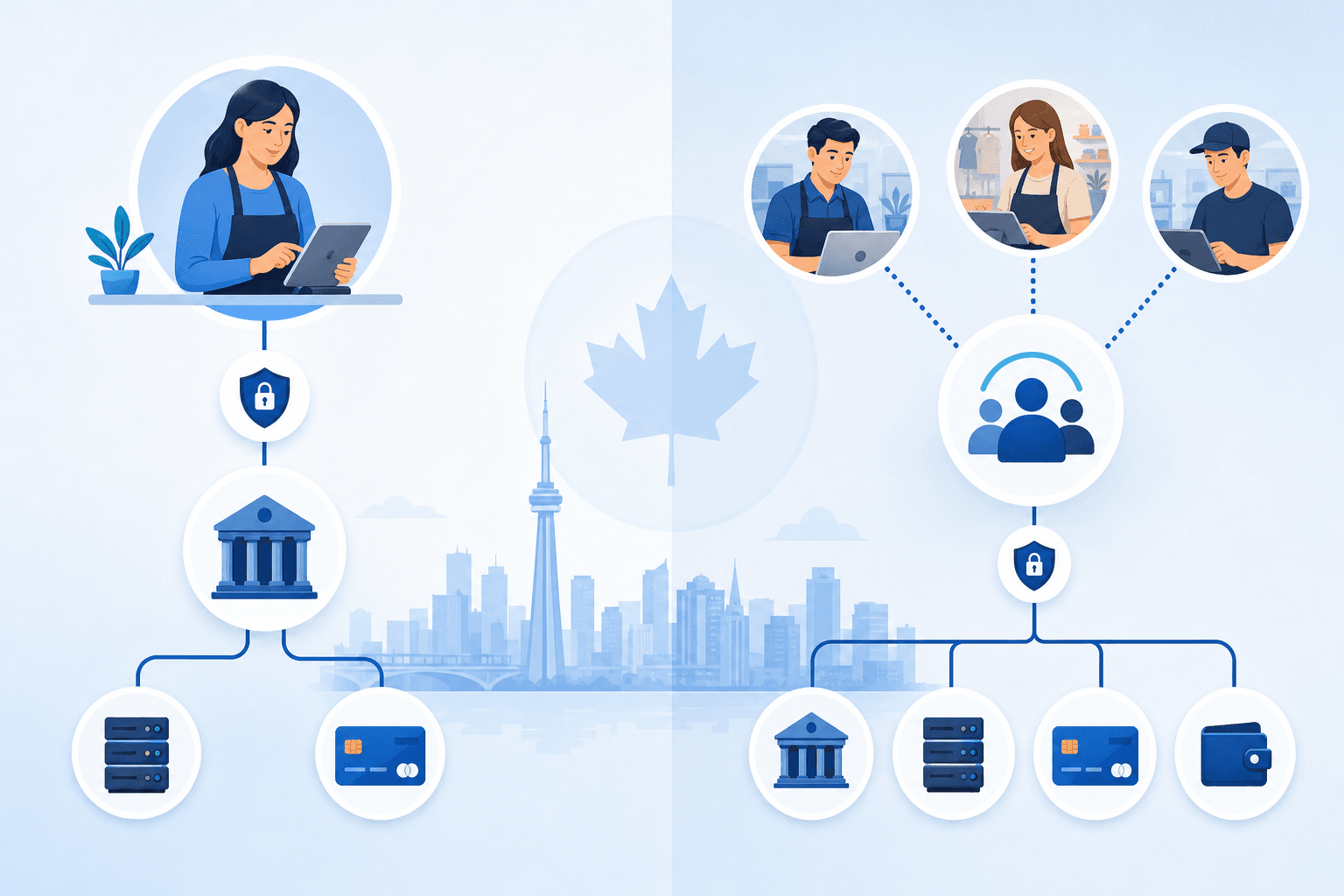
If you have ever searched for a way to accept credit cards in Canada, you have probably bumped into two very different kinds of providers. One group gives you a merchant account with your business name on it, backed by a bank relationship and transparent per-transaction costs. The other group signs you up in minutes under a shared master account, bundles everyone's risk together, and charges a flat rate on every swipe, tap, or online checkout. These are the two main models in the industry: direct processors and payment facilitators (often called PayFacs).
Choosing between them is not just a technical detail. It affects your pricing, how quickly you get your money, how much support you get when something goes wrong, and even whether your account can be frozen or held during a busy season. For Canadian small and medium business owners, understanding direct processors vs payment facilitators in Canada is one of the most important decisions you will make about how you get paid.
This guide breaks down both models in plain language, explains the pros and cons of each, and gives you a practical framework for deciding which one fits your business today, and which one might serve you better as you grow.
What Is a Payment Facilitator (PayFac)?
A payment facilitator is a company that acts as a master merchant, onboarding many small businesses under its own umbrella merchant account rather than giving each business its own dedicated account. Well-known examples in this space include Stripe and Square, among others. Instead of applying for your own merchant ID with a bank or acquirer, you sign up directly on the platform's website and start processing almost immediately.
Advantages of Payment Facilitators
- Fast, simple online onboarding with minimal paperwork
- Flat-rate pricing that is easy to understand at a glance
- Good fit for very new businesses, side projects, or low-volume sellers
- Often bundled with developer tools, invoicing, or e-commerce features
Drawbacks of Payment Facilitators
- Flat-rate pricing is usually higher than interchange-plus once volume grows, because the rate has to cover the provider's margin across every transaction, not just yours
- Your account sits inside a shared risk pool, which can mean holds, reserves, or reviews triggered by other merchants' behaviour or by sudden changes in your own sales pattern
- Support is typically limited to email or chat, with no dedicated account contact
- Because many PayFacs are US-based, some details of how Canadian funds are handled and reported can be less transparent
If you currently process through one of these platforms, it is worth comparing what you are paying against interchange-plus pricing. Use our savings calculator to see how the numbers stack up, or get a Stripe comparison if that is your current provider.
What Is a Direct Processor?
A direct processor sets you up with your own dedicated merchant account, underwritten specifically for your business under your business name. This is the traditional model used by banks and independent processors across Canada, including PaymentsPlus.
Advantages of Direct Processors
- Your own merchant account means your processing is not affected by the risk profile of unrelated businesses
- Interchange-plus pricing shows the card network cost plus the processor's markup separately on every statement, which makes it far easier to see exactly what you are paying for
- Dedicated support relationships, rather than a generic support queue
- Often better suited to growing transaction volumes, multiple locations, or specialized industries
Drawbacks of Direct Processors
- Onboarding usually requires more documentation, since the account is underwritten specifically for your business
- Some processors require long-term contracts or charge cancellation fees (always check this before signing)
- Pricing can look more complex at first glance than a single flat rate
This is really the heart of the direct processors vs payment facilitators in Canada decision: simplicity and speed on one side, ownership and long-term value on the other.
Pricing: Flat-Rate vs Interchange-Plus
Pricing is usually the biggest factor business owners weigh when comparing these two models, so it deserves a closer look.
Flat-rate pricing, the model most payment facilitators use, charges one percentage (sometimes plus a small per-transaction fee) regardless of card type. It is predictable, but it is a blended rate designed to cover the facilitator's costs across premium rewards cards, debit cards, and everything in between. You are essentially pre-paying for the convenience.
Interchange-plus pricing, the model direct processors like PaymentsPlus use, separates the actual cost set by the card networks (interchange) from the processor's markup. Both are shown separately on every statement. This means:
- You can see exactly what the card networks charge and what your processor charges
- Lower-cost transactions (like basic debit) cost you less, instead of being blended into a flat rate
- As your volume grows, the dollar impact of a transparent markup becomes much easier to manage than a flat percentage
The only way to know for certain which model costs less for your specific business is to look at your actual processing statement. That is why a free quote built from your own statement, showing the real dollar difference, is more useful than any generic percentage comparison. If you want a broader view first, you can also compare processors side by side.
Funding Speed and Cash Flow
Cash flow matters for every Canadian business, whether you are running a restaurant in Toronto or an online shop shipping across the country. Funding timelines vary significantly between providers, so this is worth confirming directly rather than assuming.
With PaymentsPlus, next-day funding is the standard, and same-day funding is available for qualified merchants. Direct processors generally have more flexibility here because your account is underwritten individually, rather than batched into a facilitator's broader payout schedule. If a payment facilitator currently advertises a different funding timeline, check that provider's current published terms, since this can change and can vary by business type.
Risk, Holds, and Account Stability
This is an area many business owners do not think about until it affects them. Because payment facilitators pool many merchants under one master account, their fraud and risk systems are built to protect the platform as a whole. That can mean:
- Automatic reviews triggered by a sudden increase in sales volume
- Holds on funds while a transaction pattern is verified
- Account restrictions that can feel sudden and hard to appeal, since support is often limited to a general queue
Direct processors underwrite your account individually from the start, which generally means a more predictable relationship, though no processor can promise an account will never be reviewed or held. What you can control is choosing a provider with responsive, direct support. PaymentsPlus responds within 24 hours, so if a question or issue comes up, you are not stuck waiting in a ticket queue.
Which Model Fits Which Business?
There is no universal right answer here. The better fit depends on your size, growth plans, and how much control you want over your payment setup.
Choose a Payment Facilitator If:
- You are testing a new business idea and want to start accepting payments today
- Your monthly volume is very low and predictable
- You need a quick, all-in-one checkout for a one-off project
Choose a Direct Processor If:
- You have steady or growing monthly card volume
- You want transparent, itemized pricing instead of a blended flat rate
- You operate a physical location, multiple locations, or a specialized business like retail, restaurants, healthcare, automotive, or construction
- You are selling online and want your merchant account properly connected to your platform, such as Shopify, WooCommerce, or Odoo
- You want the flexibility of no long-term contracts and no cancellation fees, so you are never locked in
A Note for E-Commerce and Platform-Based Businesses
If you are selling through an online store, the integration matters as much as the pricing. PaymentsPlus offers an integration service where we set up your merchant account and connect it to your platform, whether that is Shopify, WooCommerce, or Odoo, working directly with you or your developer, using the payment options your platform supports, and testing everything together before go-live. If Odoo is part of your stack, take a look at our Odoo Clover integration page for more detail. For a broader look at online payment setups, visit our e-commerce solutions page.
Making the Switch Without the Headaches
Business owners often assume switching from a payment facilitator to a direct processor is complicated. In practice, the main steps are:
- Gather a recent processing statement from your current provider
- Request a statement-based quote so you can see the actual dollar difference, not a generic percentage
- Confirm hardware needs, since hardware placement options are available for qualified merchants
- Set a transition date and confirm your PCI compliance coverage is included
- Test your new setup, especially if you are moving an online store, before fully switching over
Because PaymentsPlus does not require long-term contracts and does not charge cancellation fees, you are able to evaluate the switch on its own merits rather than being pressured by a lock-in period.
Business owners in major Canadian markets can also find location-specific guidance, including Toronto payment processing, Vancouver payment processing, Calgary payment processing, Montreal payment processing, and Ottawa payment processing.
Final Thoughts
The direct processors vs payment facilitators in Canada decision ultimately comes down to what stage your business is in and how much you value transparency, dedicated support, and control over your payment setup. Payment facilitators offer speed and simplicity for very small or brand-new operations. Direct processors offer transparent interchange-plus pricing, dedicated support, and the flexibility to grow without being boxed into a blended flat rate.
If you are ready to see exactly where your business stands, the easiest first step is a statement review. Get a free quote built from your own processing statement to see the real dollar difference, or contact our team if you have questions about which setup makes sense for your business.