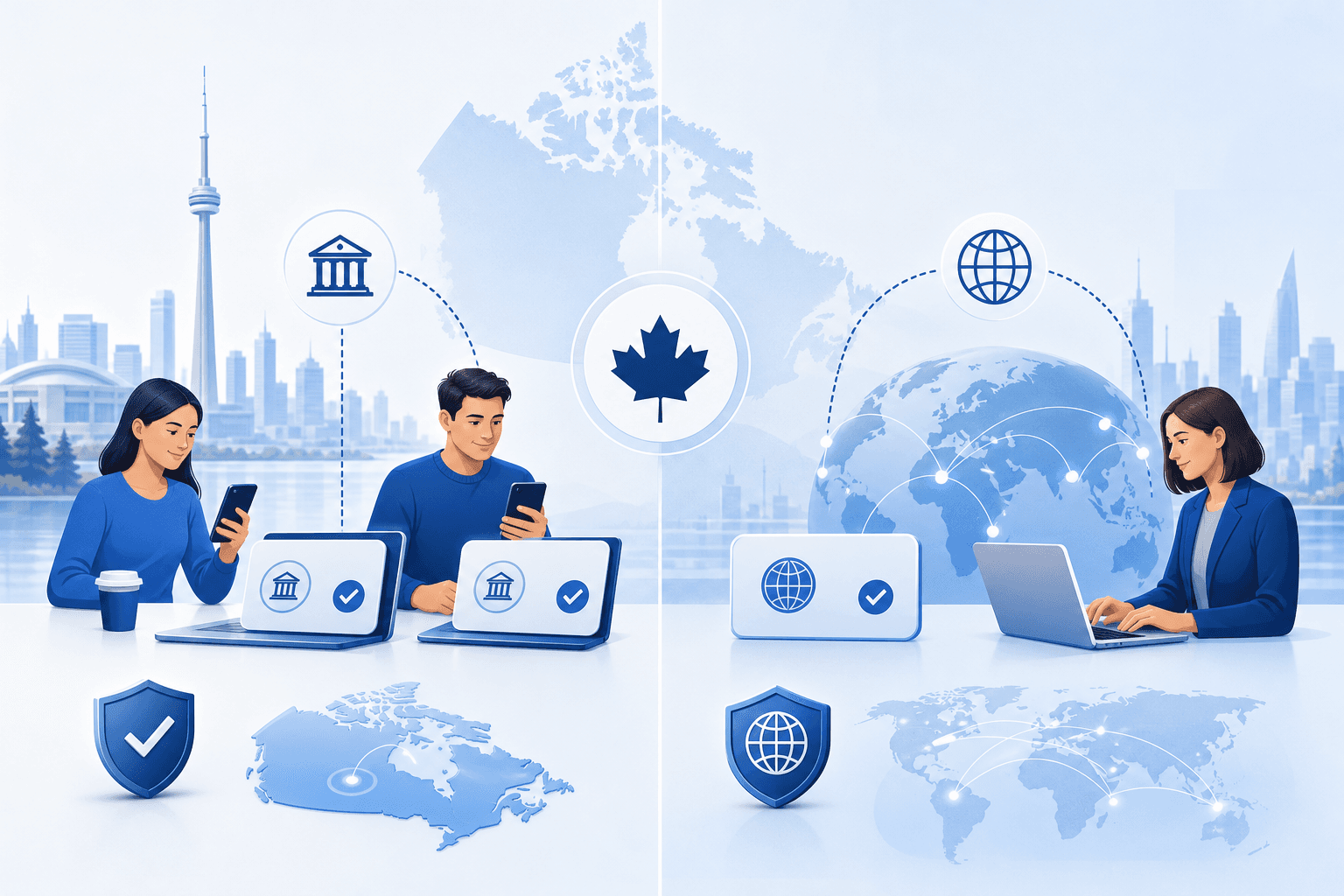
If you run a business in Canada, chances are you're processing more cross-border transactions than you realize. Whether it's an American customer buying from your online store, a supplier charging you in USD, or a Canadian snowbird using a US-issued card at your shop, the line between domestic and international payments isn't always obvious - until the fees show up on your statement.
Understanding the difference between domestic vs cross-border payment processing isn't just an accounting detail. It directly affects your bottom line, your pricing strategy, and how competitive you can be both at home and abroad. For Canadian small and medium business owners, getting this wrong can mean losing thousands of dollars a year to hidden fees and poor currency conversion rates.
In this guide, we'll break down exactly how domestic and cross-border payment processing differ, what it costs, and how to structure your payment setup to keep more revenue in your pocket.
What Is Domestic Payment Processing?
Domestic payment processing refers to transactions where the customer's card and your merchant account are both based in the same country - in this case, Canada. When a customer in Toronto pays with a Canadian-issued Visa or Mastercard at your store or website, that's a domestic transaction settled in Canadian dollars (CAD).
Domestic processing is generally:
- Cheaper - interchange and processor fees are lower because there's no currency conversion or added risk premium
- Faster to settle - funds typically land in your business bank account within 1-2 business days
- Simpler to reconcile - everything is in CAD, with no exchange rate guesswork
- More predictable - fewer disputes and chargebacks tied to currency or cross-border fraud flags
For most brick-and-mortar businesses - restaurants, retail shops, salons, and local service providers - the bulk of transactions are domestic. But even local businesses are increasingly seeing cross-border activity creep in, especially if they sell online or are located near the US border.
What Is Cross-Border Payment Processing?
Cross-border (or international) payment processing happens when a transaction involves a cardholder and a merchant in different countries, or when currencies don't match - for example, a US customer buying from your Canadian e-commerce store, or you invoicing a client in Europe.
These transactions typically involve:
- Currency conversion fees, usually charged by your processor, your bank, or both
- Higher interchange rates, since card networks classify cross-border transactions as higher risk
- Longer settlement times, sometimes 3-5 business days depending on the corridor
- Additional compliance considerations, including anti-money laundering checks and foreign exchange regulations
For Canadian businesses selling into the US or overseas markets, cross-border processing is often unavoidable - but it's also one of the biggest hidden cost centers in a merchant's monthly statement.
Key Differences That Impact Your Bottom Line
Fee Structures
Domestic transactions in Canada typically carry interchange fees in the range of 1.4%-2.5%, depending on card type and processor markup. Cross-border transactions can add anywhere from 1%-3% on top of that in foreign transaction and currency conversion fees. On high transaction volumes, that difference adds up fast.
Currency Conversion and Exchange Rates
This is where many Canadian businesses lose money without realizing it. If you accept USD payments but settle in CAD, your processor or bank is converting the currency - and they're almost always applying a markup over the mid-market exchange rate. Even a 2-3% spread on currency conversion can quietly erode margins on every cross-border sale.
Settlement and Cash Flow
Domestic payments settle quickly and predictably, which is critical for managing day-to-day cash flow. Cross-border payments can take longer to clear, and if you're dealing with multiple currencies, you may need a multi-currency account to avoid unnecessary conversion every time funds move.
Risk and Chargebacks
Cross-border transactions statistically carry higher fraud and chargeback rates. Card networks and processors price this risk into their fees, which is part of why international processing costs more. Businesses with significant cross-border volume should have strong fraud prevention tools in place.
If you're unsure how your current provider stacks up, it's worth taking a closer look. Use our savings calculator to see what you might be losing to cross-border fees and currency markups.
How Canadian Businesses Are Affected
E-Commerce and Online Sellers
Online businesses are the most exposed to cross-border complexity. If you sell to US or international customers, you need a processor that handles multi-currency pricing cleanly, offers competitive FX rates, and doesn't bury conversion fees in confusing statements. Our e-commerce solutions are built specifically to help Canadian online sellers manage this without sacrificing margin.
Retail and Hospitality
Retailers and hospitality businesses near the border or in tourist-heavy areas - think Niagara Falls, Whistler, or downtown Vancouver - regularly see US-issued cards at checkout. Understanding how your processor handles these transactions can prevent surprise fees. Check out our retail solutions and hospitality solutions for setups designed with this in mind.
Construction and B2B Services
Businesses that invoice international suppliers or clients - common in construction, manufacturing, and professional services - often deal with cross-border payments less frequently but at higher dollar values, making FX markup even more costly per transaction. Our construction solutions page covers payment setups tailored to this industry.
Local Businesses Across Canada
Even purely local businesses in Toronto, Vancouver, Calgary, Montreal, and Ottawa should understand their cross-border exposure, since many accept online orders or tourist payments without realizing the fee implications.
How to Choose the Right Processing Setup
Navigating domestic vs cross-border payment processing effectively comes down to matching your provider to how your business actually operates. Here's how to approach it:
- Audit your transaction mix. Pull a few months of statements and separate domestic from cross-border transactions. This tells you how much FX exposure you really have.
- Ask about all-in pricing. Many processors advertise low domestic rates but bury cross-border markups in the fine print. Compare processors carefully before committing.
- Consider multi-currency settlement. If you have consistent USD revenue, settling directly in USD (rather than converting every transaction) can save significantly on FX costs.
- Negotiate interchange-plus pricing. Flat-rate pricing models can be convenient but often cost more for high-volume or mixed domestic/cross-border businesses. Interchange-plus pricing tends to be more transparent.
- Review your POS and payment gateway compatibility. Make sure your point-of-sale or online checkout can handle multi-currency transactions without manual workarounds. A Clover comparison or Lightspeed comparison can help if you're evaluating POS options.
Comparing Providers
Not all processors treat cross-border transactions the same way. Bank-bundled processing, like what you might get through a TD comparison or Desjardins comparison setup, can be convenient but isn't always the most cost-effective for businesses with heavy cross-border volume. Flat-rate providers like those in our Stripe comparison are popular with online sellers but can carry higher effective costs at scale. Enterprise processors, such as those covered in our Chase comparison, may offer better cross-border rates for very high-volume merchants. The right choice depends entirely on your transaction profile.
Practical Tips to Reduce Cross-Border Costs
- Price in local currency when possible. Showing USD prices to US customers (rather than forcing a CAD-to-USD conversion at checkout) often improves conversion rates and reduces confusion.
- Use a multi-currency merchant account if you regularly receive USD or EUR payments, to avoid unnecessary back-and-forth conversion.
- Negotiate your rates annually. Processing volume changes, and so do market rates - don't assume your current rate is still competitive.
- Bundle your POS and payment processing where it makes sense, especially for retail and restaurant operations managing both in-person and online sales.
- Review your statements line by line. Cross-border and currency conversion fees are often listed separately and easy to overlook.
Switching providers can feel daunting, but it's often simpler than business owners expect - and the savings can be substantial. Get a free quote to see how your current setup compares.
Conclusion
The difference between domestic vs cross-border payment processing comes down to cost, speed, and complexity - and for Canadian businesses operating in an increasingly global marketplace, ignoring cross-border fee structures can be an expensive mistake. Whether you're a Toronto café serving tourists, a Vancouver e-commerce brand shipping to the US, or a Montreal manufacturer invoicing international clients, understanding your payment mix is the first step toward smarter processing decisions.
The good news is you don't have to figure this out alone. Our services are designed to help Canadian businesses of every size optimize their payment processing, whether that's purely domestic, heavily cross-border, or somewhere in between. Contact our team today to get a clear, honest breakdown of what you're currently paying - and where you could be saving.