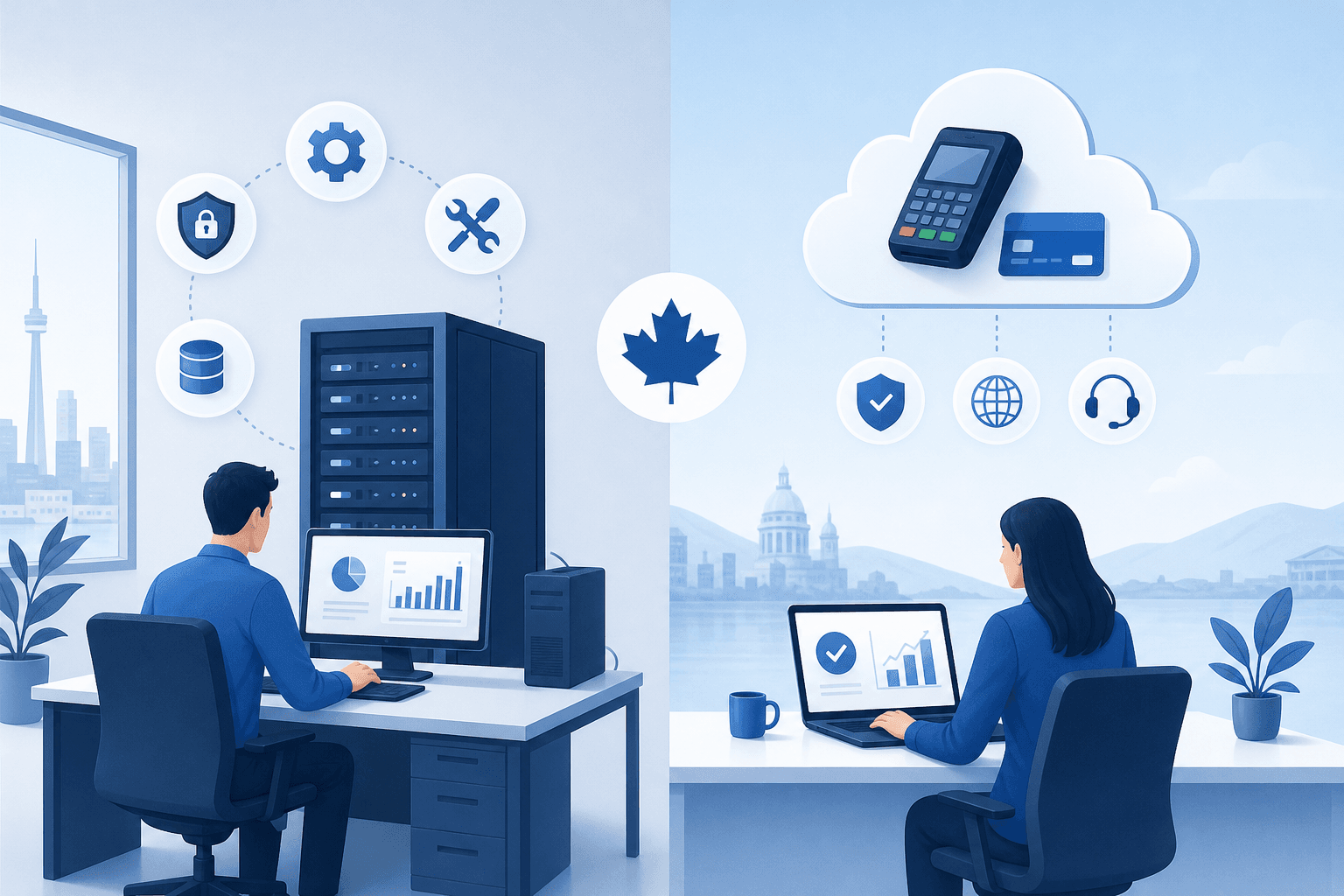
Introduction
Every Canadian small business owner reaches a point where they must decide how payments actually get accepted, managed, and reconciled. Do you build out an internal team to handle merchant accounts, reconciliation, chargebacks, and PCI compliance? Or do you hand it off to a specialized partner who already has the infrastructure in place? This is the heart of the in-house vs outsourced payment processing debate, and it's a decision that affects your cash flow, your customer experience, and your bottom line.
For many Canadian SMBs, this choice feels more complicated than it should be. You're juggling CAD settlement times, interchange fees, PCI DSS compliance, and the reality that your business doesn't operate like a large enterprise with a dedicated finance department. Add in the patchwork of provincial regulations and the dominance of a few major banks in Canadian merchant services, and it's easy to see why so many owners default to whatever their bank offers without exploring alternatives.
This article breaks down the real differences between in-house vs outsourced payment processing for Canadian SMBs, covering cost, security, scalability, and support, so you can make a decision that actually fits your business rather than one you fell into by default.
What Does "In-House" Payment Processing Really Mean?
When we talk about in-house payment processing, we mean a business that manages its own merchant account relationships, hardware, software integrations, and compliance obligations largely on its own, often through a direct bank relationship rather than a dedicated payments partner.
Common Characteristics of In-House Setups
- A merchant account opened directly through a Canadian bank (TD, RBC, Scotiabank, BMO, or Desjardins in Quebec)
- Internal staff responsible for troubleshooting terminal issues, reconciling batches, and handling disputes
- Minimal customization - you're using whatever bundled hardware and pricing structure the bank provides
- Little to no dedicated account support beyond a general business banking line
This model can work for very simple operations, but most Canadian SMBs quickly discover that bank-bundled processing comes with higher effective rates and limited flexibility. If you've ever compared your statement against what a dedicated processor offers, you've likely seen the gap. Our TD comparison breaks down exactly how bank-bundled processing stacks up against independent providers.
The Hidden Costs of DIY Processing
Many owners assume handling payments internally saves money because there's no "middleman." In reality, the hidden costs add up fast:
- Staff time spent reconciling batches, chasing down declined transactions, or sitting on hold with bank support
- Higher effective rates since banks often bundle processing with vague tiered pricing
- Compliance risk if nobody on your team is actively monitoring PCI DSS requirements
- Missed fraud patterns without dedicated monitoring tools
What Does Outsourced Payment Processing Look Like?
Outsourcing doesn't mean losing control of your payments - it means partnering with a provider whose entire business is built around processing, security, and support. A good outsourced partner handles the technical heavy lifting while you focus on running your business.
What a Dedicated Processor Typically Provides
- Transparent, often interchange-plus pricing instead of confusing tiers
- PCI DSS compliance support and documentation
- 24/7 fraud monitoring and chargeback assistance
- Hardware and POS integration (including Clover comparison and Lightspeed comparison options)
- A real human account manager instead of a call centre queue
This is where the in-house vs outsourced payment processing question really comes into focus for growing businesses. As transaction volume increases, the administrative burden of managing payments internally grows too - and that's exactly the point where outsourcing starts paying for itself.
Industry-Specific Advantages
Outsourced processors also tend to build solutions tailored to specific industries rather than offering a one-size-fits-all terminal. For example:
- Restaurants benefit from integrated tableside payments and tip management - see our restaurant solutions
- Retailers need inventory-synced POS systems - explore retail solutions
- Clinics and practices require PCI-compliant, patient-friendly payment flows - check out healthcare solutions
- Online sellers need seamless checkout experiences - our e-commerce solutions cover that
- Contractors need mobile and invoice-based payment tools - see construction solutions
- Salons and spas need appointment-linked payment and tipping tools - see salon & spa solutions
Comparing Costs: In-House vs Outsourced Payment Processing
Cost is usually the deciding factor for Canadian SMBs, so let's break it down directly.
In-House Cost Profile
- Often bundled with business banking, which can feel convenient but obscures true processing costs
- Tiered pricing structures that make it hard to know what you're actually paying per transaction
- No dedicated negotiation support - rates rarely improve over time without you pushing for it
Outsourced Cost Profile
- Interchange-plus pricing, which is typically more transparent and often cheaper at scale
- Volume discounts as your business grows
- Potential savings on PCI compliance fees, chargeback fees, and equipment leasing
The only way to know for sure which option costs less is to actually run the numbers for your business. Use our savings calculator to compare your current statement against transparent processing rates, and you may be surprised by the gap. If you want a tailored breakdown, you can also get a free quote with no obligation.
Security, Compliance, and Risk Management
Canadian businesses handling card payments are expected to comply with PCI DSS standards regardless of size. This is one area where the in-house vs outsourced payment processing decision carries real consequences.
In-House Compliance Challenges
Managing PCI compliance internally means someone on your team needs to:
- Understand and apply the current PCI DSS version
- Keep network and POS software updated
- Document compliance for audits
- Respond quickly to any data security incidents
For most SMBs, nobody has the bandwidth or expertise to do this properly, which creates real exposure.
Outsourced Compliance Support
A reputable processor builds compliance support into their service, often including:
- Automated compliance questionnaires and reminders
- PCI-validated hardware and software
- Built-in fraud detection and chargeback representation support
- Liability shift support for EMV and tokenized transactions
Given how costly a data breach or non-compliance fine can be for a small business, this is often the single biggest argument in favour of outsourcing.
Scalability and Support: Which Model Grows With You?
Scaling In-House
Scaling payments in-house usually means more manual work: more terminals to manage, more reconciliation, more staff training, and more exposure if something breaks during a busy season. For a seasonal retailer or restaurant experiencing growth, this model can become a bottleneck right when sales are climbing.
Scaling with an Outsourced Partner
Dedicated processors are built to scale with you. Adding a second location, moving into e-commerce, or integrating with accounting and ERP software is usually a configuration change rather than a complete overhaul. If you're running Odoo as your ERP, for instance, the Odoo Clover integration lets you sync sales and payments without manual double-entry.
Regional Considerations Across Canada
Payment needs can vary by region too. Businesses in major metros often benefit from local expertise and faster onboarding support:
- Toronto payment processing
- Vancouver payment processing
- Calgary payment processing
- Montreal payment processing
- Ottawa payment processing
Quebec businesses in particular should also weigh provincial language and banking considerations - our Desjardins comparison is a useful starting point.
How to Decide What's Right for Your Business
There's no universal answer to the in-house vs outsourced payment processing question - it depends on your size, industry, and growth plans. Here's a simple framework:
- Transaction volume: High volume generally favours outsourcing for better rates and support capacity.
- In-house expertise: If nobody on your team understands PCI compliance, outsourcing reduces risk significantly.
- Growth trajectory: Planning to add locations or sell online? Outsourced providers scale more easily.
- Current costs: Compare your actual effective rate against interchange-plus alternatives before assuming your bank is competitive.
- Support needs: Consider how much you value having a real account manager versus a general bank support line.
If you're still unsure, it's worth looking at how different providers stack up side by side. Compare processors to see how options like Stripe, Clover, and traditional banks differ in pricing and features, including our dedicated Stripe comparison for businesses considering flat-rate online processing.
Conclusion
The in-house vs outsourced payment processing decision isn't just a back-office detail - it directly affects your costs, your compliance risk, and how smoothly your business can grow. For many Canadian SMBs, the hidden costs and compliance burden of managing payments internally outweigh the perceived simplicity, while a dedicated outsourced partner offers transparent pricing, stronger security, and support that scales with you.
If you're ready to see what a modern, Canadian-focused payment partner can do for your business, explore our services or contact our team for a no-pressure conversation about your options.