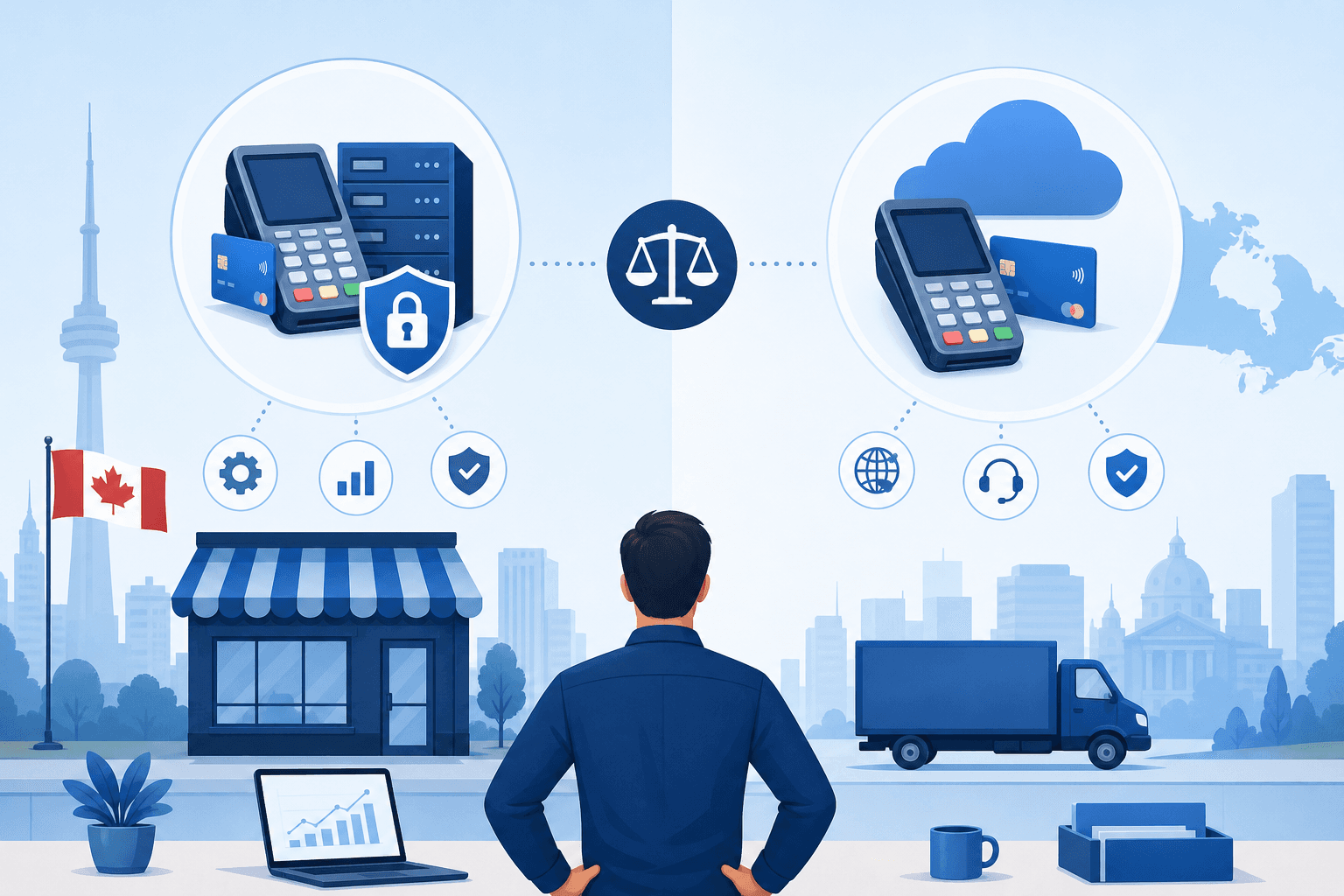
Every Canadian business owner that accepts credit and debit cards eventually faces the same decision: should you build and manage payment processing yourself, or hand it off to a specialized third-party provider? It sounds like a back-office detail, but the choice affects your cash flow, your customer experience, and how much you pay in fees every single month.
For small and medium-sized businesses across Canada, from a Toronto cafe to a Calgary auto shop to a Montreal boutique, this decision often gets made by default rather than by design. A business opens its doors, signs up with whatever processor its bank offers, and never revisits the arrangement again. That can be an expensive habit.
In this article, we'll break down what "in-house" really means versus working with a dedicated third-party processor, weigh the pros and cons of each, and help you figure out which approach fits your business. Whether you're just starting out or reconsidering an existing setup, understanding in-house vs third-party payment processing is one of the most practical steps you can take toward better margins.
What Does "In-House" Payment Processing Actually Mean?
For most SMBs, "in-house" doesn't mean building your own payment infrastructure from scratch, very few companies have the resources for that. It typically means processing through your bank's bundled merchant services, where your business bank account, loans, and card processing all come from one institution.
This approach has a certain appeal: one relationship, one login, and the comfort of sticking with a familiar name. Many Canadian business owners default to this because it feels simpler to keep everything under one roof.
The Tradeoffs of Bank-Bundled Processing
The simplicity of bank-bundled processing often comes at a cost:
- Pricing transparency. Bundled statements can blend fees together, making it hard to see exactly what you're paying for interchange versus markup.
- Flexibility. Switching providers later can mean renegotiating your entire banking relationship, not just your payment processing.
- Support responsiveness. Larger institutions may route merchant support through general call centers rather than payments specialists.
If your business currently processes through a major bank, it's worth checking that provider's current published pricing and terms before assuming it's the most cost-effective option. You can also compare processors side by side, including a dedicated TD comparison, to see how bundled bank processing stacks up.
What Third-Party Payment Processing Looks Like
A third-party processor is a company that specializes exclusively in payment processing, separate from your day-to-day banking. Your money still lands in your business bank account, but the processing relationship, pricing, support, and equipment are handled by a dedicated payments provider.
This is where most of the innovation in Canadian payments happens. Specialized processors compete on pricing transparency, funding speed, and support, because that's their entire business, not a side offering.
Key Advantages for Canadian SMBs
- Clearer pricing models. Many third-party processors offer interchange-plus pricing, where the card network cost and the provider's markup are shown separately on every statement, rather than folded into a flat rate.
- Specialized support. Because payments are the core business, response times and expertise are often more focused.
- Flexible contracts. Many providers, including PaymentsPlus, operate with no long-term contracts and no cancellation fees, so you're not locked into a relationship that no longer serves you.
- Faster access to funds. Next-day funding has become a standard expectation, with same-day funding available for qualified merchants in some cases.
In-House vs Third-Party Payment Processing: Comparing the Real Costs
When Canadian business owners weigh in-house vs third-party payment processing, pricing structure is usually the deciding factor. There are generally three pricing models you'll encounter:
- Flat-rate pricing, common with platforms like Stripe, where every transaction is charged the same percentage regardless of card type.
- Tiered pricing, often used by banks, which groups transactions into categories like "qualified" and "non-qualified" without much transparency.
- Interchange-plus pricing, which separates the card network's actual cost from the processor's markup, so you can see precisely what you're paying for.
Interchange-plus is generally considered the most transparent model because nothing is bundled or hidden. At PaymentsPlus, every statement shows the interchange cost and our markup as separate line items.
Rather than guessing which model saves more, the most reliable way to compare is to look at your actual numbers. Use our savings calculator to get a general sense of how different pricing structures might apply to your transaction volume, or request a free quote built directly from your existing processing statement, which shows the dollar difference in plain terms.
Why Statement Reviews Matter More Than Advertised Rates
Advertised rates rarely tell the full story. Many providers list a headline rate but add fees elsewhere, monthly minimums, PCI fees, batch fees, or equipment rental charges. The only way to know what you're truly paying is to look at a recent statement line by line. That's also why we never state hypothetical savings percentages, every business's card mix and transaction volume is different, and the honest answer only comes from your own numbers.
Funding Speed, Support, and Compliance
Beyond pricing, in-house vs third-party payment processing decisions often come down to operational details that affect daily cash flow and risk management.
Funding Speed
Cash flow is critical for small businesses, especially those managing payroll, inventory, or seasonal swings. Next-day funding is the standard most Canadian processors aim for, and some qualified merchants can access same-day funding. If your current setup takes longer than that to deposit funds, it's worth asking why.
Support You Can Actually Reach
When a terminal goes down on a Saturday or an online payment gateway throws an error during a sale, how fast you get help matters. At PaymentsPlus, we respond within 24 hours, which means you're not left guessing when something goes wrong.
PCI Compliance
Any business accepting card payments in Canada needs to meet PCI (Payment Card Industry) data security standards. Third-party processors often build compliance support into their service, which reduces the administrative burden on business owners who have neither the time nor the specialized knowledge to manage it alone. PCI compliance is included with PaymentsPlus service, which simplifies what can otherwise be a confusing requirement.
Matching the Right Model to Your Business Type
Not every business has the same needs, and the in-house vs third-party payment processing decision often depends heavily on your industry.
Retail and E-Commerce
Retailers juggling in-store and online sales need processing that works seamlessly across channels. For physical locations, hardware placement options for qualified merchants can simplify checkout. For businesses selling online, our integration service connects your merchant account to platforms like Shopify or WooCommerce, with testing completed before go-live. Explore our e-commerce solutions or retail solutions for more detail.
Restaurants and Hospitality
Restaurants need fast, reliable processing during peak hours, along with tableside or counter equipment that fits their workflow. Our restaurant solutions and hospitality solutions are built around these demands.
Healthcare, Salons, and Professional Services
Appointment-based businesses often need processing that supports recurring payments and in-person transactions equally well. See our healthcare solutions and salon & spa solutions for examples.
Construction, Automotive, and Nonprofits
Businesses with mobile or project-based operations, like construction solutions and automotive solutions, often need flexible processing that works on-site and in the office. Nonprofits also have unique needs around donation processing, covered in our nonprofit solutions.
Location-Specific Considerations
Canadian regulations and banking norms are fairly consistent nationwide, but local market conditions still matter. Businesses in major hubs like Toronto, Vancouver, Calgary, Montreal, and Ottawa each have their own mix of competitive processors, so it's worth comparing options specific to your region, including providers like Desjardins for Quebec-based businesses.
Making the Switch: What to Expect
If you've decided a third-party processor is the better fit, moving away from in-house or bank-bundled processing doesn't have to mean disrupting your business.
- Gather a recent processing statement. This is the foundation for an accurate comparison.
- Request a statement-based quote. A proper quote should be built from your actual numbers, not a generic rate sheet.
- Review contract terms. Look for no long-term contracts and no cancellation fees so you retain flexibility.
- Plan your integration. If you sell online, confirm how your merchant account will connect to your platform, whether that's Shopify, WooCommerce, Odoo, or another system, and make sure testing happens before go-live.
- Confirm support channels. Know who to call and how quickly you can expect a response if something goes wrong.
If you're running Odoo as your business platform, our Odoo Clover integration service handles the connection between your merchant account and your ERP setup. And if you're currently comparing POS hardware providers, our Clover comparison and Lightspeed comparison pages can help you understand how equipment options differ between providers.
Conclusion: Weighing In-House vs Third-Party Payment Processing for Your Business
There's no universal answer to the in-house vs third-party payment processing debate, the right choice depends on your transaction volume, your sales channels, and how much you value transparency and flexibility. What matters most is that the decision is intentional, not a byproduct of whatever your bank happened to offer when you opened your account.
For many Canadian SMBs, a specialized third-party processor offers clearer pricing, faster funding, and support focused specifically on payments. The best way to find out what that means for your business is to look at your actual numbers.
Get a free quote built from your own processing statement, or contact our team if you have questions about how switching might work for your business. We respond within 24 hours.