Introduction
Choosing how your customers pay you is one of the most consequential decisions you'll make as a Canadian small business owner. Walk into any coffee shop, farmers' market stall, or home services van today, and you're just as likely to see a sleek mobile card reader as you are a traditional countertop terminal. Both do the same basic job - accepting debit and credit payments - but the similarities mostly end there.
For Canadian entrepreneurs weighing their options, the debate over mobile card readers vs traditional terminals: best option for Canadian small businesses comes down to more than just price. It's about how you operate, where you sell, how fast you need funds, and what kind of customer experience you want to deliver. A food truck owner in Calgary has very different needs than a dental clinic in Ottawa or a boutique retailer in downtown Toronto.
In this guide, we'll break down the real differences between mobile card readers and traditional terminals, covering costs, functionality, reliability, and Canadian-specific considerations like interac debit support and PCI compliance. By the end, you'll have a clear framework for deciding which setup - or combination of both - makes the most sense for your business.
What Are Mobile Card Readers and Traditional Terminals?
Before comparing the two, it helps to define exactly what we're talking about.
Mobile Card Readers
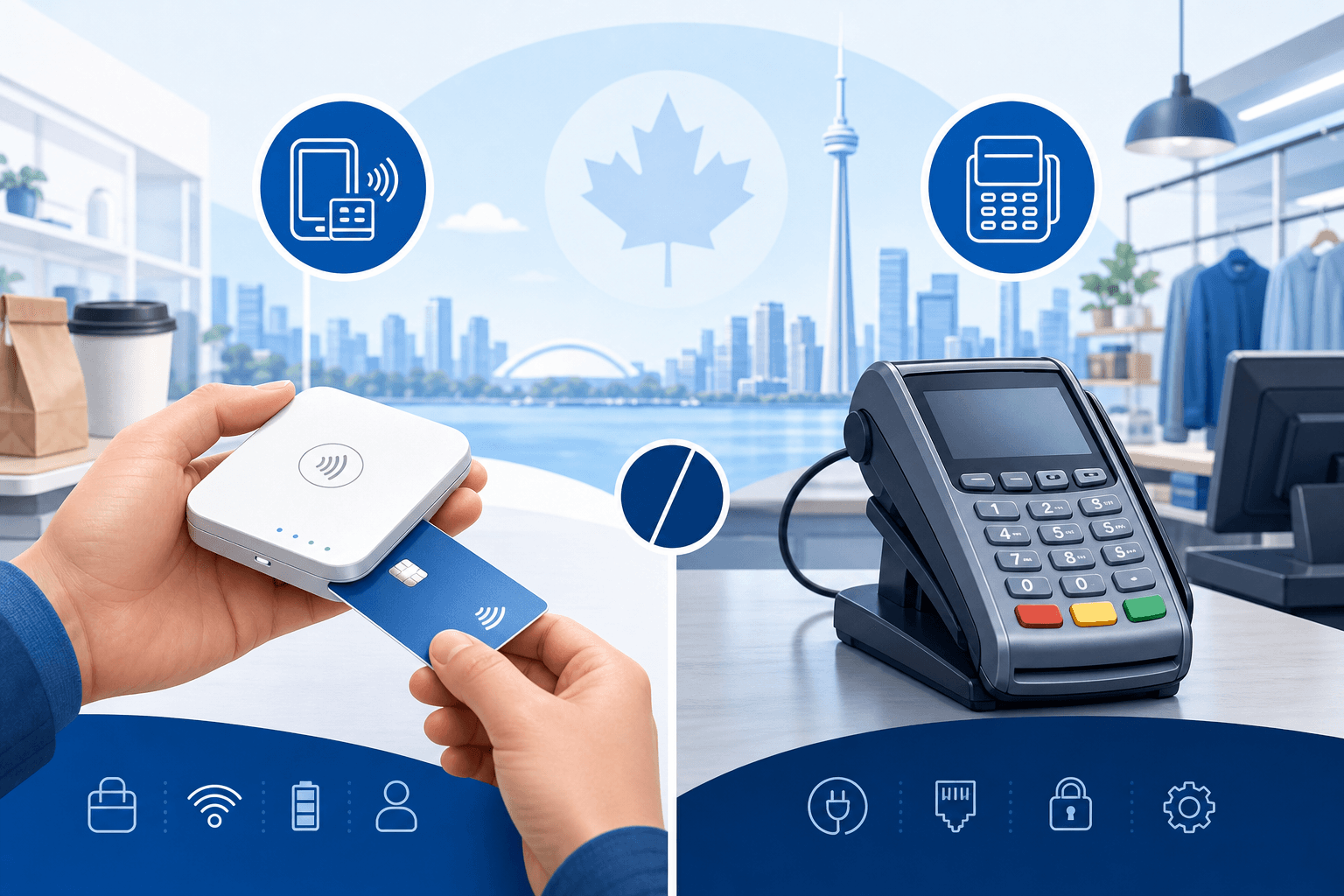
Mobile card readers are compact, often wireless devices that connect to a smartphone or tablet via Bluetooth or a plug-in port. They typically work alongside a mobile app that handles payment processing, receipts, and basic reporting. Popular in food trucks, pop-up shops, salons, and contractors who work on-site, mobile readers are prized for their portability and low upfront cost.
Traditional Terminals
Traditional terminals are the dedicated, standalone devices you see at checkout counters - often with a screen, keypad, and built-in printer. They connect via Ethernet, phone line, or Wi-Fi and are built specifically for processing payments, with more robust hardware designed for high transaction volumes. These are the backbone of most retail stores, restaurants, and healthcare offices across Canada.
Both options can accept chip, tap (contactless), and Interac debit payments - a must for Canadian consumers, who overwhelmingly prefer tap-to-pay. The real differences emerge in cost structure, durability, and scalability.
Cost Comparison: Upfront and Ongoing Fees
Cost is usually the first factor Canadian small business owners consider, and it's where mobile readers and traditional terminals diverge significantly.
Mobile Card Readers
- Lower upfront cost: Many mobile readers cost between $0 and $150 CAD, with some providers offering them free with a processing agreement.
- Flat-rate pricing: Mobile reader providers often charge a flat percentage per transaction (commonly 2.65%-2.9% + $0.10 in Canada), which is simple but can be more expensive at higher volumes.
- No monthly fees (sometimes): Many mobile solutions skip monthly terminal rental fees, appealing to seasonal or low-volume businesses.
Traditional Terminals
- Higher upfront or rental cost: Terminals can cost $300-$800 CAD to purchase outright, or $20-$50/month to rent.
- Interchange-plus pricing available: Many traditional terminal providers offer interchange-plus pricing, which can be significantly cheaper for businesses processing higher volumes.
- Potential for negotiated rates: Established processors often allow more room to negotiate based on your monthly processing volume.
If you're unsure which pricing model saves you more, use our savings calculator to compare flat-rate and interchange-plus scenarios based on your actual sales volume. For many growing businesses, the savings from switching to a better-suited pricing structure can be substantial over a year.
Features and Functionality
Mobile Card Readers: Built for Flexibility
Mobile readers shine when your business isn't tied to one location. Key advantages include:
- Portability: Accept payments anywhere - at a client's home, a market booth, or curbside.
- Quick setup: Pair with a smartphone and start accepting payments within minutes.
- Lower learning curve: Simple apps are intuitive for staff and owners alike.
- Ideal for service-based businesses: Contractors, mobile groomers, and personal trainers benefit enormously from this flexibility.
However, mobile readers can be limited when it comes to advanced inventory management, multi-user staff permissions, or integration with larger POS ecosystems.
Traditional Terminals: Built for Volume and Integration
Traditional terminals are generally the better fit for businesses with consistent, higher-volume transactions:
- Faster processing at checkout: Dedicated hardware tends to process transactions more quickly and reliably during busy periods.
- Stronger integrations: Terminals integrate more easily with full POS systems, inventory software, and accounting platforms.
- Durability: Designed for all-day, every-day use in a fixed location.
- Better support for multiple payment lines: Useful for restaurants and retailers running multiple terminals simultaneously.
If you're running a full POS setup, it's worth exploring how terminals stack up against platforms like Clover or Lightspeed. Our Clover comparison and Lightspeed comparison pages break down how these systems handle both hardware and software needs.
Industry-Specific Considerations for Canadian Businesses
The right choice often depends heavily on your industry and how you interact with customers.
Retail and E-Commerce
Retailers with a fixed storefront typically benefit from traditional terminals paired with a full POS system for inventory tracking and multi-register support. If you also sell online, you'll want a processor that bridges in-store and online sales smoothly - check out our retail solutions and e-commerce solutions for integrated options.
Restaurants and Hospitality
Restaurants often use a hybrid approach: traditional terminals at the counter and mobile readers for tableside payments or patio service. This flexibility improves turnover and customer experience. See our restaurant solutions and hospitality solutions pages for tailored setups.
Healthcare and Professional Services
Clinics and healthcare providers generally prefer traditional terminals for their reliability and integration with scheduling or billing software, though mobile readers are useful for home visits or mobile practitioners. Our healthcare solutions page covers compliant, secure options.
Construction and Field Services
Contractors and tradespeople who invoice on-site overwhelmingly favour mobile readers for their portability. Explore our construction solutions for setups designed around mobile invoicing and payments.
Salons, Spas, and Automotive
Service-based businesses like salons and auto shops often want the flexibility to take payment at the chair or in the bay rather than forcing customers to a fixed register. Check out our salon & spa solutions and automotive solutions for examples of how mobile and traditional setups can work together.
Nonprofits
Many nonprofits in Canada run events, galas, and door-to-door fundraising campaigns where mobile readers are invaluable for accepting donations on the spot. Our nonprofit solutions page highlights processing options designed for fundraising flexibility.
Reliability, Security, and Canadian Compliance
Whichever option you choose, security and compliance can't be an afterthought.
PCI Compliance
All reputable mobile readers and terminals sold in Canada should be PCI-DSS compliant, encrypting cardholder data at the point of sale. Always confirm this with your provider before signing an agreement.
Interac Debit Support
Canadian consumers rely heavily on Interac debit - more than in most other countries. Make sure whatever device you choose fully supports Interac Flash (tap) and chip-and-PIN debit transactions, not just credit cards.
Connectivity and Reliability
- Mobile readers depend on your smartphone's cellular or Wi-Fi connection, which can be unreliable in rural areas or basements.
- Traditional terminals often have more consistent connectivity options, including Ethernet and dedicated phone lines, making them more dependable for high-volume, fixed locations.
If your business operates in a region with spotty mobile coverage - rural Alberta or parts of Northern Ontario, for example - this is a critical factor to weigh carefully.
Making the Right Choice for Your Business
There's no universal winner in the mobile card readers vs traditional terminals debate - the best option for Canadian small businesses depends on how and where you operate. Here's a quick decision framework:
- Choose mobile card readers if: You operate on the go, run a seasonal or pop-up business, have lower transaction volume, or need a low-cost entry point.
- Choose traditional terminals if: You have a fixed storefront, process a high volume of transactions daily, need robust POS integration, or want access to interchange-plus pricing.
- Consider a hybrid setup if: Your business has both in-store and mobile needs - many restaurants, salons, and retailers find this combination works best.
Regardless of which direction you lean, it's worth comparing providers rather than defaulting to whatever your bank offers. Big banks like TD often bundle processing with business accounts, but the rates aren't always competitive - our TD comparison breaks down the differences. The same goes for Quebec-based businesses considering Desjardins, or larger operations evaluating enterprise options like Chase comparison.
Location Matters Too
Where your business operates in Canada can also influence your best setup, from local tax considerations to regional connectivity. Business owners in major hubs can find tailored guidance through our city-specific resources: Toronto payment processing, Vancouver payment processing, Calgary payment processing, Montreal payment processing, and Ottawa payment processing.
Conclusion
The choice between mobile card readers and traditional terminals isn't about picking the "better" technology - it's about matching the right tool to your business model. Mobile readers offer unbeatable flexibility and low upfront costs for businesses on the move, while traditional terminals deliver reliability, speed, and deeper integrations for established, high-volume operations. Many Canadian small businesses find that a hybrid approach, using both depending on the situation, delivers the best of both worlds.
Before committing to any processor or hardware, take the time to compare your options. Compare processors to see how different providers stack up on fees, features, and support, or explore our services to find a payment solution built around your business. Ready to find out what you could be saving? Get a free quote today, or contact our team for personalized guidance on choosing the right payment setup for your Canadian business.