Introduction
If you're a Canadian business owner shopping for a new way to accept payments, you've likely come across two very different options: the compact mobile card reader that pairs with a smartphone or tablet, and the traditional countertop terminal that's been a fixture at checkout counters for decades. Both get the job done, but they serve different kinds of businesses in different ways, and picking the wrong one can mean paying for features you don't need or missing out on flexibility that could help you sell more.
The decision isn't just about price. It's about how your business actually operates. A food truck owner in Calgary has very different needs than a dental office in Ottawa or a boutique retailer in downtown Toronto. This guide breaks down the real differences between mobile card readers vs traditional terminals, so you can make a confident choice for your Canadian business, whether you're setting up your first payment solution or replacing aging equipment.
We'll walk through cost considerations, mobility, reliability, and what matters most for different industries, with practical advice you can act on right away. And if you want a clearer picture of what you're currently paying, get a free quote built from your actual processing statement so you can compare options with real numbers in hand.
What's the Difference Between Mobile Readers and Traditional Terminals?
Before diving into which option fits your business, it helps to understand what each actually is.
Mobile Card Readers
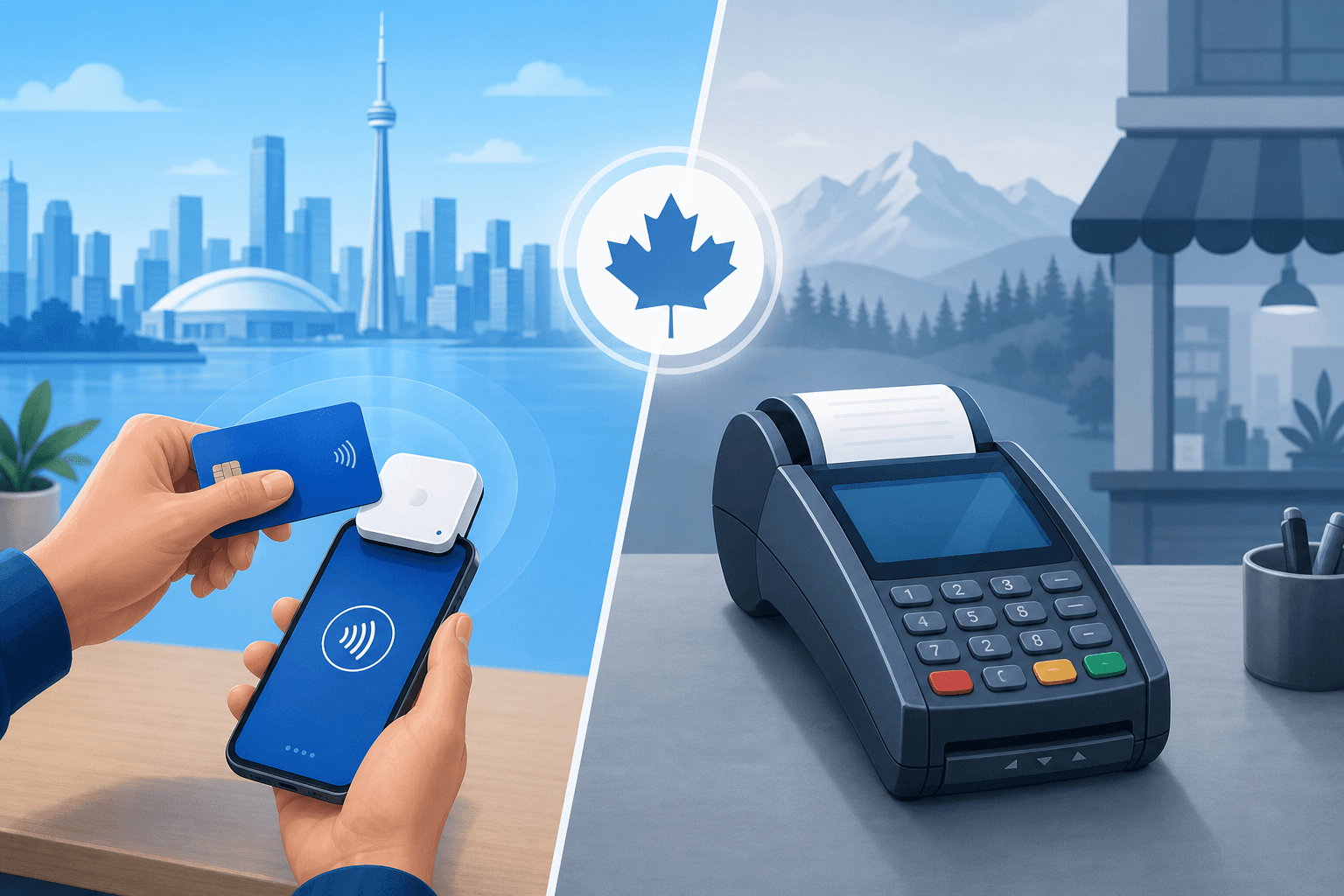
Mobile card readers are small devices, often the size of a deck of cards, that connect to a smartphone or tablet via Bluetooth or a headphone jack. They rely on an app to process transactions and typically support tap, chip, and sometimes swipe payments. Because they're lightweight and battery-powered, they go wherever your business goes.
Traditional Terminals
Traditional terminals are standalone countertop or handheld devices built specifically for processing payments. They usually have their own screen, keypad, receipt printer, and a dedicated connection, whether that's Ethernet, Wi-Fi, or a phone line. They don't depend on a separate smartphone to function, which some business owners see as an advantage for reliability and simplicity.
Both types of hardware can be set up with interchange-plus pricing, where you see the card network cost plus the markup separately on every statement, rather than a blended rate that hides the details.
Cost Considerations for Canadian Businesses
Cost is usually the first question business owners ask, and it's a fair one. Here's what to weigh:
- Upfront hardware cost: Mobile readers are often less expensive to acquire initially, which appeals to startups and seasonal businesses. Traditional terminals can involve a higher upfront investment, though hardware placement options for qualified merchants may be available depending on your processor and business profile.
- Monthly fees: Some mobile solutions bundle software fees into the cost, while traditional terminal setups may have separate line items for the terminal, PCI compliance, and statement fees.
- Processing rates: The card reader itself doesn't determine your rate. What matters more is whether your processor uses interchange-plus pricing or a blended flat rate. Flat-rate processors, like Stripe, often appeal to businesses that value simplicity, but the tradeoff can be less transparency into what you're actually paying. If you're comparing providers, our Stripe comparison page breaks down how flat-rate pricing compares to interchange-plus.
- Hidden costs: Ask about cancellation fees and contract length regardless of which hardware you choose. PaymentsPlus doesn't charge cancellation fees and doesn't lock merchants into long-term contracts, which matters if your business needs change down the road.
The real way to know which setup costs less for your specific business is to look at your actual numbers. Use our savings calculator or request a statement review to see the dollar difference between what you're paying now and what an interchange-plus setup would look like.
Mobility and Flexibility
This is where mobile card readers really shine. If your business doesn't operate from a single fixed location, a mobile reader may be the obvious choice.
Businesses That Benefit From Mobile Readers
- Food trucks and market vendors who move between locations
- Contractors and tradespeople who invoice on-site, including those in construction solutions
- Home service providers like landscapers or cleaners who collect payment at the client's door
- Pop-up retailers and craft fair vendors who need a setup that fits in a bag
- Salons and mobile beauty professionals who travel to clients, a good fit alongside our salon & spa solutions
Businesses That May Prefer Traditional Terminals
- Restaurants with a fixed counter or host stand, where a dedicated terminal integrated into a POS system can speed up table turnover; see our restaurant solutions for more on this setup
- Retail stores with consistent foot traffic and a checkout counter, covered in our retail solutions
- Medical and dental clinics that want a stable, dedicated device for patient payments, as discussed in our healthcare solutions page
- Hotels and hospitality businesses that need a front-desk terminal integrated with reservation and billing systems, see our hospitality solutions
That said, many businesses use both. A retailer might keep a traditional terminal at the register while using a mobile reader for curbside pickup or trade shows. There's no rule that says you have to pick just one.
Reliability, Connectivity, and Canadian Realities
Canada's geography creates real connectivity challenges that affect which payment hardware makes sense.
Rural and Remote Connectivity
If your business operates in a rural area or a region with spotty cell coverage, a mobile reader that depends entirely on a smartphone's data connection could leave you stuck during a transaction. Traditional terminals with Ethernet or landline backup options can offer more consistent uptime in these situations. Before choosing, check what connectivity options are available in your area and whether your chosen processor's hardware supports offline or backup modes.
Urban Business Considerations
In busier markets like Toronto payment processing, Vancouver payment processing, or Montreal payment processing areas, Wi-Fi and cellular coverage tend to be more dependable, which gives businesses in these cities more flexibility to choose mobile-first setups without worrying as much about dropped connections. Businesses in Calgary payment processing and Ottawa payment processing regions should weigh similar factors based on their specific neighbourhood and building infrastructure.
Battery and Power Dependence
Mobile readers rely on charged batteries, both for the reader itself and the connected phone or tablet. A busy sales day without a charging plan can mean lost transactions. Traditional terminals plugged into a wall outlet don't have this concern, which is worth considering for high-volume businesses.
PCI Compliance and Security
Regardless of which hardware you choose, protecting cardholder data is a non-negotiable part of running a Canadian business that accepts card payments. PCI compliance requirements apply to businesses of all sizes, and the processor you work with should make this straightforward rather than confusing.
PaymentsPlus includes PCI compliance support as part of its service, which helps take the guesswork out of meeting these requirements whether you're running a mobile reader at a farmers market or a countertop terminal in a retail shop. It's worth asking any processor you're considering exactly what PCI support includes before you sign up, since coverage varies by provider.
Funding Speed and Cash Flow
For small business owners, how quickly you get access to your money matters just as much as the hardware you use to accept it. Next-day funding is the standard with PaymentsPlus, meaning the money from today's transactions is typically available the next business day. For qualified merchants, same-day funding may also be available, which can help smooth out cash flow during tight weeks.
This applies regardless of whether you're using a mobile reader or a traditional terminal. The funding timeline is tied to your merchant account and processor, not the device you tap or swipe on. When comparing processors, it's worth asking directly about funding timelines rather than assuming they're all the same. You can compare processors to see how funding speed and other features stack up.
E-Commerce and Hybrid Businesses
Many Canadian businesses don't just need in-person hardware, they also sell online. If that's you, a mobile card reader or traditional terminal is only part of the picture. You'll also need a merchant account connected to your online store.
PaymentsPlus offers an integration service for this: we set up the merchant account for online payments and connect it to your platform, whether that's Shopify, WooCommerce, or Odoo, using the payment options that platform supports, and we test it with you before go-live. If you run an Odoo-based business, our Odoo Clover integration page covers how that connection works in more detail. For businesses selling primarily online, check out our e-commerce solutions for a fuller picture of what's involved.
Choosing Between a Mobile Reader and a Traditional Terminal
Here's a practical checklist to help you decide:
- Do you operate from a fixed location or move between job sites and events? Fixed locations lean toward traditional terminals; mobility favours mobile readers.
- How reliable is your internet or cell connection where you work? Unreliable connectivity favours hardware with backup connection options.
- Do you need integration with a POS system? If you're running a full POS setup, compare options like our Clover comparison or Lightspeed comparison pages to see what fits your existing systems.
- What's your transaction volume? High-volume counters often benefit from dedicated terminals, while lower-volume or seasonal businesses may prefer the lower upfront cost of a mobile reader.
- Do you also sell online? If so, you'll need the integration piece covered above in addition to your physical hardware choice.
There's no universal right answer. The best approach is to match the hardware to how your business actually operates day to day, not the other way around.
Making the Switch With Confidence
Whether you land on mobile card readers, traditional terminals, or a mix of both, the hardware is only one piece of the puzzle. The pricing structure behind it, the funding speed, and the contract terms matter just as much, if not more, over the life of your merchant account.
If you're currently locked into a long-term contract or paying cancellation fees with your existing provider, it's worth checking your options. PaymentsPlus offers no long-term contracts and no cancellation fees, so you're not stuck if your business needs change. Contact our team to talk through your specific setup, or get a free quote built from your own processing statement to see exactly where your money is going today.