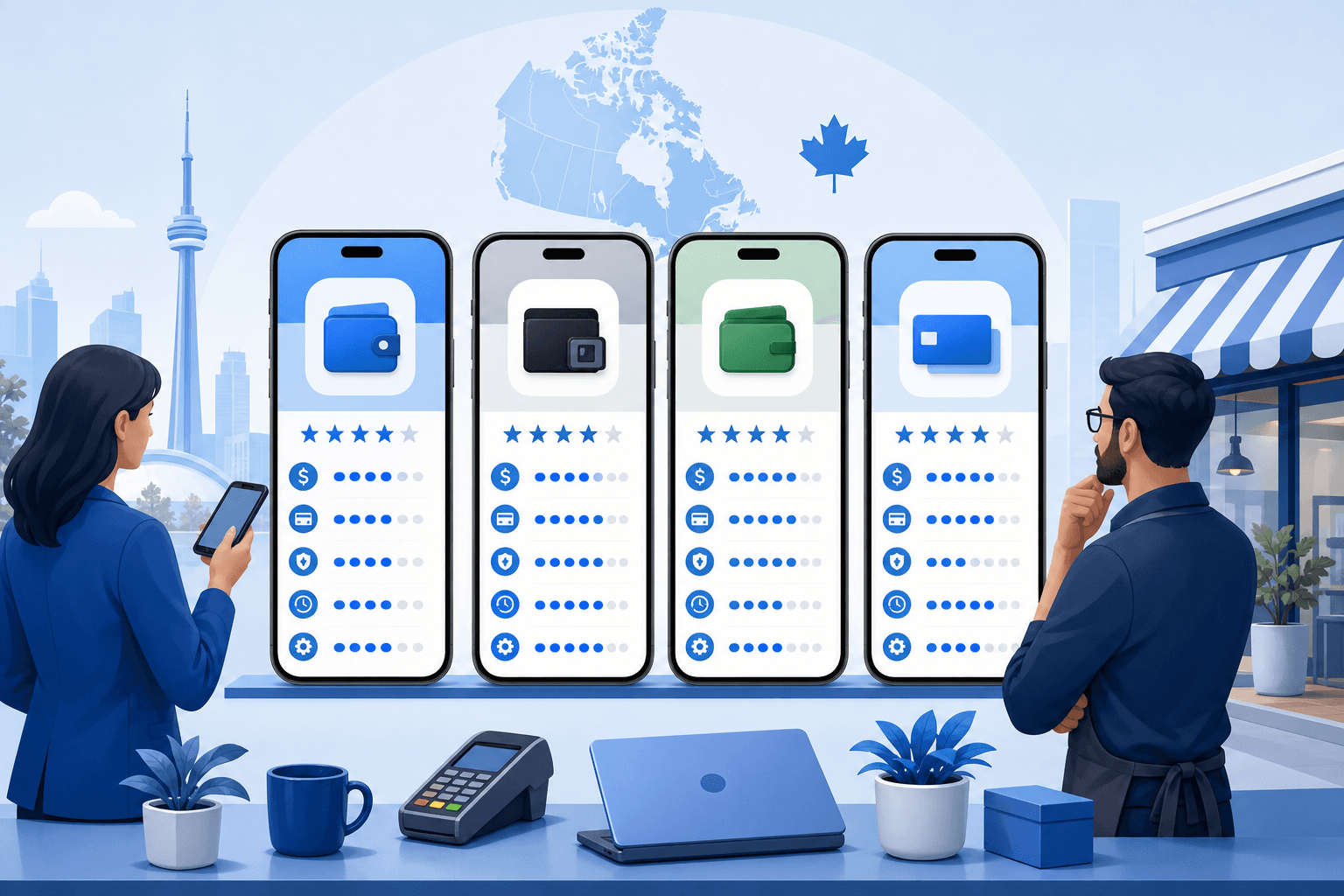
If you've ever watched a customer tap their phone at a farmers' market stall or a food truck window, you've seen mobile payment apps in action. For Canadian small business owners, these apps have become essential tools - no more losing sales because you don't have a traditional terminal on hand. Whether you're running a mobile dog grooming business in Calgary, selling crafts at a weekend market in Halifax, or managing a food truck in downtown Toronto, a reliable mobile payment app can mean the difference between a completed sale and a missed opportunity.
But with so many options flooding the Canadian market - each with different fee structures, hardware requirements, and features - choosing the right one isn't always straightforward. Some apps advertise "no monthly fees" but quietly charge higher per-transaction rates. Others bundle in inventory management and invoicing but cost more upfront. And because pricing is often shown in USD on international apps, Canadian business owners need to dig a little deeper to understand what they'll actually pay in CAD.
This guide breaks down Mobile Payment Apps Compared: Best Options for Canadian Small Businesses, so you can make an informed decision based on your actual transaction volume, business type, and growth plans - not just flashy marketing claims.
Why Mobile Payment Apps Matter for Canadian SMBs
Mobile payment apps turn a smartphone or tablet into a point-of-sale system, letting you accept tap, chip, and contactless payments anywhere you have cell service or Wi-Fi. For many Canadian small businesses, this flexibility is a game-changer:
- Service-based businesses (contractors, landscapers, mobile pet groomers) can collect payment on-site instead of chasing invoices later.
- Seasonal and market vendors can accept cards without investing in a full POS system.
- Restaurants and cafés can enable tableside or curbside payment, speeding up turnover.
- Retailers can add mobile checkout during busy periods or pop-up events.
The catch is that convenience often comes at a price - literally. Mobile apps typically charge a flat percentage per transaction (commonly 2.65%-2.99% in Canada), which can add up quickly for businesses with higher sales volume. That's why it's worth comparing your options carefully, and in some cases, pairing a mobile app with a more cost-effective merchant account for your primary transactions.
Top Mobile Payment Apps for Canadian Businesses
Square
Square remains one of the most recognizable names in mobile payments, and for good reason. It offers a free card reader (with paid upgrades available), a clean app interface, and solid reporting tools. Square charges a flat rate per tap, dip, or swipe transaction, with no monthly fees on its basic plan.
Best for: Businesses just starting out that want simple, transparent pricing with no long-term commitment.
Watch out for: Flat-rate pricing can become expensive as your transaction volume grows. If you're processing more than $10,000-$15,000 a month, it's worth running the numbers against a traditional merchant account.
PayPal Zettle
PayPal's mobile reader integrates tightly with PayPal accounts, making it a natural fit for businesses that already invoice or sell online through PayPal. It supports tap, chip, and contactless payments, and funds typically land in your PayPal balance quickly.
Best for: Businesses with an existing PayPal ecosystem, especially those selling both online and in person.
Watch out for: Currency conversion fees if you're operating with USD-based PayPal settings instead of CAD.
Moneris Go
As a Canadian-founded processor, Moneris offers a mobile solution built specifically with Canadian tax rules, CAD settlement, and local support in mind. Moneris Go is a popular choice for businesses that want a mobile option backed by a long-established Canadian processor.
Best for: Canadian businesses that prioritize local support and want next-day CAD deposits.
Clover Go
Clover's mobile app pairs with its broader ecosystem of POS hardware, making it a smart option for businesses that may want to scale into a full countertop or terminal setup later. If you're already considering a Clover system for your storefront, Clover Go offers consistency across your mobile and in-store payments. See our full Clover comparison for more detail on how it stacks up against other POS platforms.
Best for: Growing businesses that want a mobile app today and a full POS system tomorrow.
Stripe Terminal
Stripe is better known for its online payment infrastructure, but its Terminal product extends that same technology to in-person transactions. It's a strong choice for businesses with developers or custom e-commerce setups who want a unified system across online and offline sales. Check out our Stripe comparison to see how its flat-rate model compares to traditional processing.
Best for: E-commerce businesses that also need occasional in-person payment capability.
Comparing Costs: What Canadian Businesses Actually Pay
Transaction fees are the biggest factor in choosing a mobile payment app, but they're not the only cost to consider. Here's what to look at:
- Per-transaction rate - Usually 2.65%-2.99% for tapped/chipped cards, often higher for manually keyed-in transactions.
- Hardware cost - Readers range from free to $100+ CAD depending on the provider and features (e.g., receipt printing, larger screen).
- Monthly or subscription fees - Some apps are free to use but charge for premium features like advanced reporting or multi-user access.
- Settlement speed - Some providers deposit funds next business day, others take 2-3 business days, which matters for cash flow.
- Currency handling - Make sure CAD is the default settlement currency to avoid unnecessary conversion fees.
For many Canadian small businesses processing moderate to high volumes, flat-rate mobile apps can actually cost more per month than an interchange-plus merchant account with a dedicated processor. If you're unsure where you stand, use our savings calculator to compare your current or expected mobile app fees against other processing options.
Choosing the Right App for Your Industry
Different industries have different needs when it comes to mobile payments.
Restaurants and Food Service
For food trucks, pop-up kitchens, and restaurants offering tableside payment, speed and reliability matter most. Look for apps with strong offline modes (for areas with weak signal) and tip prompt customization. Explore our restaurant solutions for options that integrate mobile payments with broader POS needs.
Retail and Pop-Up Shops
Retailers benefit from apps with solid inventory tracking, especially if you're running both a storefront and market stalls. Our retail solutions page covers POS systems that sync mobile and in-store sales data.
Home and Field Services
Contractors, electricians, and landscapers need apps that work well offline and allow for easy invoicing. Pairing a mobile app with broader construction solutions can simplify both job quoting and payment collection.
Salons, Spas, and Personal Care
Mobile checkout is handy for businesses offering at-home services. Review our salon & spa solutions for tools that combine appointment booking with mobile payment.
Healthcare and Wellness Practitioners
Mobile therapists, physiotherapists, and wellness practitioners making house calls also benefit from secure, PCI-compliant mobile payment tools. Our healthcare solutions outline compliant options for practitioners on the move.
Regional Considerations Across Canada
Payment processing needs can vary slightly depending on where you operate. Businesses in high-density urban markets like Toronto or Vancouver often deal with higher transaction volumes and may outgrow flat-rate mobile apps faster than businesses in smaller markets. Meanwhile, seasonal businesses in cities like Calgary and Ottawa - think festivals, farmers' markets, and tourism-driven sales - may prioritize flexibility and ease of setup over long-term rate optimization.
For Quebec-based businesses, it's also worth considering bilingual support and local regulatory requirements. Our Montreal payment processing resources and Desjardins comparison can help you evaluate Quebec-specific options alongside national mobile app providers.
When to Graduate from a Mobile App to a Full Merchant Account
Mobile payment apps are excellent for getting started, but many businesses eventually outgrow them. Signs it's time to consider a dedicated merchant account include:
- Consistently processing more than $10,000-$15,000 CAD per month
- Needing detailed reporting, multi-location support, or staff permissions
- Wanting lower per-transaction rates through interchange-plus pricing
- Requiring integrations with accounting or inventory software
If any of these sound familiar, it's worth exploring your options. Compare processors to see how traditional merchant accounts stack up against mobile apps, or get a free quote to see what you could save by switching to a solution tailored to your transaction volume.
Final Thoughts
There's no single "best" mobile payment app for every Canadian small business - the right choice depends on your transaction volume, industry, and growth plans. Square and PayPal Zettle are great for businesses just starting out, Moneris Go appeals to those who want Canadian-based support, and Clover Go or Stripe Terminal make sense for businesses planning to scale into more robust POS systems.
Whatever stage your business is in, it's worth periodically reassessing whether your current setup still makes financial sense. As your sales grow, even small differences in transaction fees can add up to thousands of dollars a year.
Ready to find the right fit? Contact our team for personalized guidance, or explore our services to see how PaymentsPlus can help your business accept payments efficiently - whether you're on the move or behind the counter.