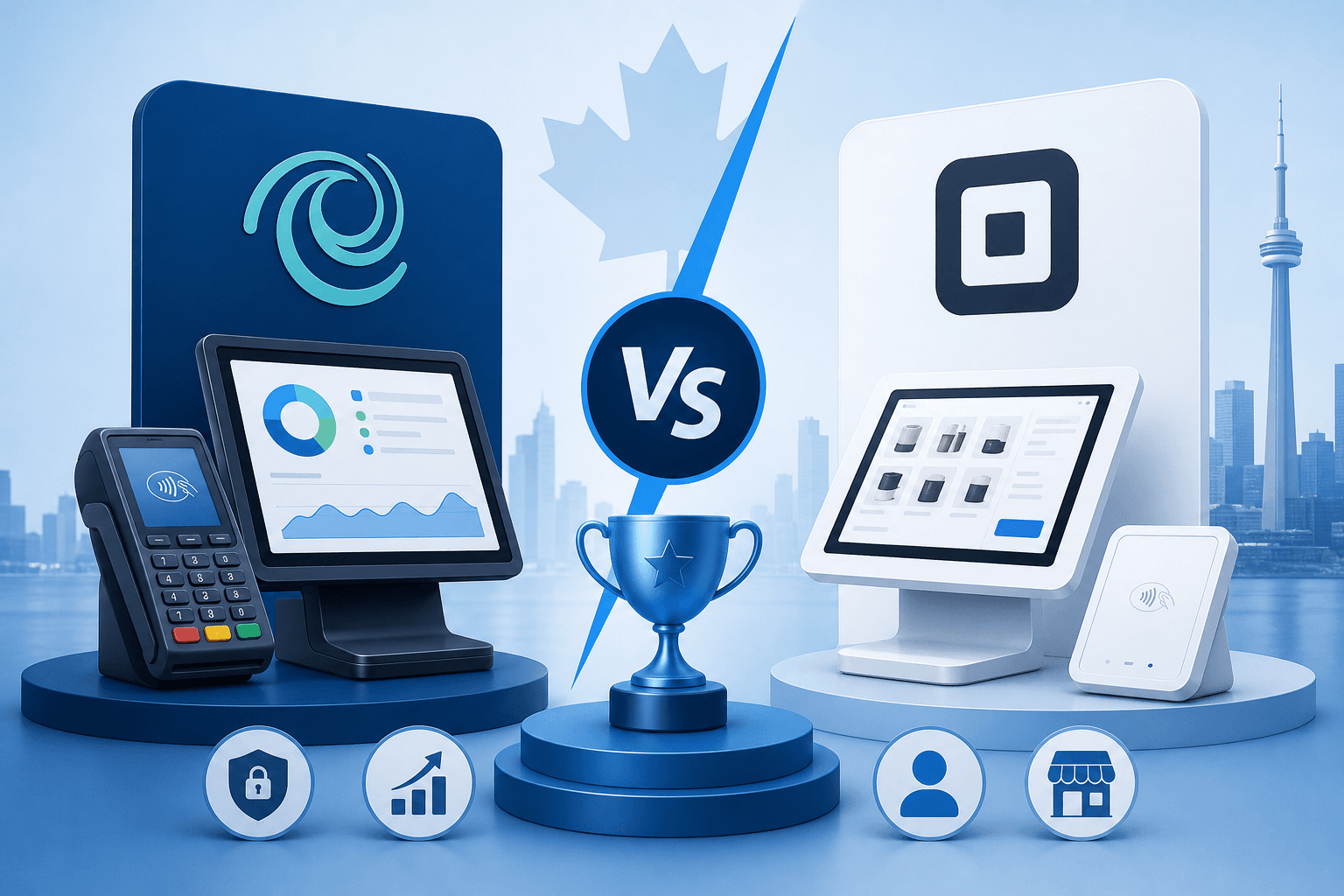
If you're a Canadian business owner trying to decide how to accept payments in 2026, chances are two names keep popping up: Moneris and Square. Both are household names in Canadian payment processing, but they serve very different types of businesses in very different ways. Choosing the wrong one could mean overpaying on fees for years or getting stuck with hardware and software that doesn't fit how you actually run your business.
Moneris, a joint venture between RBC and BMO, has been a dominant force in Canadian payment processing for over two decades, with deep roots in traditional retail, restaurants, and enterprise-level businesses. Square, on the other hand, built its reputation on simplicity and transparency, winning over freelancers, mobile vendors, and small shops that wanted to start accepting cards without a mountain of paperwork.
So which one actually wins in 2026? The honest answer is: it depends on your business size, industry, and growth plans. In this guide, we'll break down the Moneris vs Square Canada debate across pricing, hardware, contracts, support, and more, so you can make a confident, informed decision - or discover there's actually a better option out there for you.
Moneris vs Square Canada: The Quick Overview
Before diving into the details, here's the high-level picture:
- Moneris is best suited for established businesses with consistent transaction volume, especially restaurants, retail chains, and healthcare providers that need robust, Canadian-bank-backed infrastructure.
- Square is best suited for startups, mobile businesses, and low-volume merchants who want fast setup, flat-rate pricing, and no long-term commitment.
Both process payments in CAD and comply with Canadian financial regulations, including PCI DSS compliance and Interac debit integration. But the similarities largely end there. Let's dig into the specifics.
Pricing and Fees: Where the Real Difference Lies
Pricing is usually the deciding factor for most Canadian business owners, and it's also where Moneris and Square diverge the most.
Moneris Pricing Structure
Moneris typically offers interchange-plus or tiered pricing models, depending on your negotiated plan. This means your rate is based on the type of card used (consumer, rewards, corporate, etc.) plus a markup. For higher-volume businesses, this can result in lower effective rates - but it requires negotiation and a good understanding of your statement to avoid overpaying.
Key pricing characteristics:
- Rates vary significantly based on your industry, volume, and negotiating leverage
- Monthly fees, PCI compliance fees, and statement fees are common
- Equipment is often leased, which can add long-term costs
- Contracts may include early termination fees
Square Pricing Structure
Square uses flat-rate pricing, which is refreshingly simple: you pay the same percentage on every transaction regardless of card type.
- In-person transactions: a flat rate per swipe, tap, or insert
- Online and keyed-in transactions: a higher flat rate
- No monthly fees for the basic plan
- No long-term contracts
For low-volume or seasonal businesses, Square's flat-rate model can be more predictable and easier to budget for. But as your transaction volume grows, that flat rate can end up costing significantly more than a well-negotiated interchange-plus plan with Moneris or another processor.
The takeaway: If you're processing under $10,000-$15,000 CAD per month, Square's simplicity may save you money and hassle. Once you cross that threshold, Moneris (or a competitively priced interchange-plus provider) often wins on cost. Use our savings calculator to see exactly where your business falls.
Hardware and POS Systems
Moneris Hardware
Moneris offers a range of terminals and POS systems, from basic countertop terminals to full point-of-sale solutions for restaurants and retail. Their hardware is reliable and widely supported, but it often comes with lease agreements that lock you in for multiple years. If you're comparing POS options more broadly, it's worth taking a look at how Moneris stacks up against systems like Clover or Lightspeed.
- Countertop and wireless terminal options
- Integrated POS systems for restaurants and retail
- Hardware typically leased, not purchased outright
- Setup usually requires working with a sales representative or contact our team for help choosing the right fit
Square Hardware
Square's hardware philosophy is the opposite: buy it outright, no lease required.
- Square Reader (mobile chip and tap reader) starting at a low one-time cost
- Square Terminal and Square Register for more established setups
- No long-term lease commitments
- Easy self-setup, ideal for business owners without dedicated IT support
If your business is mobile, pop-up, or just getting started, Square's plug-and-play hardware is hard to beat. If you need a full-featured POS for a busy restaurant floor or multi-register retail shop, Moneris (or a dedicated POS comparison with Clover comparison or Lightspeed comparison) may serve you better long-term.
Contracts, Flexibility, and Hidden Fees
One of the biggest complaints Canadian merchants have about traditional processors is getting locked into multi-year contracts with early termination penalties. This is an area where Square has historically had the upper hand.
- Moneris: Contracts can range from month-to-month to multi-year agreements, often tied to leased hardware. Always read the fine print on equipment leases - these can outlast the usefulness of the terminal itself.
- Square: No contracts, no cancellation fees. You can stop using the service anytime without penalty.
That said, "no contract" doesn't always mean "cheapest." Businesses that lock in a well-negotiated rate with Moneris and stick with it for years can end up paying less overall than a growing business paying Square's flat rate indefinitely. This is exactly why it pays to compare processors before committing to either option - and why many businesses find more value in independent processors that offer interchange-plus pricing without the lease traps.
Industry Fit: Which Businesses Should Choose Which?
Not all businesses process payments the same way, and your industry should heavily influence your decision.
Where Moneris Tends to Win
- Restaurants: Full-service POS integration, tableside payment, and tip management. See our restaurant solutions for more on what to look for.
- Healthcare: Secure, compliant processing for clinics and practices - explore healthcare solutions.
- Established retail: Multi-location inventory and POS integration via retail solutions.
- Construction and field services: Businesses needing invoicing plus in-person payments, covered under construction solutions.
Where Square Tends to Win
- Mobile and pop-up businesses: Farmers markets, food trucks, craft fairs
- Salons and spas: Simple appointment-based payment flows - see salon & spa solutions
- Nonprofits and small fundraisers: Low commitment, easy setup for nonprofit solutions
- New e-commerce stores: Though for online-first businesses, it's worth comparing Square against platforms like Stripe - check our Stripe comparison and e-commerce solutions
Regional Considerations for Canadian Businesses
Because Moneris is Canadian-owned and deeply embedded in the banking system, it has a strong presence across the country, including partnerships that run through major banks. Square operates nationally as well but functions more like a US-style fintech product adapted for Canada.
If you're located in a major Canadian market, local support and installation options can matter:
- Businesses in the GTA can explore Toronto payment processing
- BC-based businesses should check Vancouver payment processing
- Alberta merchants can review Calgary payment processing
- Quebec businesses - including those weighing Desjardins - should see our Montreal payment processing guide and Desjardins comparison
- Ottawa-area businesses can find tailored info at Ottawa payment processing
Customer Support and Reliability
Moneris offers 24/7 phone support, which is a major advantage for businesses that can't afford downtime - think restaurants during dinner rush or retailers on a busy Saturday. Square's support is primarily digital (chat and email), with phone support available but sometimes slower to access, especially during peak times.
For businesses that bundle their payment processing with their bank (similar to how TD comparison or Chase comparison customers operate), Moneris can feel like a natural extension of existing banking relationships. Square, by contrast, operates independently of Canadian banks, which some merchants prefer for keeping business lines separate.
So, Which One Actually Wins in 2026?
The truth is, the Moneris vs Square Canada decision isn't about which company is objectively "better" - it's about which one fits your business model, transaction volume, and growth plans.
- Choose Moneris if you run an established, higher-volume business that needs robust POS integration, in-person support, and are willing to negotiate rates and navigate equipment leases.
- Choose Square if you're a smaller or mobile business that values simplicity, transparent flat-rate pricing, and zero contracts.
But here's the catch: both Moneris and Square are far from the only options, and in many cases, an independent Canadian processor can beat both on pricing, flexibility, and support - without the drawbacks of bank-owned bureaucracy or flat-rate markups. Before you sign anything, it's worth getting a true side-by-side look at your numbers.
Make the Right Choice for Your Business
Choosing a payment processor is one of the most impactful financial decisions a small business owner makes, and the Moneris vs Square Canada comparison is just the starting point. Rates, contracts, and hardware requirements change frequently, and the "winner" for your neighbor's restaurant might be the wrong choice for your retail shop or clinic.
The smartest move is to get real numbers based on your actual processing volume and industry. Get a free quote to see how your current provider stacks up, or use our savings calculator to estimate how much you could save by switching. If you'd rather talk it through with a real person, contact our team - we help Canadian businesses across every province find the payment processing setup that actually fits.