Introduction
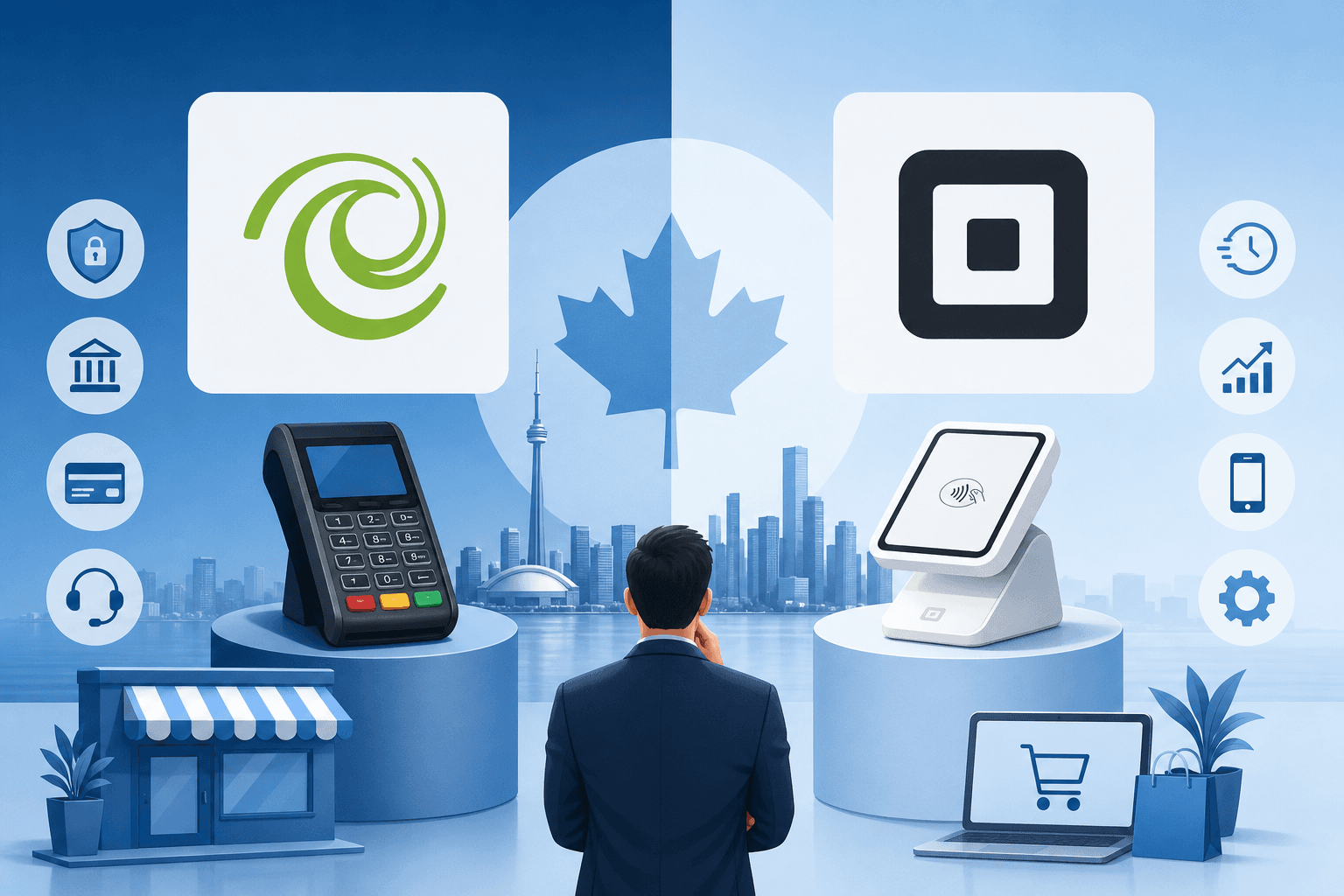
If you run a business in Canada and you have started shopping for a way to accept credit and debit cards, chances are two names keep coming up: Moneris and Square. Both are well known across the country, both are used by thousands of Canadian merchants, and both claim to make accepting payments simple. But "simple" does not always mean "right for your business."
Choosing between Moneris vs Square: which payment processor is best for Canadian businesses really depends on what you sell, how you sell it, and how closely you want to track your processing costs. A coffee shop in Toronto has very different needs than a contractor in Calgary or an online boutique shipping across Ontario and Quebec. This article breaks down how these two processors generally compare, what Canadian business owners should pay attention to, and how to figure out which option actually fits your bottom line.
Before we dive in, one important note: pricing, contract terms, and features change over time, and every processor publishes its own current rates. We encourage you to check each provider's published pricing directly as part of your research, and to use a statement review to compare actual numbers rather than advertised ones.
Moneris at a Glance
Moneris is one of the most established payment processors in Canada, originally formed as a joint venture between two major Canadian banks. It is widely used by retailers, restaurants, and larger merchants who want a processor with deep roots in the Canadian market.
What Canadian Businesses Should Know About Moneris
- Moneris offers a range of terminals and POS hardware aimed at businesses of different sizes, from countertop terminals to integrated POS systems.
- Because of its banking heritage, Moneris is often bundled with business banking relationships, which can make it a default choice for some business owners rather than an actively chosen one.
- Pricing structures and contract terms vary by merchant and by plan, so it is worth asking for a detailed breakdown rather than accepting a general quote.
If your bank has already suggested Moneris as part of a business banking package, it is still worth comparing it to other options. You can compare processors to see how a bank-bundled setup stacks up against other pricing models, and if you are weighing a TD-bundled option specifically, our TD comparison walks through what to look for there.
Square at a Glance
Square built its reputation on simplicity. It is popular with new businesses, mobile vendors, and anyone who wants to start accepting cards quickly without a complicated setup process. Its flat-rate pricing model and all-in-one hardware and software ecosystem have made it a go-to for food trucks, pop-up shops, and service providers across Canada.
What Canadian Businesses Should Know About Square
- Square typically uses flat-rate pricing rather than interchange-plus pricing, which means the rate you pay is usually the same regardless of the card type used.
- Square's hardware and app ecosystem is designed to be self-serve, which appeals to business owners who want to set things up themselves.
- As your transaction volume grows, flat-rate pricing can start to cost more than an interchange-plus model, since larger businesses often process a mix of card types where the difference becomes more noticeable.
For businesses evaluating flat-rate processors generally, it is worth also looking at our Stripe comparison, since Stripe uses a similar flat-rate approach and the same pricing considerations apply.
Moneris vs Square: Which Payment Processor Is Best for Canadian Businesses, By Business Type
There is no single answer that works for every business. Here is how the decision often breaks down by industry.
Restaurants and Cafes
Restaurants need fast transaction speeds, tip handling, and often integration with a POS system for table management. Both Moneris and Square offer restaurant-focused hardware, but transaction volume and average ticket size matter a lot here. A busy restaurant processing a high volume of card payments daily should calculate costs under both flat-rate and interchange-plus models before committing. See our restaurant solutions for more on what Canadian restaurants should look for in a processor.
Retail Stores
Retailers often deal with a wide mix of card types, including premium rewards cards that carry higher interchange costs. This is where flat-rate pricing can quietly cost more than expected. Our retail solutions page covers what retailers should ask before signing with any processor.
E-commerce and Online Businesses
For online sellers, the conversation shifts from countertop terminals to payment gateways and platform integrations. If you sell through Shopify, WooCommerce, or another platform, the processor needs to connect cleanly to your store. Check out our e-commerce solutions for details on how online payment setups typically work.
Salons, Spas, and Service Businesses
Appointment-based businesses often value simplicity and fast setup, which is part of why Square has found traction here. But as appointment volume grows, it is worth reviewing whether a different pricing structure would cost less over time. Our salon & spa solutions page has more detail.
Construction and Field Services
Contractors and field service businesses often need mobile payment acceptance away from a fixed location, plus the ability to invoice and collect deposits. Our construction solutions page outlines what matters most for businesses that are rarely behind a countertop.
Pricing: The Most Important Factor to Compare
When business owners ask Moneris vs Square: which payment processor is best for Canadian businesses, the conversation almost always comes back to pricing. There are two major pricing models at play:
- Flat-rate pricing (common with Square): You pay one percentage rate per transaction, regardless of card type.
- Interchange-plus pricing: You pay the actual interchange cost set by the card networks, plus a fixed markup, shown separately on your statement.
Flat-rate pricing is easy to understand, which is why it appeals to new business owners. But it bundles the card network's actual cost together with the processor's margin, so you cannot see what you are really being charged for each transaction. Interchange-plus pricing separates those two numbers, so you can see exactly what the card networks charge and what the processor charges on top of it.
This is one of the areas where PaymentsPlus takes a different approach. We use interchange-plus pricing, the card network cost plus our markup, shown separately on every statement, so Canadian business owners can see precisely where their processing costs come from rather than guessing.
The only reliable way to know which pricing model costs less for your specific business is to look at your actual processing statement. That is why we offer a free quote built from your own processing statement, showing the dollar difference rather than a generic estimate. You can also use our savings calculator to get a general sense of how different pricing structures might compare for your transaction mix.
Funding Speed, Hardware, and Support
Pricing is not the only factor that matters. Here are a few other practical considerations.
Funding Speed
How quickly funds land in your account affects your cash flow, especially for businesses managing payroll or supplier payments. Different processors structure this differently, and it is worth confirming current funding timelines directly with any provider you are considering. At PaymentsPlus, next-day funding is the standard, with same-day funding available for qualified merchants.
Hardware Options
Square is known for its self-contained hardware and software ecosystem, which can be a strength for businesses that want everything from one vendor. Moneris also offers its own terminal lineup. If you are considering a POS system more broadly, our Clover comparison and Lightspeed comparison pages are useful references, since both are commonly compared against bank-owned and all-in-one processors. PaymentsPlus offers hardware placement options for qualified merchants, so you are not limited to a single fixed hardware package.
Contracts and Flexibility
Contract length and cancellation terms matter more than many business owners expect, especially if your needs change or you outgrow your current setup. Always ask a provider directly about their current contract terms and any cancellation fees before signing. PaymentsPlus does not use long-term contracts and does not charge cancellation fees, which means you are not locked into a decision that no longer fits your business.
Support
When a terminal goes down on a Saturday afternoon or a payment fails at checkout, how quickly you can reach a real person matters. Ask any processor you are considering about their current support channels and response times. At PaymentsPlus, we respond within 24 hours.
Making the Switch: What to Expect
If you decide to move away from either Moneris or Square, the switching process does not have to be disruptive. A good starting point is a statement review, where your current processing statement is analyzed line by line to show the actual dollar difference between what you are paying now and what an interchange-plus structure would look like.
If you are running an online store, switching also involves making sure your new merchant account connects properly to your platform. This is where our integration service comes in: we set up the merchant account for online payments and connect it to your platform, whether that is Shopify, WooCommerce, Odoo, or another system, working directly with you or your developer, using the payment options your platform supports, and testing everything together before go-live. If you use Odoo specifically, our Odoo Clover integration page has more detail on how that connection works.
Businesses in specific regions may also want region-specific guidance. If you are based in Toronto, Vancouver, Calgary, Montreal, or Ottawa, there are local considerations worth reviewing, including the typical mix of card types used by customers in your area.
Conclusion
So, Moneris vs Square: which payment processor is best for Canadian businesses? The honest answer is that it depends on your transaction volume, your card mix, how you sell (in person, online, or both), and how much visibility you want into your processing costs. Square's flat-rate simplicity appeals to newer or smaller businesses, while Moneris's banking ties make it a familiar default for many. But neither is automatically the cheapest or the best fit for every Canadian business.
The best way to find out what makes sense for you is to look at your own numbers. Get a free quote built from your actual processing statement, or contact our team to talk through your options with someone who can walk you through the details. You can also explore our services to see the full range of solutions available to Canadian merchants.