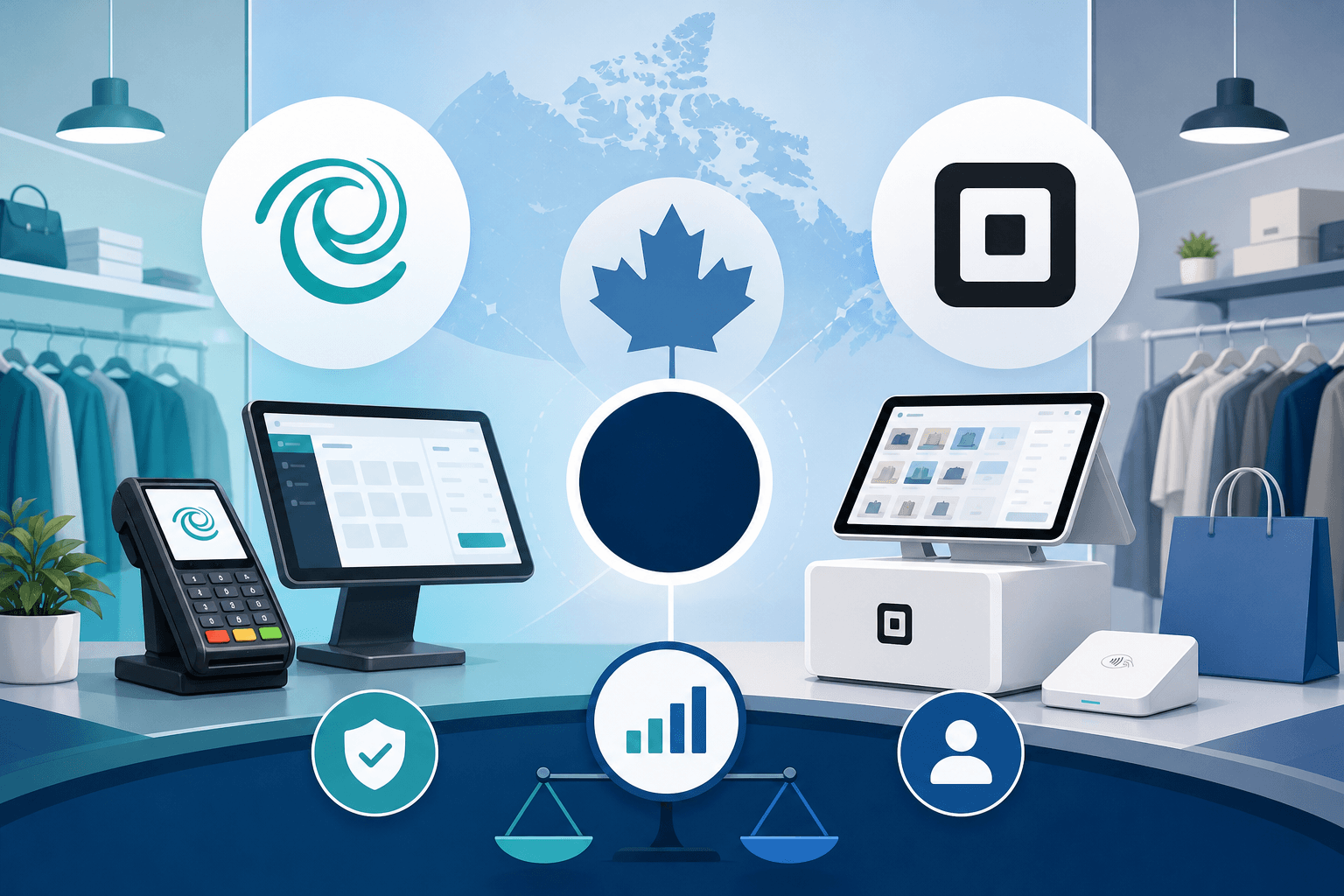
If you're running a retail business in Canada, choosing a payment processor is one of those decisions that feels small until you realize it's costing you thousands of dollars a year in hidden fees, or locking you into a contract you can't escape. Two names dominate the conversation for Canadian retailers: Moneris, the homegrown giant backed by RBC and BMO, and Square, the sleek American import that's become a favorite with mobile and small-format sellers.
Both have loyal followings. Both claim to be the best choice for small business. But they're built on fundamentally different models, and the right answer depends heavily on your sales volume, your store format, and how much you value predictable pricing versus flexibility. In this guide, we'll break down Moneris vs Square: which payment processor wins for Canadian retailers, so you can make a confident, informed decision rather than a rushed one.
Whether you're opening your first storefront in Toronto, running a boutique in Vancouver, or managing multiple retail locations across Canada, this comparison will help you understand what you're really paying for - and what you might be giving up.
Moneris and Square at a Glance
Before diving into pricing and features, it helps to understand what each company actually is.
Moneris is a Canadian payment processing company, jointly owned by RBC and BMO, and it has been processing payments for Canadian merchants for over two decades. It's deeply embedded in the Canadian banking system, offers a wide range of terminals, and is often bundled into business banking packages. Moneris supports everything from tiny mom-and-pop shops to large national retail chains.
Square, by contrast, is a U.S.-based fintech company that expanded into Canada with a simple promise: no contracts, no monthly fees, and flat-rate pricing that's easy to understand. Square built its reputation on affordable, attractive hardware and an all-in-one ecosystem that includes POS software, online ordering, invoicing, and even payroll.
Both are legitimate, well-established options - but they serve different kinds of retailers particularly well. If you want a broader view of how these stack up against other providers too, you can compare processors side by side before making a final call.
Pricing: Flat-Rate Simplicity vs. Interchange-Plus Potential
Square's Flat-Rate Model
Square's pricing is famously simple: a flat percentage on every tapped, dipped, or swiped transaction (typically around 2.65% in Canada), with no monthly fees and no long-term contract. For a new retailer processing a modest volume of sales, this simplicity is genuinely appealing. You know exactly what you're paying, there's no equipment rental fee, and you can cancel anytime.
The catch is that flat-rate pricing doesn't scale well. As your monthly processing volume grows, that flat percentage starts to cost significantly more than what you'd pay on an interchange-plus plan, where you pay the actual card network interchange rate plus a small, transparent markup.
Moneris's Tiered and Interchange-Plus Options
Moneris offers more pricing structures, including interchange-plus plans that can be considerably cheaper for established retailers with higher monthly volumes. However, Moneris's standard quoted rates can also include monthly fees, terminal rental costs, and sometimes a contract term - and getting to the best possible rate often requires negotiation.
This is exactly why so many Canadian retailers get quoted a number that sounds fine on paper, then discover extra fees on their statement a few months in. If you're unsure whether your current rate is competitive, it's worth using a savings calculator to see what you could be paying under a different pricing structure.
Bottom line: Square tends to win for low-volume or seasonal retailers who value predictability. Moneris tends to win for higher-volume retailers who can negotiate a strong interchange-plus rate.
Hardware and Point-of-Sale Experience
Square Hardware
Square's hardware is one of its biggest draws. The Square Reader, Square Terminal, and Square Register are stylish, intuitive, and ready to use within minutes of unboxing. For retailers who want a modern-looking checkout counter without a steep learning curve, Square's design-forward approach is a real advantage. Its POS software is also well-regarded for inventory tracking, employee management, and basic reporting.
Moneris Hardware
Moneris offers a wider range of terminal options, including countertop, wireless, and mobile units, many of which are built specifically for the demands of Canadian retail environments - including robust support for Interac Debit, which remains hugely popular with Canadian shoppers. Moneris terminals are reliable workhorses, though the interface and setup process can feel more dated compared to Square's modern design.
If your retail operation already runs on a POS system like Clover or Lightspeed, it's worth checking how each processor integrates before switching. See our Clover comparison or Lightspeed comparison for more detail on how POS choice affects your processing options.
Contracts, Fees, and Flexibility
This is where the two companies diverge most sharply.
Square:
- No long-term contracts
- No monthly minimums
- Cancel anytime without penalty
- Transparent flat-rate pricing
Moneris:
- Contract terms are common, especially through bank referrals
- Early termination fees may apply
- Monthly fees and terminal rental costs are often part of the package
- Rates can be negotiated, especially for higher-volume merchants
For a retailer just starting out, Square's lack of commitment is a real selling point - you can test the waters without risk. For an established retailer with consistent, high-volume sales, Moneris's negotiated contracts can deliver lower effective costs, even with the added complexity.
This is also where many Canadian business owners get caught off guard. A processor that looked cheap at signing can turn out to be expensive once monthly fees, PCI compliance charges, and batch fees are added up. Before signing anything, it's worth getting a clear breakdown - you can get a free quote to see exactly what you'd pay with a transparent, itemized structure.
Customer Support and Canadian Market Fit
Local Support Matters
Moneris has decades of experience supporting Canadian retailers specifically, with Canadian-based customer service, a deep understanding of provincial tax requirements, and strong relationships with Canadian banks. For retailers in Toronto, Vancouver, Calgary, Montreal, or Ottawa, this local grounding can matter - especially when you need fast, in-person terminal replacement or support that understands Canadian banking rules.
Square's support has improved significantly over the years, but it's still fundamentally a U.S. company adapting its products for the Canadian market, which occasionally shows in smaller gaps, such as feature rollouts arriving in Canada later than in the U.S.
Regional Considerations
Retailers operating in different Canadian markets may find one processor better supported locally than another. If you're based in a major hub, check out our location-specific resources:
- Toronto payment processing
- Vancouver payment processing
- Calgary payment processing
- Montreal payment processing
- Ottawa payment processing
Quebec retailers in particular should also weigh how each processor handles bilingual support and provincial compliance - our Desjardins comparison is a useful companion read if you're evaluating options specific to Quebec.
Which One Actually Wins for Canadian Retailers?
So, back to the core question: Moneris vs Square, which payment processor wins for Canadian retailers? The honest answer is that it depends on your business profile.
Choose Square if you:
- Are a new or small-volume retailer
- Want simple, flat-rate pricing with no surprises
- Value modern, attractive hardware and an intuitive app
- Don't want to be locked into a contract
- Run a mobile or pop-up retail operation
Choose Moneris if you:
- Process a high volume of transactions monthly
- Want access to negotiated interchange-plus pricing
- Need robust Interac Debit support
- Value a processor deeply familiar with Canadian banking and compliance
- Operate multiple retail locations and need enterprise-level support
Many retailers actually outgrow Square's flat-rate model within their first year or two, especially once sales volume increases - at which point Moneris, or a competitively priced interchange-plus provider, often becomes the smarter financial choice. Others, especially boutique or seasonal retailers, find Square's simplicity and low barrier to entry unbeatable.
It's also worth noting that Moneris and Square aren't the only two options. Retailers frustrated with either should also look at flat-rate alternatives like the Stripe comparison, bank-bundled options such as our TD comparison, or enterprise-grade processing covered in our Chase comparison.
A Note for Other Retail-Adjacent Businesses
If your business blends retail with another category - like a café counter inside a retail space, or a spa that sells product lines - it's worth exploring more tailored solutions. Our retail solutions, hospitality solutions, and salon & spa solutions pages dig into processor features designed for mixed business models.
Final Thoughts and Next Steps
There's no universal winner in the Moneris vs Square debate - only the right fit for your specific retail business. Square is hard to beat for simplicity, speed of setup, and predictable costs at lower volumes. Moneris, with its Canadian roots and negotiable interchange-plus pricing, tends to pull ahead as your sales grow and your needs become more complex.
The best way to find your answer isn't to guess - it's to run the actual numbers. Take your current monthly processing volume and average transaction size and see how each pricing model plays out over a full year.
Ready to stop guessing and start saving? Contact our team for a no-obligation review of your current processing costs, or explore our services to see how PaymentsPlus helps Canadian retailers find the payment solution that actually fits their business.