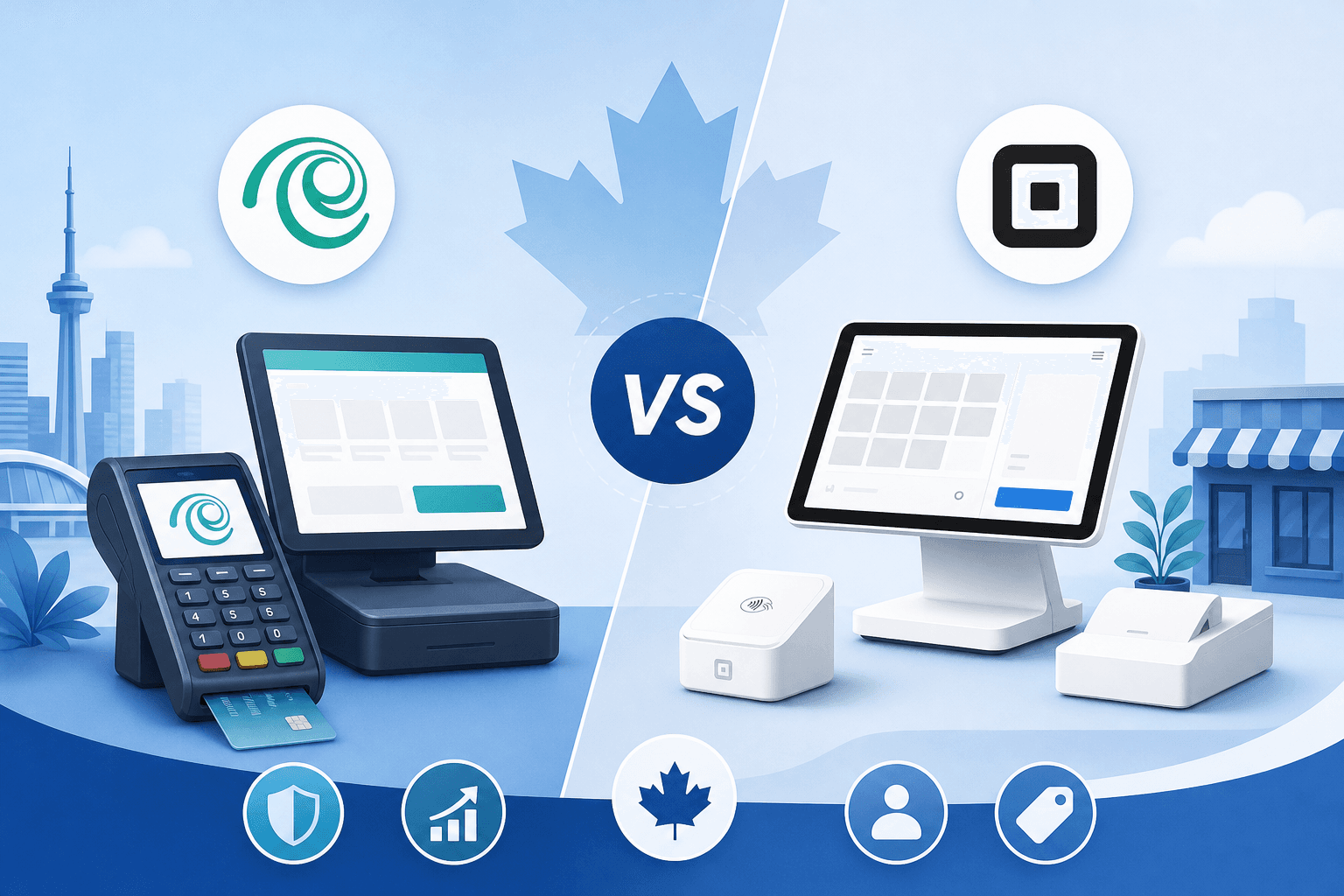
If you've started researching payment processors for your Canadian business, you've probably landed on two names over and over again: Moneris and Square. Both are well known in Canada, both process a huge volume of transactions for businesses across the country, and both are regularly recommended as starting points for small business owners trying to accept debit and credit cards. But "well known" doesn't always mean "right for your business."
The Moneris vs Square decision isn't as simple as picking the bigger brand or the one with the catchier app. These two companies serve small businesses in very different ways, with different pricing structures, different hardware philosophies, and different approaches to support. A coffee shop in Ottawa might have completely different needs than an online retailer in Vancouver or a contractor invoicing clients in Calgary.
In this article, we'll break down how Moneris and Square actually compare for Canadian small and medium businesses, what to watch for in each, and how to figure out which setup (or which alternative) makes the most financial sense for your business.
A Quick Overview of Moneris and Square
Moneris is a Canadian payment processor, originally a joint venture between two of Canada's major banks, and it's one of the most established names in Canadian card processing. It offers a wide range of terminals, POS systems, and integrated solutions aimed at businesses of all sizes, from independent retailers to national chains.
Square, by contrast, is a US-based company that expanded into Canada with a simpler, more self-serve model. It's built around flat-rate pricing and easy-to-use hardware, like its countertop terminals and mobile card readers, and it has become popular with newer businesses, mobile vendors, and anyone who wants to start accepting payments quickly without a lot of paperwork.
Both process payments in CAD and both support Canadian debit networks, but the similarities largely end there. The real differences show up in pricing structure, contract terms, and how much flexibility you have as your business grows.
Pricing Structure: Flat-Rate vs Interchange-Plus
This is where the Moneris vs Square comparison really matters for your bottom line.
Square is known for flat-rate pricing: one percentage rate applied to every transaction, regardless of card type. This is simple to understand, which is part of its appeal, but it also means you may be paying the same rate on a low-cost debit transaction as you do on a premium rewards credit card, even though the underlying interchange cost to process those two transactions is very different.
Moneris offers multiple pricing models depending on the plan and contract, and it's important to check Moneris's current published pricing directly, since rates and plan structures can change and vary by business type.
Many Canadian processors, including PaymentsPlus, use interchange-plus pricing instead. With this model, you pay the actual interchange cost set by the card networks, plus a clear, fixed markup, and both are shown separately on your statement. There's no blending of rates across card types, which means lower-cost transactions actually cost you less. For businesses with any real transaction volume, this transparency can make a meaningful difference over time.
If you want to see exactly how your current processing costs compare, use our savings calculator or request a free quote built from your actual processing statement, which shows the dollar difference rather than a generic estimate.
Hardware and Point-of-Sale Options
Square's Hardware Approach
Square's hardware is one of its biggest selling points for very small or mobile businesses. Its readers and terminals are designed to be purchased outright and used with minimal setup, which appeals to market vendors, pop-up shops, and service providers who need to take a card payment occasionally rather than constantly.
Moneris's Hardware Approach
Moneris offers a broader range of countertop and wireless terminals suited to higher-volume retail, hospitality, and restaurant environments, along with integrated POS options for businesses that need more robust reporting and inventory features.
How PaymentsPlus Compares
PaymentsPlus offers hardware placement options for qualified merchants, matched to how your business actually operates, whether that's a busy restaurant counter, a retail checkout, or a mobile service setup. Rather than locking you into one brand's ecosystem, the right hardware is selected based on your transaction volume, environment, and existing systems. If you're also weighing other POS options, it's worth taking a look at our Clover comparison and Lightspeed comparison alongside Moneris and Square.
Funding Speed and Cash Flow
For small businesses, how quickly you can access your money matters almost as much as what you're paying in fees. Processors differ in how fast funds move into your bank account, and these timelines can change, so it's worth checking directly with any provider you're considering.
At PaymentsPlus, next-day funding is the standard, meaning qualifying transactions processed today are typically available in your account the next business day. Same-day funding is also available for qualified merchants, which can help businesses managing tight cash flow, such as restaurants, retailers, or seasonal operations. For Moneris's and Square's current funding timelines, check each provider's published terms directly, since this is one of the more important details to confirm before committing.
Contracts, Fees, and Flexibility
One of the most common frustrations Canadian business owners run into with payment processing isn't the rate itself, it's the contract. Long-term agreements, early termination penalties, and bundled equipment leases can make switching providers expensive even when a better deal comes along.
Before signing with any processor, Moneris, Square, or otherwise, ask directly:
- Is there a long-term contract, and what happens if I need to cancel?
- Are there early termination or cancellation fees?
- Is PCI compliance included, or billed separately?
- Is hardware purchased outright, leased, or provided under a placement arrangement?
- How are statement fees and monthly minimums structured?
For reference, PaymentsPlus operates with no long-term contracts and no cancellation fees, and PCI compliance is included as part of the service. That kind of flexibility matters if your business is growing, seasonal, or simply not ready to commit to a multi-year agreement with early termination penalties attached.
If you're trying to directly stack up your options, our compare processors page walks through how different Canadian providers approach pricing and contracts, which can help make the Moneris vs Square decision, and any other processor you're considering, a lot clearer.
Integration With Your Business Platform
If you sell online, or plan to, how well a processor connects to your platform matters just as much as its in-person hardware. Square has built-in e-commerce tools designed to work within its own ecosystem. Moneris offers integrations with various e-commerce and POS platforms, but setup requirements and supported platforms are best confirmed directly with Moneris.
PaymentsPlus offers an integration service where we set up your merchant account for online payments and connect it to your platform, whether that's Shopify, WooCommerce, Odoo, or another system, working directly with you or your developer using the payment options your platform supports. We test everything with you before go-live, so there are no surprises when real transactions start flowing. If you're running an ERP setup, our Odoo Clover integration page covers how that connection works in more detail.
This kind of hands-on setup support is especially valuable for businesses in e-commerce, where a misconfigured payment gateway can mean lost sales, or in multi-location retail operations where in-store and online systems need to stay in sync.
Which Industries Tend to Fit Where
Neither Moneris nor Square is a universal best fit, and the right answer often depends heavily on your industry:
- Restaurants and hospitality often need fast table turnover, tip handling, and integration with kitchen or reservation systems. See our restaurant solutions and hospitality solutions pages for more on what to look for.
- Retail businesses need reliable inventory syncing and checkout speed, covered in our retail solutions overview.
- Salons and spas often benefit from appointment-linked payment tools; see our salon & spa solutions page.
- Healthcare practices have specific privacy and billing considerations outlined in our healthcare solutions page.
- Construction and trades businesses often need mobile and invoice-based payment options, detailed in our construction solutions page.
- Automotive shops typically need both in-person terminals and service-based billing, covered in our automotive solutions page.
- Nonprofits often have different processing needs around donation handling, covered in our nonprofit solutions page.
Regional Considerations for Canadian Businesses
Where your business operates in Canada can also shape which processor and hardware setup makes the most sense, from local support expectations to the systems most common in your area. Businesses in Toronto, Vancouver, Calgary, Montreal, and Ottawa all have slightly different vendor landscapes and competitive dynamics worth factoring in. Quebec-based businesses in particular should also look at our Desjardins comparison, since Desjardins has a strong regional presence.
Making the Right Choice for Your Business
There's no single answer to the Moneris vs Square question that applies to every Canadian small business. Square's simplicity can work well for very low-volume or mobile sellers who value ease of setup over long-term cost efficiency. Moneris's broader terminal lineup and Canadian banking roots appeal to businesses that want a familiar, established name with more extensive hardware options.
But for businesses that process a meaningful volume of transactions each month, flat-rate pricing can quietly cost more over time than a transparent interchange-plus model, and long-term contracts with either provider can limit your flexibility down the road. Before committing to any processor, it's worth running the actual numbers.
The most reliable way to compare is to look at your own processing statement rather than published rate cards alone. Get a free quote built from your current statement, and you'll see the dollar difference clearly laid out rather than relying on a general estimate. From there, contact our team and we'll respond within 24 hours to walk through your options, including hardware placement for qualified merchants, next-day funding, and integration support for your specific platform.