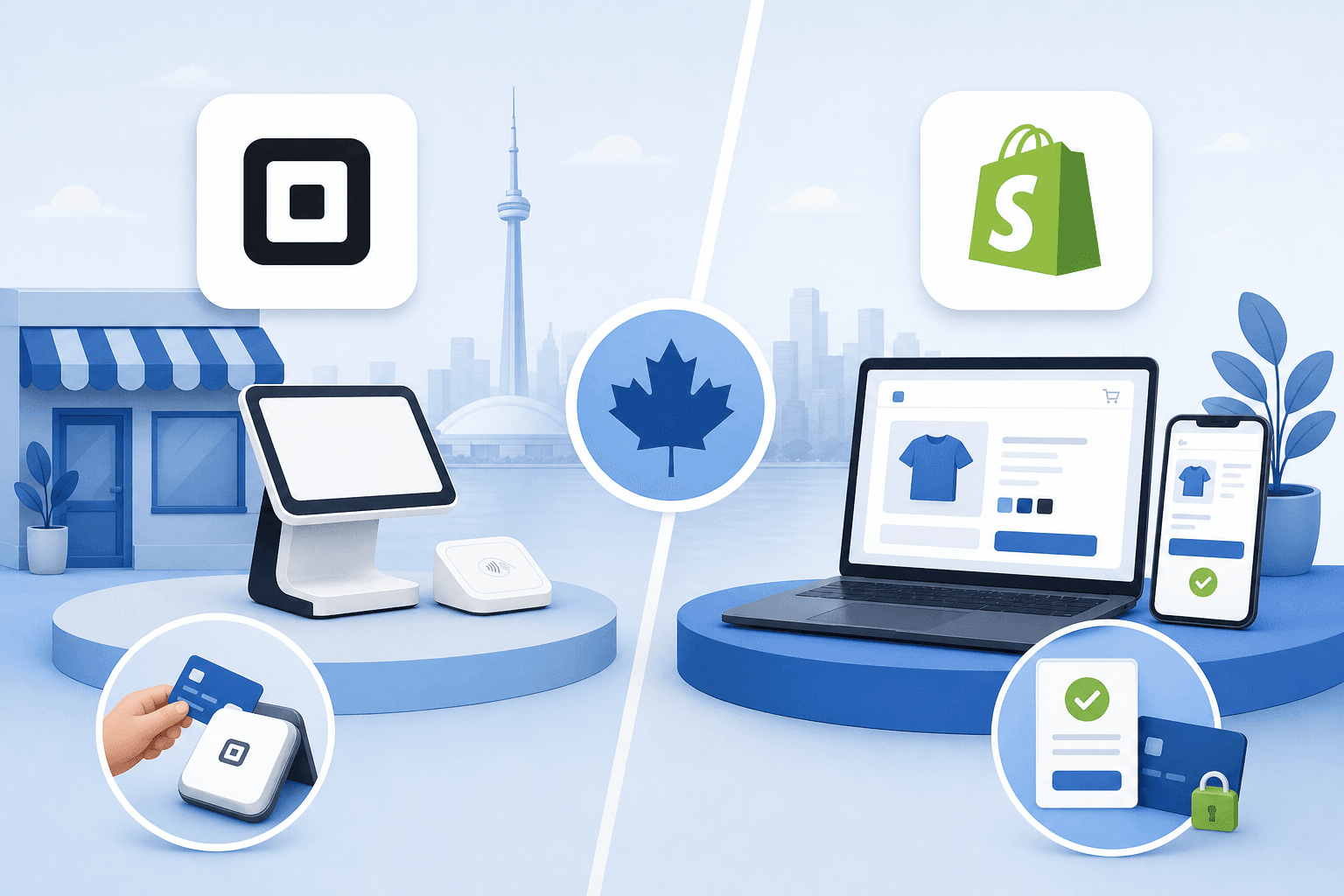
If you're a Canadian retailer trying to decide how to accept payments both in-store and online, chances are Square and Shopify Payments have both landed on your shortlist. They're two of the most popular processors for small and medium businesses across Canada, and for good reason - both offer simple setup, transparent pricing, and tools built for modern retail. But "popular" doesn't always mean "right for your business."
The Square vs Shopify Payments debate comes down to more than just transaction fees. It's about how you sell, where you sell, what hardware you need, and how quickly you need your money in your Canadian bank account. A boutique in Toronto selling primarily through Instagram and pop-up markets has very different needs than a Vancouver home goods store running a full-fledged online shop with in-store pickup.
In this guide, we'll break down Square vs Shopify Payments across pricing, features, hardware, and support - specifically through the lens of Canadian retailers dealing with CAD pricing, provincial sales tax requirements, and Canadian banking timelines. By the end, you'll have a clear picture of which platform fits your business, and what to consider if neither is the perfect fit.
Square vs Shopify Payments: The Quick Overview
Before diving into the details, here's the high-level distinction that matters most for Canadian retailers:
- Square is primarily a point-of-sale (POS) and hardware company that added online selling tools. It's built for businesses that sell in person first, online second.
- Shopify Payments is built into the Shopify e-commerce platform, meaning it's designed for businesses that sell online first, with in-person tools (Shopify POS) added on.
This distinction shapes almost everything else - pricing structure, hardware ecosystem, and how well each platform handles omnichannel selling (in-store + online + social).
Who Each Platform Is Built For
Square works well for:
- Cafes, food trucks, and quick-service retail
- Farmers market and pop-up vendors
- Service businesses needing simple invoicing
- Retailers who want affordable, flexible hardware
Shopify Payments works well for:
- Online-first retailers and DTC (direct-to-consumer) brands
- Businesses planning to scale across multiple sales channels
- Retailers with a strong need for customizable storefronts
- Stores selling to both Canadian and international customers online
Pricing Comparison: What It Actually Costs in CAD
Pricing is usually the deciding factor for Canadian business owners, so let's look at actual numbers.
Square Pricing in Canada
Square uses flat-rate pricing with no monthly fees on its basic plan:
- In-person transactions: approximately 2.65% per tap, chip, or swipe
- Online transactions: approximately 2.9% + $0.30 CAD per transaction
- Keyed-in/manually entered transactions: approximately 3.4% + $0.15 CAD
- No long-term contracts; pay-as-you-go
Shopify Payments Pricing in Canada
Shopify Payments fees are tied to your Shopify subscription plan:
- Basic plan: approximately 2.9% + $0.30 CAD online, 2.6% + $0.10 CAD in person
- Shopify plan: slightly lower rates as your subscription increases
- Advanced/Plus plans: lowest processing rates, but higher monthly software costs
- Additional fees apply if you use a third-party payment gateway instead of Shopify Payments
The key takeaway: Square's flat-rate model is simpler and more predictable for low-volume or in-person-heavy retailers, while Shopify Payments can become more cost-effective at higher sales volumes on higher-tier plans - but you're also paying for the Shopify platform itself, not just payment processing.
If you're unsure how these numbers translate to your actual monthly costs, use our savings calculator to compare based on your real transaction volume and average sale size.
Features and Functionality Compared
Point of Sale Experience
Square's POS app is widely praised for being intuitive, even for staff with no payments experience. It handles inventory, basic CRM, employee management, and reporting without needing deep customization. For a retailer running a single storefront or a small chain, Square's POS can be up and running the same day.
Shopify POS is also solid, but it genuinely shines when your in-store inventory and online store inventory need to stay in sync in real time. If you're running "buy online, pick up in-store" (BOPIS) or want unified customer profiles across channels, Shopify's ecosystem is purpose-built for that.
E-commerce Capabilities
This is where the gap widens. Shopify is, first and foremost, an e-commerce platform - it offers far more flexibility in storefront design, app integrations, SEO tools, and marketing automation than Square's online store builder. If a meaningful part of your revenue comes from (or will come from) your website, Shopify has a significant edge.
Square's online store tools have improved but remain more limited - fine for a simple online catalogue, less ideal for retailers wanting a highly customized or content-rich e-commerce experience. Retailers focused heavily on e-commerce growth should also look at our dedicated e-commerce solutions for options beyond these two platforms.
Hardware Options
Square has a clear advantage in affordable, flexible hardware:
- Square Reader (contactless + chip): low upfront cost
- Square Terminal: standalone, portable
- Square Stand and Register: full counter setups
Shopify's hardware (Shopify POS Go, card readers, Shopify POS terminal) is capable but tends to be pricier and more tied to your Shopify subscription tier. If hardware cost and flexibility matter to your retail operation, Square generally wins here, though it's worth comparing both against dedicated Clover comparison options, which many Canadian retailers also consider for hardware-forward setups.
Payouts, Banking, and Canadian Considerations
Deposit Timelines
Both platforms deposit funds into Canadian bank accounts in CAD, but timing differs:
- Square: typically 1-2 business days for standard deposits, with instant deposit options for a fee
- Shopify Payments: typically 1-3 business days, varying by plan and bank processing times
For retailers managing tight cash flow - common in seasonal retail or businesses with high inventory carrying costs - faster, more predictable payouts can matter more than a slightly lower percentage rate.
Currency Handling and Cross-Border Sales
If you sell to U.S. or international customers, Shopify Payments has more mature multi-currency tools, allowing you to display and settle in different currencies while still depositing CAD into your account. Square's multi-currency support is more limited, which can matter if a chunk of your customer base is outside Canada.
Tax and Compliance
Neither platform files your sales tax for you, but both integrate with common Canadian accounting tools to help you track GST/HST and provincial sales tax collected. Make sure whichever platform you choose, your reporting clearly separates tax collected by province, especially if you sell across multiple provinces with different HST/PST/GST rules.
Which One Should Canadian Retailers Choose?
There's no universal winner in the Square vs Shopify Payments comparison - the right choice depends on how your business actually sells.
Choose Square if:
- You primarily sell in person (retail counter, markets, pop-ups)
- You want low-cost, flexible hardware
- You don't need a highly customized online store
- You want simple, predictable flat-rate pricing
Choose Shopify Payments if:
- E-commerce is a primary or growing revenue channel
- You need advanced storefront customization and marketing tools
- You're scaling toward omnichannel retail with synced inventory
- You sell internationally and need multi-currency support
A Third Option: Dedicated Payment Processing
Many growing Canadian retailers eventually outgrow both platforms' one-size-fits-all pricing, especially once monthly volume climbs. At that point, a dedicated merchant account with interchange-plus pricing often beats flat-rate models from Square or Shopify, sometimes saving retailers hundreds or thousands of dollars a year. This is particularly true for retailers processing more than $20,000-$30,000 CAD per month.
If you want to see how your current setup stacks up, get a free quote or compare processors side by side before committing to either platform long-term. It's also worth reviewing how these two stack up against other popular options like our Stripe comparison or Lightspeed comparison, depending on whether flat-rate or POS-centric pricing matters more to you.
Regional Considerations for Canadian Retailers
Where your business operates can also influence which platform - or which supplementary processor - makes the most sense.
- Retailers in Toronto and the GTA often deal with higher transaction volumes and benefit from reviewing Toronto payment processing options alongside Square or Shopify.
- Vancouver retailers with strong tourism and cross-border traffic should weigh multi-currency needs carefully - see Vancouver payment processing for local insights.
- Calgary businesses balancing seasonal retail cycles can benefit from reviewing Calgary payment processing alternatives.
- Montreal and Quebec retailers should also consider bilingual support and Quebec-specific requirements - our Montreal payment processing guide covers this in more detail.
- Ottawa retailers serving a mix of government, tourism, and local foot traffic can find tailored guidance via Ottawa payment processing.
Final Thoughts
Both Square and Shopify Payments are legitimate, trustworthy options for Canadian retailers - the "better" choice really depends on whether your business lives primarily in a physical storefront, online, or somewhere in between. Square keeps things simple and affordable for in-person sellers, while Shopify Payments gives online-first and scaling retailers more horsepower.
Whichever direction you lean, it's worth running the numbers specifically for your sales volume and average transaction size before committing - flat-rate pricing can look appealing on paper but cost more in practice once volume grows. Our retail solutions team works with Canadian businesses every day to find the right fit, whether that's Square, Shopify, or a dedicated processor built around your actual transaction patterns.
Ready to see what you could be saving? Contact our team for a no-obligation review of your current payment setup, or get a free quote to compare your options side by side.