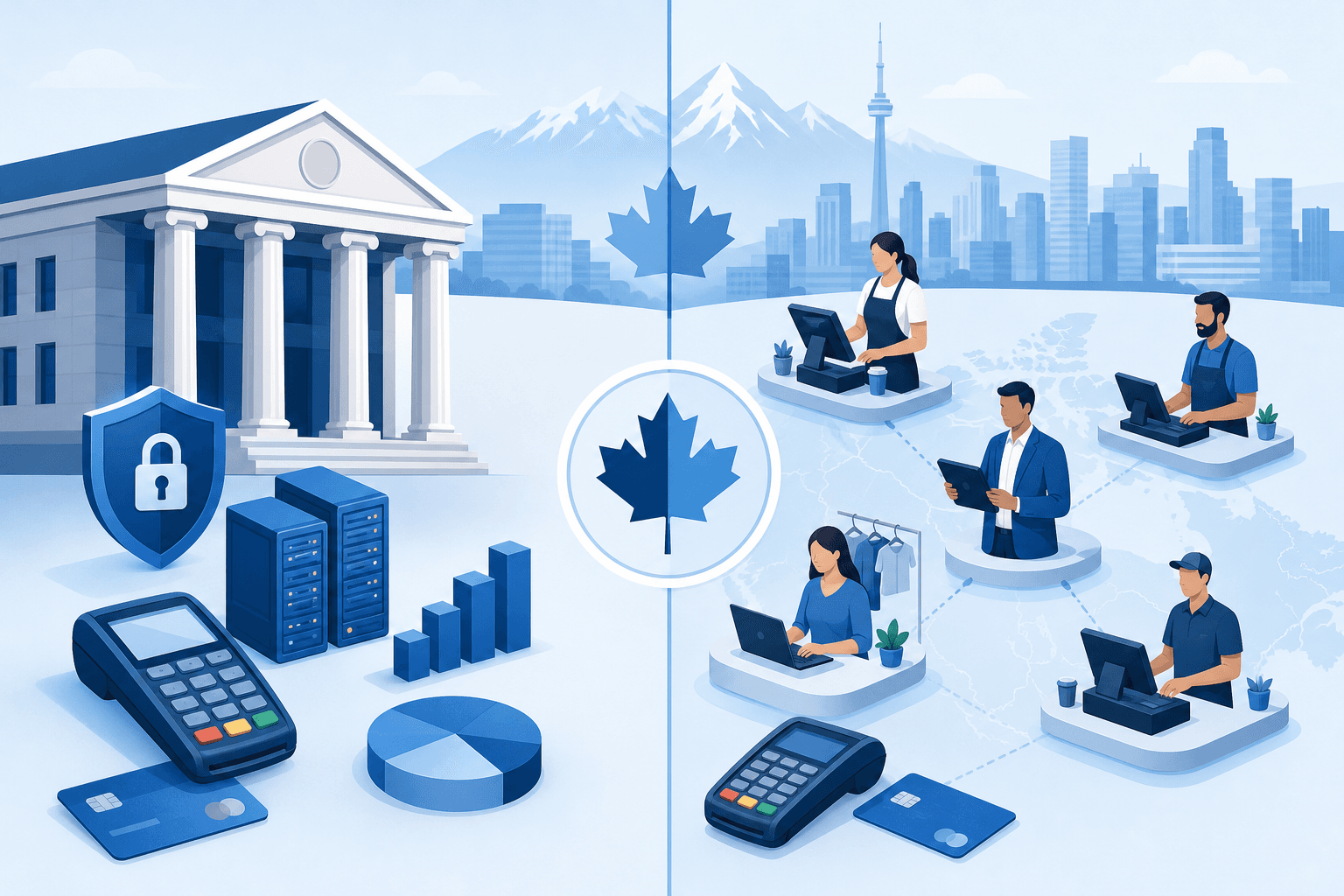
If you've started shopping around for credit card processing in Canada, you've probably noticed two very different types of providers knocking on your door: the big banks and a crowd of independent companies you may never have heard of. Both promise competitive rates and reliable service, but they operate in fundamentally different ways - and the choice between them can significantly affect your monthly processing costs, contract flexibility, and customer support experience.
For Canadian small and medium business owners, this decision isn't just academic. Processing fees are often one of the largest recurring operating costs after rent and payroll, especially for retailers, restaurants, and e-commerce businesses running high transaction volumes in CAD. Choosing the wrong provider can lock you into a multi-year contract with rigid terms and hidden fees, while choosing the right one can save you thousands of dollars a year.
This guide breaks down the real differences between bank-owned processors vs independent ISOs in Canada, so you can make an informed decision based on your business size, industry, and growth plans - not just a flashy sales pitch.
What Are Bank-Owned Processors?
Bank-owned processors are payment processing arms operated directly by Canada's major financial institutions, such as TD, RBC, Scotiabank, BMO, and Desjardins. If you already bank with one of these institutions, chances are a representative has offered to "bundle" your merchant services with your business banking.
How They Work
Bank-owned processors integrate payment processing directly with your existing business bank account. Funds are typically deposited quickly since everything stays within the same institution, and the sales process is streamlined - a single point of contact can set up your business bank account, line of credit, and payment terminal all at once.
Pros of Bank-Owned Processors
- Convenience: One institution handles your banking and processing, simplifying reconciliation.
- Brand trust: Many business owners feel more comfortable with a recognizable Canadian bank name.
- Bundled perks: Some banks offer discounts on business accounts or loans when you sign up for processing.
Cons of Bank-Owned Processors
- Less pricing flexibility: Bank processors often use tiered pricing models that can obscure your true costs.
- Slower innovation: Banks are typically slower to roll out new POS technology, integrations, or industry-specific tools compared to ISOs.
- Limited customization: Merchant agreements with banks are often standardized with little room for negotiation, particularly for smaller merchants.
- Customer service bottlenecks: Support may be routed through general banking call centers rather than dedicated merchant services teams.
If you're currently processing with a major bank, it's worth checking our TD comparison or Desjardins comparison pages to see how your current rates stack up against alternatives.
What Are Independent ISOs?
ISO stands for Independent Sales Organization. These are companies - like PaymentsPlus - that partner with payment networks and acquiring banks to offer merchant services, but operate independently from any single financial institution.
How They Work
ISOs act as intermediaries, often with more flexibility to negotiate rates, bundle hardware and software, and tailor pricing structures to your specific industry. Because they're not tied to one bank's product suite, ISOs can shop across multiple acquiring relationships to find the best fit for your business.
Pros of Independent ISOs
- Competitive, often lower rates: Interchange-plus pricing is more common, giving you transparent, often lower effective rates than tiered bank pricing.
- Specialized industry solutions: Many ISOs build tailored packages for restaurants, retail, healthcare, and other verticals.
- Flexible contracts: Independent providers are often more willing to negotiate contract length, early termination terms, and equipment costs.
- Dedicated support: Many ISOs provide a direct account manager instead of a general call center queue.
- Faster adoption of new technology: ISOs frequently partner with modern POS systems like Clover and Lightspeed, giving you access to better hardware and software integrations.
Cons of Independent ISOs
- Variable reputation: Because there are many ISOs in Canada, quality and transparency vary widely - due diligence is essential.
- Separate banking relationship: Your merchant account won't be directly tied to your business bank account, which some owners find less convenient.
Bank-Owned Processors vs Independent ISOs in Canada: Key Differences
When comparing bank-owned processors vs independent ISOs in Canada, the differences generally come down to four factors: pricing structure, contract flexibility, technology, and support.
1. Pricing Structure
Banks typically use tiered pricing, which groups transactions into categories (qualified, mid-qualified, non-qualified) with different rates. This structure can make it hard to predict your actual costs and often results in higher effective rates for certain card types, like premium rewards cards.
Independent ISOs more commonly offer interchange-plus pricing, which separates the wholesale interchange fee (set by Visa, Mastercard, etc.) from the processor's markup. This transparency usually means lower and more predictable costs, particularly for businesses processing significant monthly volume in CAD.
2. Contract Terms
Bank contracts can run three to five years, often with automatic renewal clauses and steep early termination fees. Independent ISOs vary, but many offer shorter terms, month-to-month options, or more negotiable buyout clauses - especially if you're switching from another provider.
3. Technology and Integrations
If your business relies on a modern point-of-sale system, integrated e-commerce checkout, or accounting software connections, ISOs tend to have an edge. Many Canadian ISOs partner closely with platforms like Clover and Lightspeed, and offer integrations with ERP systems. If you use Odoo for your business operations, for example, check out our Odoo Clover integration to see how payment processing can sync directly with your accounting and inventory.
4. Customer Support
With a bank, your merchant services question might get routed through a general banking support line. With an ISO, you're more likely to have a dedicated account manager who understands your specific setup and industry.
Which Option Is Right for Your Business?
The right answer depends on your business model, transaction volume, and growth stage.
Choose a Bank-Owned Processor If:
- You strongly prefer having all your financial services under one roof
- Your transaction volume is low and pricing differences are marginal for your business
- You value brand familiarity over rate transparency
Choose an Independent ISO If:
- You want transparent, interchange-plus pricing that could save you meaningful money
- You run a specialized business (restaurant, retail, salon, healthcare clinic) that benefits from industry-specific hardware and software
- You want flexible contract terms and dedicated support
- You're scaling and need integrations with e-commerce, POS, or ERP systems
For most small and medium Canadian businesses - particularly those in competitive, margin-sensitive industries - independent ISOs tend to offer better value. Compare processors side by side to see how the numbers play out for your specific business.
How to Evaluate Your Options
Before signing with either a bank or an ISO, take these steps:
- Request a full rate breakdown. Ask for interchange-plus pricing quotes, not just a blended "effective rate."
- Review the contract length and termination fees. Understand what it costs to leave if your needs change.
- Ask about equipment ownership. Some providers lease terminals at inflated long-term costs; others offer outright purchase or included hardware.
- Check industry fit. A restaurant needs different POS features than a construction company or an e-commerce store. Look at restaurant solutions, retail solutions, construction solutions, or e-commerce solutions depending on your business type.
- Run the numbers. Use our savings calculator to compare your current processing costs against alternative providers based on your actual monthly volume.
Regional Considerations Across Canada
Payment processing needs can vary by region, particularly around provincial regulations and local market competition. Businesses in Toronto, Vancouver, Calgary, Montreal, and Ottawa all have access to both bank-owned and independent processing options, but local ISOs often provide faster, more personalized support and a better understanding of regional business trends.
Common Myths About ISOs and Bank Processors
Myth: Bank processors are always safer. In reality, all Canadian payment processors - bank-owned or independent - must work within the regulatory framework established by Payments Canada and comply with PCI DSS security standards. Security isn't determined by whether your processor is a bank.
Myth: ISOs are only for small businesses. Many ISOs serve businesses of all sizes, including multi-location retailers and enterprise clients. Some even offer processing comparable to large-scale providers like Chase Paymentech - see our Chase comparison for enterprise-level context.
Myth: Switching processors is complicated and risky. With the right partner, switching is often seamless, with minimal downtime and support throughout the transition.
Final Thoughts
There's no universal right answer in the bank-owned processors vs independent ISOs in Canada debate - but for most small and medium businesses, the transparency, flexibility, and industry-specific tools offered by independent ISOs make them a compelling choice. Bank-owned processors can work well for businesses that prioritize simplicity and already have strong banking relationships, but they often come at the cost of higher fees and less flexible terms.
The best way to know for sure is to compare your actual numbers. Get a free quote to see what an independent ISO like PaymentsPlus could save your business, or contact our team to talk through your specific industry needs with a real person - not a call center queue.