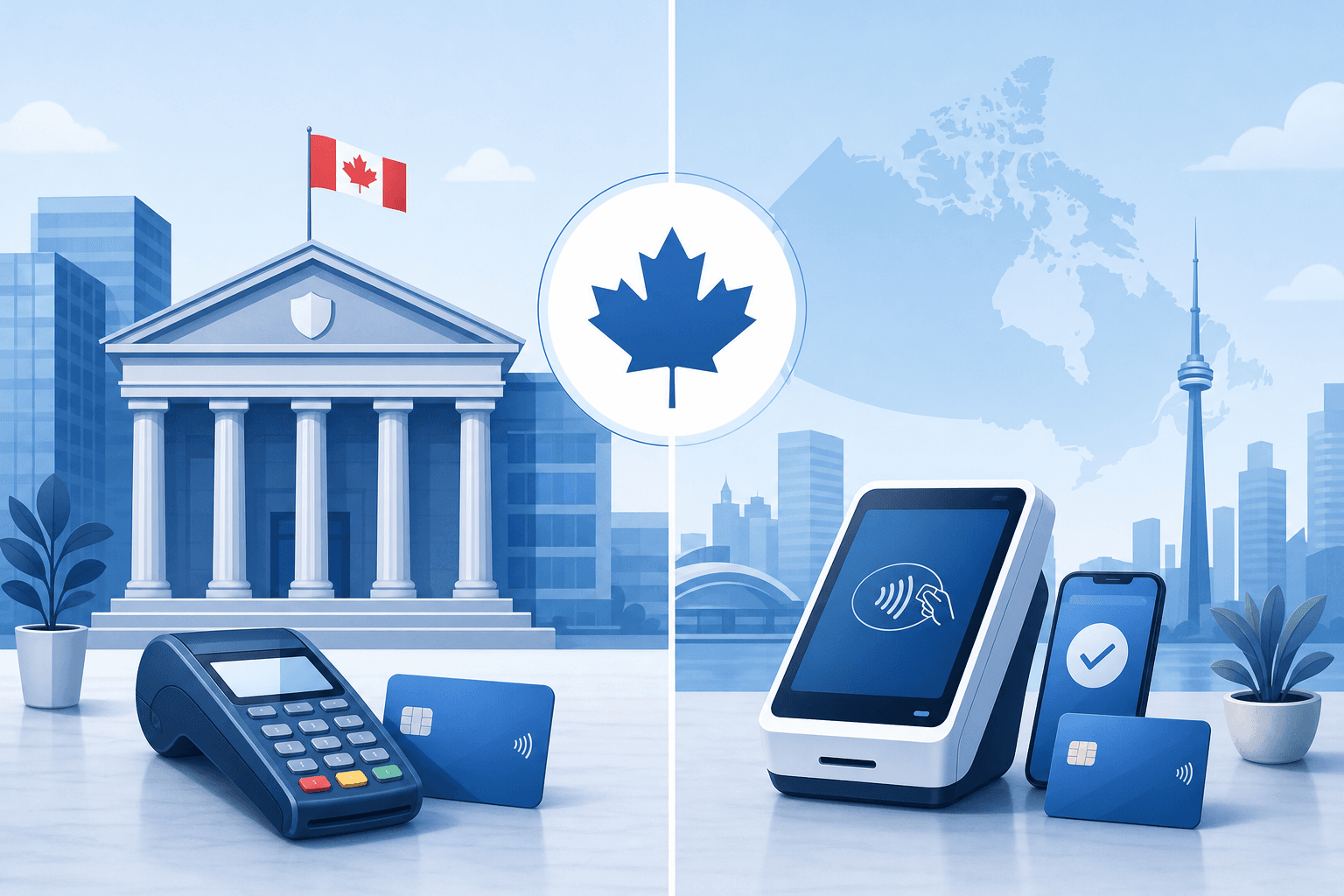
When it's time to choose how your Canadian business accepts credit and debit cards, you'll quickly discover two very different camps competing for your business: the big banks and the independent processors. Both promise lower fees, faster deposits, and better service, but their business models, pricing structures, and customer experiences can be worlds apart.
For small and medium business owners across Canada, this decision isn't just about picking a logo you recognize. It affects your monthly costs, your cash flow, the quality of support you receive when something goes wrong, and how easily your payment system integrates with your POS or e-commerce platform. Get it right, and payment processing becomes a seamless part of running your business. Get it wrong, and you could be stuck in a multi-year contract with hidden fees eating into your margins.
In this guide, we'll break down the real differences between bank-owned vs independent payment processors in Canada, including the pros and cons of each, so you can make an informed decision for your business.
Understanding the Two Models
Before comparing pros and cons, it helps to understand what actually separates these two types of providers.
Bank-Owned Processors
Bank-owned processors are merchant services divisions operated directly by Canada's major financial institutions, think RBC, Scotiabank, BMO, and TD. If you already have a business bank account with one of these institutions, they'll often bundle payment processing into your banking relationship. Our TD comparison breaks down how one of the largest bank-bundled offerings stacks up against competitors.
Independent Payment Processors
Independent processors (sometimes called ISOs, or independent sales organizations) are standalone companies that specialize exclusively in payment processing and merchant services. They aren't tied to a specific bank and often partner with multiple financial networks behind the scenes. Companies like Stripe, Square, and dedicated Canadian merchant services providers fall into this category. If you want to see how a popular independent fits into the Canadian landscape, check out our Stripe comparison.
Both models ultimately move money from your customer's card to your business bank account, but how they price, support, and structure that service varies significantly.
Pros and Cons of Bank-Owned Processors
Advantages
Familiarity and trust. Many Canadian business owners feel more comfortable sticking with a bank they already know, especially if they've banked with the same institution for years.
Single relationship management. Having your business banking and payment processing under one roof can simplify reconciliation and reporting, at least on the surface.
Perceived stability. Canada's big banks are heavily regulated and have deep pockets, which can feel reassuring for business owners wary of smaller providers.
Disadvantages
Higher, less transparent pricing. Bank-owned processors are notorious in the industry for bundled, tiered pricing structures that make it difficult to understand what you're actually paying per transaction. Many Canadian merchants discover only after months of statements that they're paying significantly more than an independent provider would charge for the same volume.
Slower innovation. Banks move cautiously. New POS technology, contactless payment features, and integrations tend to roll out to independent processors first.
Rigid contracts. Bank processing agreements often come with long-term commitments, early termination fees, and leased equipment contracts that can lock you in for years.
Generic customer support. Because merchant services is just one division of a much larger institution, support can be slow, with long call wait times and representatives who aren't specialized in payment processing issues.
If you've ever felt like your banking relationship was costing you more than it was saving you, it's worth taking a closer look at your statements. Use our savings calculator to see exactly how much you could save by switching.
Pros and Cons of Independent Payment Processors
Advantages
Competitive, transparent pricing. Independent processors typically compete hard on rate transparency, offering interchange-plus pricing that clearly shows what you're paying in network fees versus provider markup. This structure is almost always more cost-effective for growing businesses.
Flexible contracts. Many independent providers offer month-to-month agreements with no long-term lock-in, giving you the freedom to switch if your needs change.
Specialized support. Because payment processing is their core business (not a side offering), independent processors often provide dedicated account management and faster issue resolution.
Faster access to new technology. Independent processors are usually first to market with new POS hardware, e-commerce integrations, and value-added features like inventory management or loyalty programs.
Tailored industry solutions. Independents are more likely to offer solutions built for your specific business type, whether that's restaurant solutions, retail solutions, healthcare solutions, or salon & spa solutions.
Disadvantages
Varying quality. Because there are so many independent processors in the market, quality and reliability can vary significantly. Due diligence matters.
Less brand recognition. Business owners may be less familiar with independent providers, which can feel like a leap compared to sticking with a known bank.
Equipment compatibility. Some independents use proprietary hardware or software, so it's worth confirming compatibility with your existing systems before switching, particularly if you use POS platforms like Clover or Lightspeed. Our Clover comparison and Lightspeed comparison can help you evaluate your options.
Key Factors to Compare
When weighing bank-owned vs independent payment processors in Canada, focus on these core decision points:
- Pricing structure - Ask for a full breakdown of interchange fees, markup, and monthly costs. Avoid providers who won't clearly explain tiered pricing.
- Contract terms - Look for month-to-month flexibility and clarify any early termination penalties before signing.
- Settlement speed - Find out how quickly funds land in your account; next-day CAD deposits are standard with many independents.
- Hardware and software compatibility - Make sure your POS, e-commerce platform, or accounting software integrates smoothly.
- Customer support quality - Ask about average response times and whether you'll have a dedicated account manager.
- PCI compliance and security - Both bank-owned and independent processors must meet Canadian and international security standards, but ask how compliance fees are handled.
It's also worth putting providers side by side. Compare processors to see how leading Canadian options stack up on fees, features, and contract terms.
Which Option Is Right for Your Business?
There's no universal answer, the right choice depends on your business model, transaction volume, and growth plans.
Choose a Bank-Owned Processor If:
- You run a very low-volume business and value simplicity over savings
- You strongly prefer having all financial services under one institution
- You're not comfortable managing a separate vendor relationship
Choose an Independent Processor If:
- You process a meaningful volume of transactions monthly and want to minimize fees
- You need flexible contract terms without long-term lock-in
- You want access to modern POS technology and e-commerce integrations, like e-commerce solutions or Odoo Clover integration for businesses running an ERP
- You operate in a specialized industry, such as construction solutions, automotive solutions, hospitality solutions, or nonprofit solutions
- You want dedicated, Canadian-based support
For most growing Canadian small and medium businesses, independent processors tend to offer the better combination of cost savings, flexibility, and service quality. But the only way to know for sure is to compare actual numbers based on your specific transaction volume and average ticket size.
Regional Considerations Across Canada
Payment processing needs can vary slightly depending on where your business operates. Businesses in major hubs like Toronto payment processing, Vancouver payment processing, Calgary payment processing, Montreal payment processing, and Ottawa payment processing each face unique customer payment preferences, competitive landscapes, and local support availability. Quebec businesses in particular often weigh options like our Desjardins comparison given the province's strong regional banking presence. Larger enterprise operations may also want to review our Chase comparison for high-volume processing needs.
Whatever your location, working with a processor that understands the Canadian regulatory environment, including PCI DSS compliance and CAD settlement timelines, is essential.
Making the Switch Without the Headache
If you've decided an independent processor is the better fit, switching is usually simpler than business owners expect. Most reputable providers will:
- Review your current statements and identify savings opportunities
- Handle equipment setup and staff training
- Coordinate the transition to avoid any processing downtime
- Provide ongoing support after you've switched
The hardest part is usually just getting started. A good first step is requesting a detailed cost comparison based on your actual processing statements rather than relying on advertised rates alone.
Conclusion
Choosing between bank-owned vs independent payment processors in Canada ultimately comes down to what matters most for your business: convenience and familiarity, or transparency, flexibility, and cost savings. While big bank processing can feel like the safe, simple choice, independent processors have earned their growing market share by offering better rates, faster innovation, and more personalized support, advantages that add up significantly over time for busy Canadian business owners.
Before renewing your current contract or signing up with your bank by default, take the time to compare your options. Get a free quote to see exactly what you could be paying with a transparent, Canadian-focused processor, or contact our team to talk through your specific business needs.