Introduction
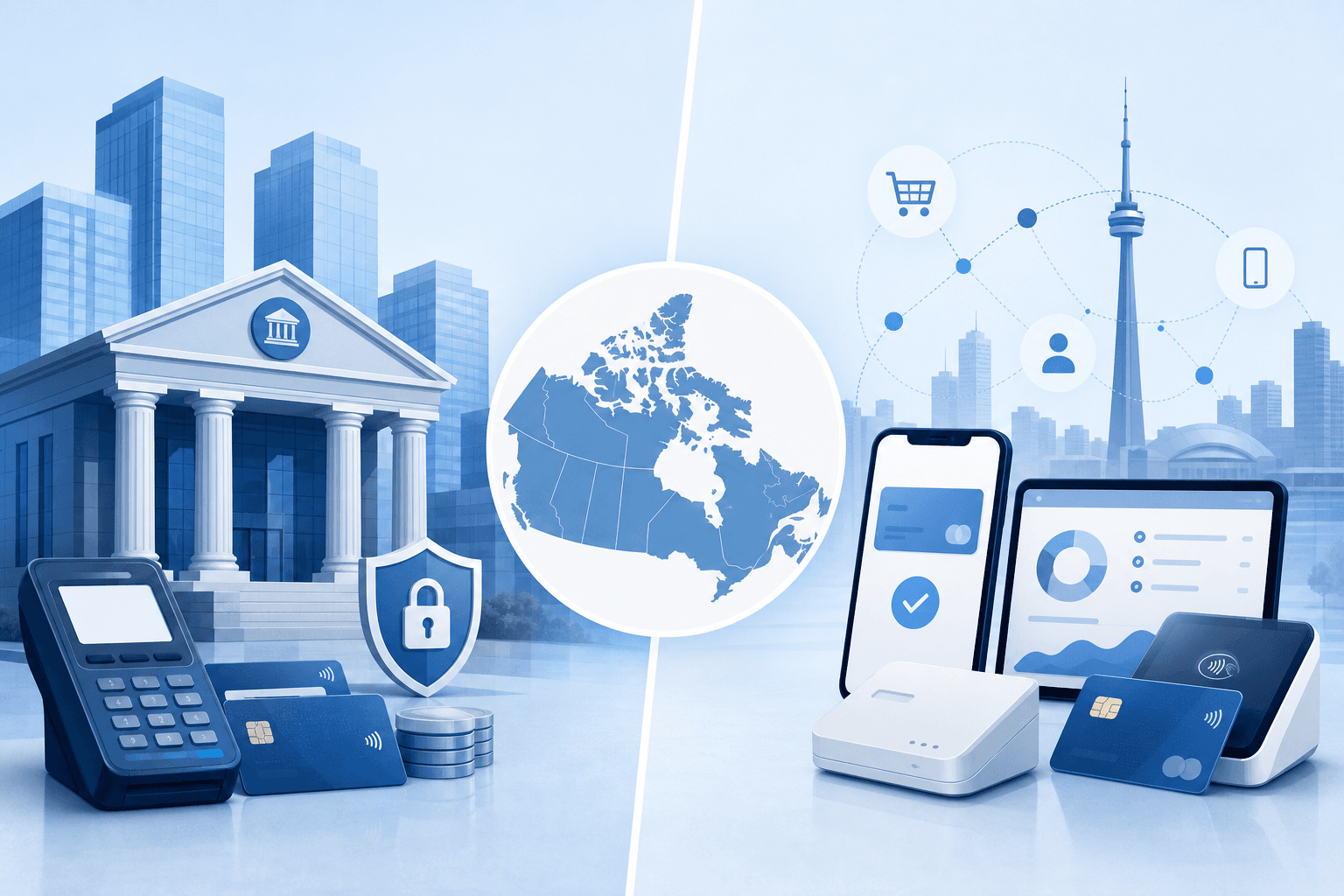
If you've ever sat across from your business banker and been offered a "convenient" merchant services add-on to your existing bank account, you've already brushed up against one side of a debate that affects nearly every Canadian business owner: should you process payments through your bank, or through an independent payment company?
It's a bigger decision than most entrepreneurs realize. Payment processing fees quietly eat into your margins every single day, and the difference between a bank-owned processor and an independent provider can mean thousands of dollars in CAD per year, not to mention vastly different experiences when something goes wrong with your terminal on a busy Friday night. Yet many business owners simply default to whatever their bank offers because it feels easier to keep everything "under one roof."
The reality is more nuanced. Bank-owned processors and independent payment companies in Canada each have real strengths and real limitations, and the right choice depends on your industry, transaction volume, growth plans, and how much personalized support you need. This guide breaks down exactly how they differ so you can make a confident, informed decision for your business.
How Bank-Owned Processors Work
Canada's major banks - RBC, TD, Scotiabank, BMO, CIBC, and Desjardins - all offer merchant processing services, usually bundled with your business bank account. On the surface, this is appealing: one statement, one relationship, one phone number to call.
The Appeal of Bundling
Bank-owned processors lean heavily on convenience. If you already bank with a major institution, adding merchant services can feel like a natural next step. You may also get a slightly smoother credit approval process since the bank already has your financial history on file.
Where Bank-Owned Processors Fall Short
In practice, bank-owned processing often comes with trade-offs that aren't obvious until you're a few months into your contract:
- Less competitive pricing: Banks often rely on tiered pricing models that bundle qualified, mid-qualified, and non-qualified rates, making it hard to know what you're actually paying per transaction.
- Generic support: Merchant services are frequently outsourced to a third-party processor behind the scenes, even though the branding says "TD" or another bank name. Support staff may not be specialized in payments.
- Rigid contracts: Bank processing agreements often include multi-year terms with early termination fees.
- Slower innovation: Banks tend to move slowly on adopting new POS technology, integrations, and e-commerce tools compared to independent providers.
If you currently process through a major bank, it's worth checking our TD comparison or Desjardins comparison to see how your existing rates and terms stack up against alternatives - especially if you're a Quebec-based business comparing Desjardins options.
How Independent Payment Companies Work
Independent payment processors - companies like PaymentsPlus - specialize exclusively in payment processing and related technology. Because this is their core business, they tend to compete much harder on price, service, and features.
Specialized Focus Means Better Service
Independent processors live and die by merchant satisfaction. Unlike a bank where merchant services is one small division among dozens, independents build their entire business around:
- Transparent, often interchange-plus pricing structures
- Dedicated account managers who understand payments inside and out
- Faster, more flexible contract terms
- Modern hardware and software integrations, including POS systems like Clover and Lightspeed
Technology and Flexibility
Independent processors are usually quicker to integrate with modern business tools. Whether you need a countertop terminal, a mobile card reader, or a fully integrated POS system connected to your accounting software, independents typically offer more choice. Many also support ERP integrations - for example, if you run Odoo, our Odoo Clover integration connects your POS directly to your back-office systems, something most bank-owned processors simply don't offer.
Potential Downsides
Independent companies aren't automatically the right fit for every business. It's worth doing your homework:
- Quality varies significantly between providers, so reputation and Canadian-based support matter
- Some independents still use confusing tiered pricing, so always ask for a full rate breakdown
- Not all independents offer the same breadth of banking relationships for fund settlement speed
This is exactly why comparing options matters. Use our compare processors page to see how different providers - bank-owned and independent - stack up on fees, contracts, and features side by side.
Comparing Costs: Bank-Owned vs Independent
Cost is usually the single biggest factor business owners care about, and it's where the bank-owned processors vs independent payment companies in Canada debate gets the most interesting.
Pricing Models Explained
- Flat-rate pricing: A single percentage fee per transaction, regardless of card type. Simple but not always cheapest for high-volume merchants. See our Stripe comparison for a deeper look at flat-rate pricing.
- Tiered pricing: Common with banks, this groups transactions into "qualified," "mid-qualified," and "non-qualified" buckets - often with unclear criteria for which rate you get.
- Interchange-plus pricing: Common with independents, this shows the actual interchange rate plus a transparent markup, making it easier to audit your true costs.
Hidden Fees to Watch For
Both bank-owned and independent processors can include additional costs such as:
- PCI compliance fees
- Statement or batch fees
- Early termination fees
- Equipment lease charges (which can far exceed the cost of simply buying a terminal)
Because these fees vary so widely, the only reliable way to know if you're overpaying is to run the numbers. Use our savings calculator to compare your current statement against a transparent interchange-plus model - most Canadian businesses are surprised by how much they could be saving in CAD each month.
Which Option Is Right for Your Business?
The right processor depends heavily on your industry and how you take payments.
Retail and E-Commerce
High-volume retailers and online stores benefit from competitive per-transaction rates and strong fraud protection tools. Independent processors typically offer more flexible e-commerce solutions and retail solutions, including integrations with popular shopping cart platforms that most banks don't support well.
Restaurants and Hospitality
Fast-paced environments need reliable terminals, quick support response times, and tableside or tip-adjustable payment options. Our restaurant solutions and hospitality solutions are built specifically for these needs - something a generic bank merchant account usually can't match.
Healthcare, Salons, and Service Businesses
Appointment-based businesses often need recurring billing, invoicing, and contactless payment options. Check out our healthcare solutions and salon & spa solutions for tools tailored to these workflows.
Construction, Automotive, and Nonprofits
Businesses with mobile or field-based operations, like construction solutions and automotive solutions, often need mobile card readers and invoicing tools that banks rarely prioritize. Charities and community organizations should also look at nonprofit solutions, which often include discounted processing rates.
Regional Considerations
Payment processing needs can also vary by region. Businesses in major Canadian markets like Toronto payment processing, Vancouver payment processing, Calgary payment processing, Montreal payment processing, and Ottawa payment processing each have local support networks and regional pricing nuances worth exploring.
Making the Switch: What to Expect
Many business owners assume switching from a bank-owned processor to an independent company is a hassle. In reality, most transitions are straightforward:
- Review your current statement to identify your effective rate and any contract end dates or termination fees.
- Compare quotes from independent providers against your existing bank rates.
- Confirm hardware compatibility - many modern terminals, including Clover devices, can be reprogrammed rather than replaced. Our Clover comparison page breaks down what's compatible, and our Lightspeed comparison covers POS-specific switching considerations.
- Schedule a low-disruption cutover date, often timed around a slower business week.
- Train staff on any new hardware or software, which usually takes less than a day.
If you're a larger operation processing significant volume, it's also worth exploring enterprise-level options - our Chase comparison covers what to expect from large-scale processors like Chase Paymentech.
Conclusion
The debate over bank-owned processors vs independent payment companies in Canada ultimately comes down to priorities: convenience and bundling versus transparency, specialization, and competitive pricing. For many Canadian small and medium businesses, independent processors offer the flexibility, modern technology, and dedicated support that banks simply aren't built to provide.
The best way to know for sure is to compare your actual numbers. Get a free quote to see what you could save, or contact our team to talk through your specific business needs - whether that's a restaurant in Toronto, a retail shop in Calgary, or an e-commerce business shipping across Canada.