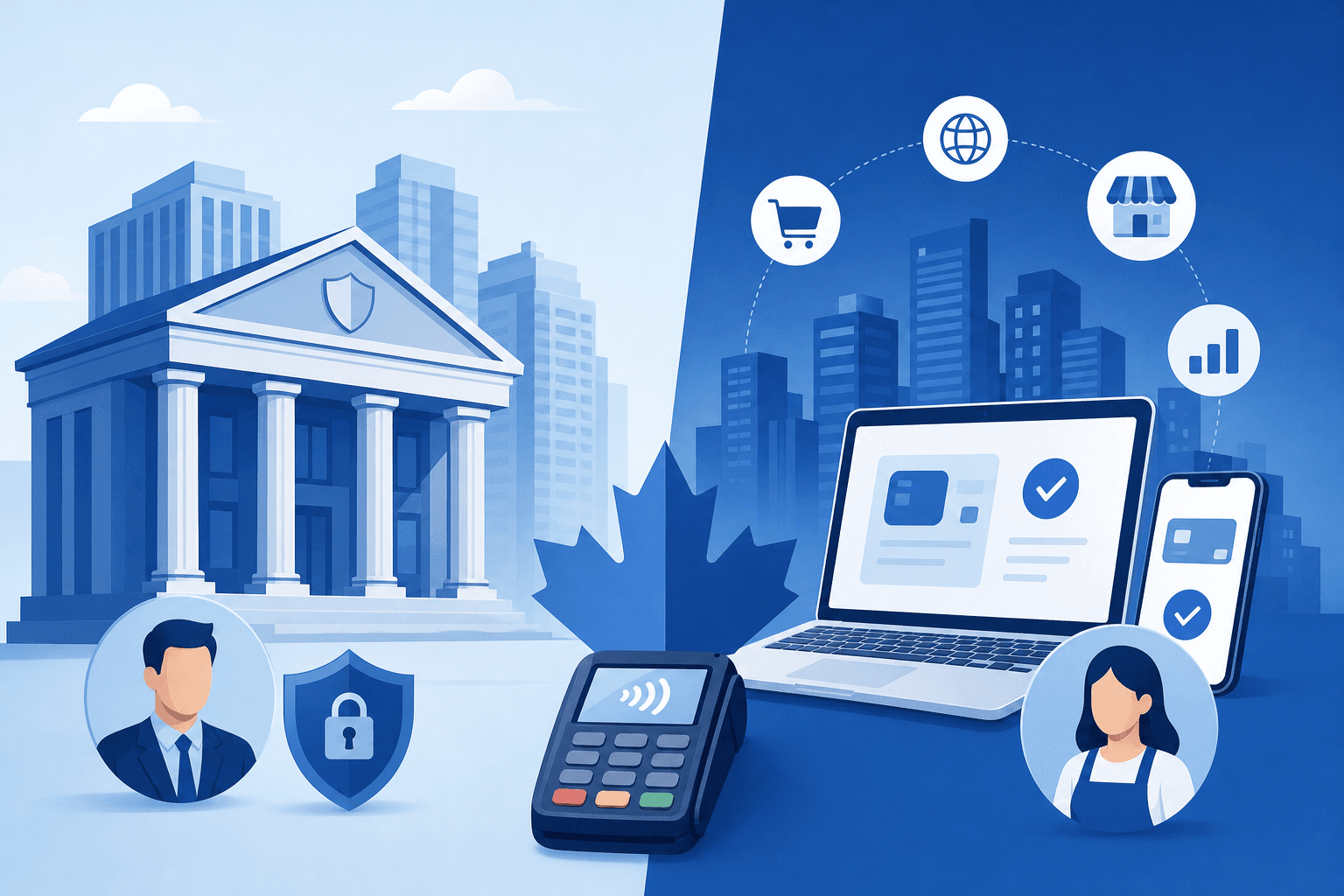
If you've started shopping for a merchant account in the last little while, you've probably noticed that your options seem to fall into two very different camps. On one side, you have the big Canadian banks - RBC, TD, Scotiabank, BMO, CIBC, Desjardins - each offering their own payment processing bundled with your business banking. On the other side, you have independent processors who focus exclusively on payments, often promising better rates and more flexible service.
So which one actually makes sense for your business? The honest answer is: it depends on your industry, your transaction volume, and how much you value personalized service versus the convenience of "one-stop banking." This guide breaks down the real differences in the debate of bank-owned vs independent payment processors in Canada: which is better? - so you can make a decision based on facts, not sales pitches.
For many Canadian business owners, this decision gets made by default. You open a business account at your bank, the account manager mentions they can also set you up with a card terminal, and you say yes because it's easy. But "easy" isn't always "optimal," and payment processing fees compound every single month for as long as you're in business. A few percentage points of difference can mean thousands of dollars a year - money that could go back into your business.
How Bank-Owned Payment Processors Work
Canada's major banks either run their own payment processing divisions (like Moneris, which is jointly owned by RBC and BMO) or partner closely with a processor to offer bundled services to their banking clients. When you open a business account, it's a natural upsell: one application, one relationship manager, one monthly statement that (theoretically) ties everything together.
The Appeal of Bank-Owned Processing
- Convenience: Your banking and payment processing live under one roof, which can simplify reconciliation and reporting.
- Trust: Many business owners feel more comfortable with a brand name they already know.
- Bundled perks: Some banks offer discounted rates on processing if you maintain a certain balance or loan relationship with them.
The Drawbacks
- Less competitive pricing: Bank-owned processors often rely on tiered pricing models that bundle different card types together, making it hard to know what you're actually paying for each transaction.
- Generic service: Because payments are a side offering rather than the core business, support can be slower and less specialized.
- Rigid contracts: Bank processing agreements can come with long terms and equipment leases that are costly to exit.
- One-size-fits-all terminals: Hardware and software options are often limited compared to independent providers who integrate with a wider range of POS systems.
If you bank with TD and have been offered their payment processing, it's worth comparing the numbers directly - see our TD comparison for a breakdown of how bank-bundled processing stacks up against independent alternatives. Quebec-based businesses working with Desjardins should take a similar look at our Desjardins comparison.
How Independent Payment Processors Work
Independent processors - like PaymentsPlus - aren't tied to a specific bank. Instead, they work with multiple banking partners and card networks to find the best possible rates and technology fit for your specific business. Because payments are their entire business, not a side product, the level of specialization tends to be much higher.
The Appeal of Independent Processors
- Competitive, transparent pricing: Independent processors often offer interchange-plus pricing, which shows you exactly what you're paying in interchange fees versus markup - far more transparent than bundled bank rates.
- Industry-specific solutions: Independent processors frequently build out tailored solutions for restaurants, retail, healthcare, and other verticals.
- Flexible contracts: Many independents offer month-to-month agreements with no long-term lock-in.
- Dedicated support: Since payments are their core focus, independent processors typically offer faster, more knowledgeable customer service.
- Better technology options: Independents often support a wider range of POS hardware, including popular systems like Clover and Lightspeed.
The Trade-Offs
- Less brand recognition: Independent processors aren't household names the way banks are, which can feel less familiar at first.
- Due diligence required: Because there are more independent providers in the market, it takes a bit more research to find a reputable one with strong Canadian support and transparent pricing.
This is exactly why comparison shopping matters. You can compare processors side by side to see how independent options measure up against bank-owned providers on pricing, contract terms, and technology.
Pricing Models: Where the Real Differences Show Up
The biggest practical difference between bank-owned and independent processors usually comes down to pricing structure.
- Tiered pricing (common with banks): Transactions are grouped into "qualified," "mid-qualified," and "non-qualified" categories, each with different rates. This model is notoriously difficult to audit and often results in higher effective costs.
- Flat-rate pricing (common with newer fintech processors like Stripe): You pay one flat percentage per transaction, regardless of card type. Simple, but often more expensive for higher-volume businesses. Our Stripe comparison covers this in more detail.
- Interchange-plus pricing (common with independent processors): You pay the actual interchange fee set by Visa/Mastercard, plus a small, transparent markup. This is typically the most cost-effective model for established Canadian businesses processing meaningful volume.
If you're not sure which pricing model your current provider uses, pull your last three statements and look for the words "tiered," "qualified," or "interchange." Better yet, use our savings calculator to see what you could be saving in CAD each month by switching to a more transparent pricing structure.
Service, Support, and Contract Flexibility
Pricing isn't the only factor that matters - especially when something goes wrong on a Saturday night during dinner service or during a Black Friday sales rush.
Customer Support
Bank call centres handle a massive range of banking issues, and payment processing is just one small piece of what they manage. This often means longer wait times and support reps who aren't deeply specialized in merchant services. Independent processors, by contrast, usually offer dedicated account managers and support teams whose entire job is to solve payment issues quickly.
Contract Terms
Many Canadian business owners don't realize they've signed a multi-year contract with auto-renewal clauses and early termination fees until they try to switch providers. Independent processors are often more willing to offer:
- Month-to-month terms
- No long-term equipment leases
- Transparent cancellation policies
Before signing anything, it's worth asking directly: "What happens if I want to cancel in six months?" If the answer is vague, that's a red flag.
Technology and Integrations
Modern businesses need more than just a card terminal. Independent processors typically offer broader compatibility with POS systems and business software. For example, if your business runs on Odoo for inventory and accounting, you'll want a processor that supports a proper Odoo Clover integration rather than forcing you into a closed banking ecosystem. Similarly, if you're comparing POS hardware options, check out our Clover comparison and Lightspeed comparison to see what fits your workflow best.
Which Option Is Better for Your Industry?
The right answer also depends heavily on what kind of business you run.
- Restaurants and cafés often need fast, reliable terminals with tableside payment and tip adjustment - see our restaurant solutions for processor options built for hospitality speed.
- Retail stores benefit from integrated POS and inventory tools - our retail solutions page covers processors that sync sales data in real time.
- Healthcare practices need PCI-compliant, patient-friendly payment options - explore our healthcare solutions for compliant processing.
- E-commerce businesses need strong online gateways and fraud protection - check our e-commerce solutions for Canadian-friendly online processing.
- Construction companies often need mobile and invoice-based payment tools - see our construction solutions.
- Auto shops benefit from flexible in-person and over-the-phone processing - our automotive solutions page has details.
- Hotels and hospitality businesses need deposit holds and multi-terminal setups - see our hospitality solutions.
- Salons and spas benefit from appointment-integrated payments - check our salon & spa solutions.
- Nonprofits often need low-cost donation processing - see our nonprofit solutions.
In almost every one of these cases, an independent processor with industry-specific tools outperforms a generic bank bundle.
Making the Switch: What to Expect
If you've decided an independent processor is the better fit, switching is usually simpler than business owners expect. A reputable provider will:
- Review your last few statements to show exact savings
- Handle the paperwork and terminal setup
- Coordinate a switch-over date with minimal disruption
- Provide training for you and your staff
Many Canadian business owners in major cities are making this switch right now. If you're based in Ontario, check out our dedicated pages for Toronto payment processing and Ottawa payment processing. Businesses out west can see Calgary payment processing and Vancouver payment processing, while Quebec businesses can check Montreal payment processing for local support and bilingual service.
Final Verdict: Which Is Better?
There's no universal winner in the bank-owned vs independent payment processors in Canada debate - but for most small and medium businesses, independent processors offer a better combination of pricing transparency, dedicated support, and technology flexibility. Bank-owned processing can still make sense if you prioritize simplicity above all else and don't process high volumes, but for businesses looking to control costs and scale efficiently, independents usually come out ahead.
The best way to know for sure is to compare your actual numbers. Get a free quote to see what an independent processor could save your business, or contact our team to talk through your specific industry needs with a real person - not a call centre script.