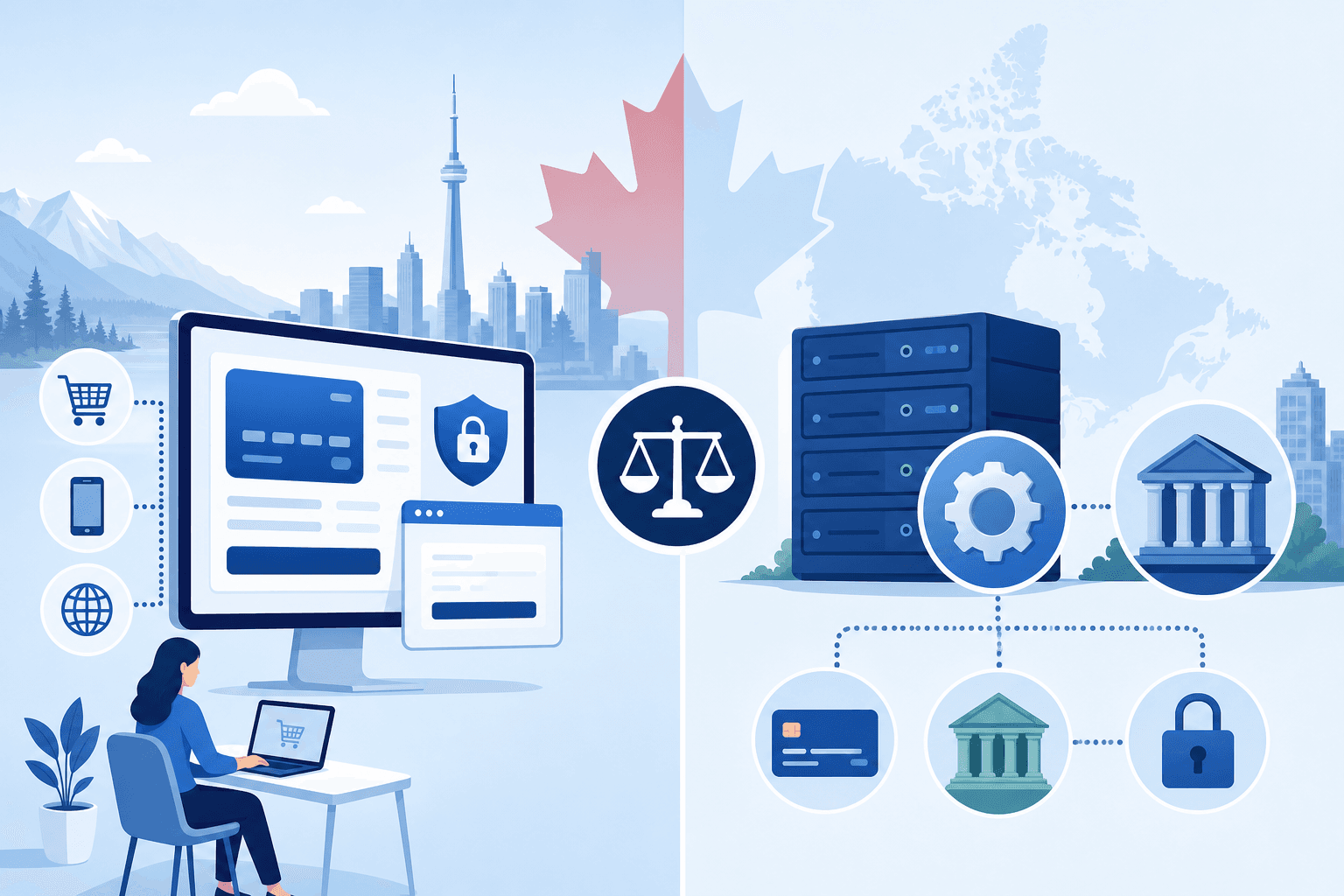
If you've started researching how to accept payments for your Canadian business, you've probably run into two terms that seem to be used interchangeably: payment gateway and payment processor. Sales reps throw them around casually, software documentation treats them as synonyms, and most business owners nod along without really knowing the difference - until something goes wrong, a fee seems unexplained, or an integration doesn't work the way they expected.
Here's the truth: a payment gateway and a payment processor are two distinct pieces of technology that work together to move money from your customer's card to your bank account. Understanding how they differ matters because it affects your costs, your software choices, your security obligations, and how easily you can switch providers down the road.
In this guide, we'll break down exactly what each one does, how they work together, and what Canadian business owners need to know before choosing a payment solution - whether you're running a retail shop in Toronto, a restaurant in Montreal, or an online store shipping across the country.
What Is a Payment Gateway?
A payment gateway is the technology that securely captures and transmits your customer's payment information. Think of it as the digital doorway between your customer and the financial institutions that need to approve the transaction.
When a customer enters their credit card details on your website, taps their card on your terminal, or inserts a chip card at checkout, the gateway is responsible for:
- Encrypting the cardholder's data so it can't be intercepted
- Sending that data to the payment processor for authorization
- Relaying the approval or decline back to the point of sale
- Ensuring the transaction is compliant with PCI DSS security standards
Popular gateway technology includes names you may have heard, like Stripe, Authorize.net, or Moneris' online gateway. For in-person transactions, your card terminal or POS system (like Clover or Lightspeed) often has gateway functionality built right in.
Where Gateways Matter Most
Gateways are especially important for:
- E-commerce businesses accepting online payments, where secure data transmission is critical
- Subscription or recurring billing models that need to store and reuse payment credentials safely
- Multi-channel businesses that need consistent checkout experiences online and in-store
If you run an online store, your gateway choice directly affects your checkout experience, cart abandonment rates, and the types of payment methods (Interac, Visa, Mastercard, Amex, digital wallets) you can offer. Our e-commerce solutions are built specifically to help Canadian online retailers choose gateway technology that fits their platform.
What Is a Payment Processor?
While the gateway handles the secure transmission of data, the payment processor is the company that actually facilitates the movement of funds between banks. The processor communicates with the card networks (Visa, Mastercard, Amex) and the issuing bank to verify that funds are available, approve or decline the transaction, and eventually settle the money into your Canadian business bank account.
Processors also handle:
- Charging your business the appropriate interchange and processing fees
- Managing chargebacks and disputes
- Providing reporting and reconciliation tools
- Ensuring compliance with card network rules
In short, the processor is the financial engine working behind the scenes, while the gateway is the front-end technology that talks to your customer.
Why the Distinction Matters for Pricing
This is where many Canadian business owners get confused - and where they often overpay. Some providers bundle the gateway and processor together into one flat-rate package (common with providers like Stripe or Square), which is simple but can be expensive at higher volumes. Others offer interchange-plus pricing, where you pay the true interchange rate plus a small, transparent markup, often resulting in meaningful savings for established businesses.
If you've ever wondered why your bank's bundled merchant account seems pricier than expected, it may be because you're paying retail-style markups for both services combined without transparency into what you're actually being charged for each piece. Use our savings calculator to see what you could save with transparent interchange-plus pricing instead.
Payment Gateway vs Payment Processor: How They Work Together
It helps to think of a transaction as a relay race with several handoffs:
- Customer initiates payment - by tapping a card, entering details online, or using a digital wallet
- Gateway captures and encrypts the data - securely packaging the transaction details
- Gateway sends the data to the processor - which routes the request to the card network
- Card network contacts the issuing bank - to confirm the customer has sufficient funds or credit
- Approval or decline travels back - through the processor, to the gateway, and finally to the customer
- Processor settles funds - depositing money into your business bank account, typically within one to two business days in Canada
This entire sequence usually takes two to three seconds, but every step involves a different player, and potentially a different fee. Understanding this chain is the real answer to "payment gateway vs payment processor" - they're sequential partners in the same transaction, not competing options.
Many providers today bundle both functions into a single service, which is convenient but can obscure where your money is actually going. This is exactly why it pays to compare processors rather than assume your current provider offers the best combination of technology and pricing.
Common Setups for Canadian Businesses
Your ideal combination of gateway and processor depends heavily on how and where you sell.
In-Person / Retail Businesses
If you operate a brick-and-mortar store, a POS system with an integrated gateway and processor, like Clover, is often the simplest path. These systems combine hardware, software, and payment processing into one package. Check out our Clover comparison or retail solutions to see what fits your store.
Restaurants and Hospitality
Restaurants need fast, reliable processing that can handle tips, split bills, and table-side payments. A combined POS and gateway solution designed for hospitality - like what we offer through our restaurant solutions and hospitality solutions - typically outperforms generic setups.
E-commerce and Online Stores
Online businesses need a gateway that integrates cleanly with their shopping cart platform (Shopify, WooCommerce, Odoo, etc.) and a processor offering competitive rates for card-not-present transactions, which typically carry higher interchange costs. Our e-commerce solutions are designed around this exact need, and if you run your operations through an ERP, our Odoo Clover integration connects your accounting and payments seamlessly.
Healthcare, Salons, and Service Businesses
Appointment-based businesses like clinics and salons benefit from gateways that support recurring billing, deposits, and no-show protection. See our healthcare solutions and salon & spa solutions for tailored setups.
Construction and Automotive
Mobile and field-service businesses need gateways that work on mobile devices and processors with strong invoicing and remote payment capabilities. Our construction solutions and automotive solutions are built around businesses that collect payment outside a traditional storefront.
How to Choose the Right Combination for Your Business
When evaluating providers, Canadian business owners should ask these questions:
- Is the gateway PCI DSS compliant? This is non-negotiable for protecting customer data and avoiding liability.
- Does the processor settle in CAD, directly to a Canadian bank account? Avoid unnecessary currency conversion fees.
- What is the actual pricing model? Flat-rate, interchange-plus, or tiered pricing all have very different cost structures. Compare processors side by side, including popular options like our Stripe comparison, TD comparison, and Desjardins comparison for Quebec-based businesses.
- Can the gateway integrate with your existing software? Accounting systems, POS hardware, and e-commerce platforms all need to talk to each other smoothly.
- What happens if you want to switch providers later? Some bundled gateway-processor combinations lock you into proprietary hardware or long-term contracts, making it harder to change course if your needs evolve.
A Note on Bank-Bundled Processing
Many Canadian businesses default to whatever processing solution their bank offers, since it's convenient to have everything under one roof. But bank-bundled packages, like those from major Canadian banks, often use tiered pricing with limited transparency and higher effective rates than independent processors. If you've never compared your current statement against the market, it's worth taking the time. Our TD comparison and Desjardins comparison pages break down exactly how these stack up.
Regional Considerations
Payment processing needs can vary slightly depending on where your business operates. If you're based in a major Canadian city, check out our location-specific resources for Toronto payment processing, Vancouver payment processing, Calgary payment processing, Montreal payment processing, and Ottawa payment processing - each covering local considerations like regional POS support and in-person setup.
The Bottom Line: Gateway and Processor Are a Team
When comparing payment gateway vs payment processor options for your Canadian business, remember that you're not choosing one or the other - you need both, working together smoothly. The real decision is whether you want a bundled, all-in-one provider or a more customized combination of gateway and processor that gives you better pricing transparency and flexibility as you grow.
For many small and medium Canadian businesses, the right answer comes down to transaction volume, sales channel (in-person vs online), and how much control you want over your technology stack. A high-volume e-commerce store might prioritize gateway flexibility and lower per-transaction rates, while a single-location retail shop might prefer the simplicity of an all-in-one POS and processing package.
Get Expert Help Choosing the Right Setup
Navigating payment gateway vs payment processor decisions doesn't have to be overwhelming. At PaymentsPlus, we help Canadian business owners cut through the jargon, compare real pricing, and choose a setup that fits how they actually do business - whether that's a quick-service restaurant, a growing e-commerce brand, or a multi-location retail chain.
Ready to see what you could save with a smarter setup? Get a free quote today, or contact our team to talk through your specific business needs. You can also explore our services to see the full range of solutions we offer Canadian businesses from coast to coast.